IEEE 802.1Qbv TAS: the time-aware shaper, gates on a timetable
The Time-Aware Shaper (TAS) is the TSN tool that gives the strongest timing guarantees, and the hardest one to configure. The mechanism in the bridge is simple: a gate per queue and a timetable. The difficulty lies in computing the timetable.
Abbreviations used in this post (9)
| Abbreviation | Stands for | Meaning |
|---|---|---|
| CNC | Centralized Network Configuration | The 802.1Qcc entity that computes paths, schedules and reservations for the whole network and configures the bridges. |
| GCL | Gate Control List | The repeating timetable of gate states used by the Time-Aware Shaper (and by stream gates in PSFP). |
| IEEE | Institute of Electrical and Electronics Engineers | The professional association whose Standards Association publishes the IEEE 802 LAN/MAN standards. |
| PCP | Priority Code Point | The 3-bit priority field of the 802.1Q tag (priorities 0 to 7). |
| PTP | Precision Time Protocol | IEEE 1588, a protocol that synchronises clocks over a packet network using timestamped message exchanges. |
| SDN | Software-Defined Networking | An architecture that separates the control plane, run by a logically centralised controller, from the data plane of the network elements (RFC 7426). |
| TAS | Time-Aware Shaper | IEEE 802.1Qbv scheduled traffic: a gate per queue, opened and closed by a repeating gate control list. |
| TSN | Time-Sensitive Networking | The set of IEEE 802.1 standards that give Ethernet bounded latency, time synchronisation and high reliability. |
| VLAN | Virtual LAN | A logical LAN within a bridged network, identified by a 12-bit VLAN ID in the 802.1Q tag. |
1. Definition
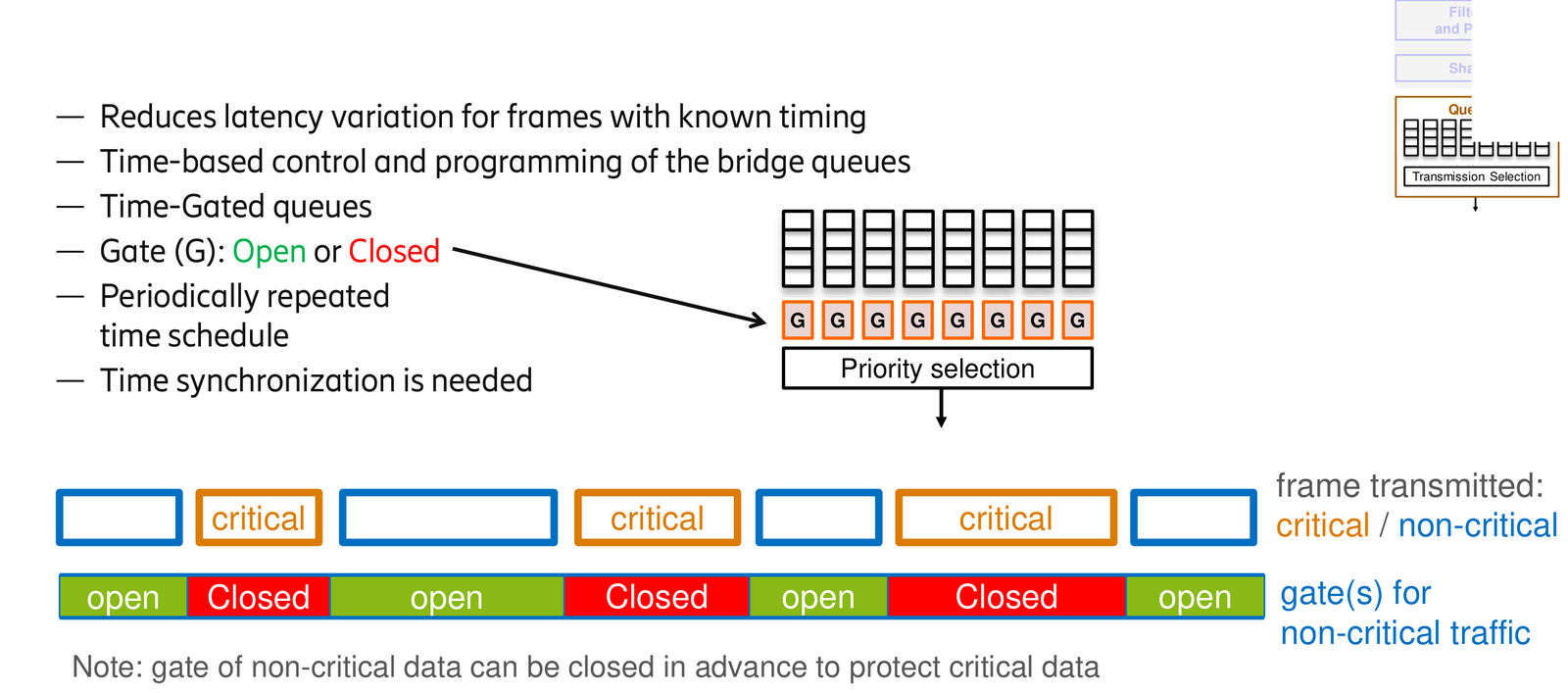
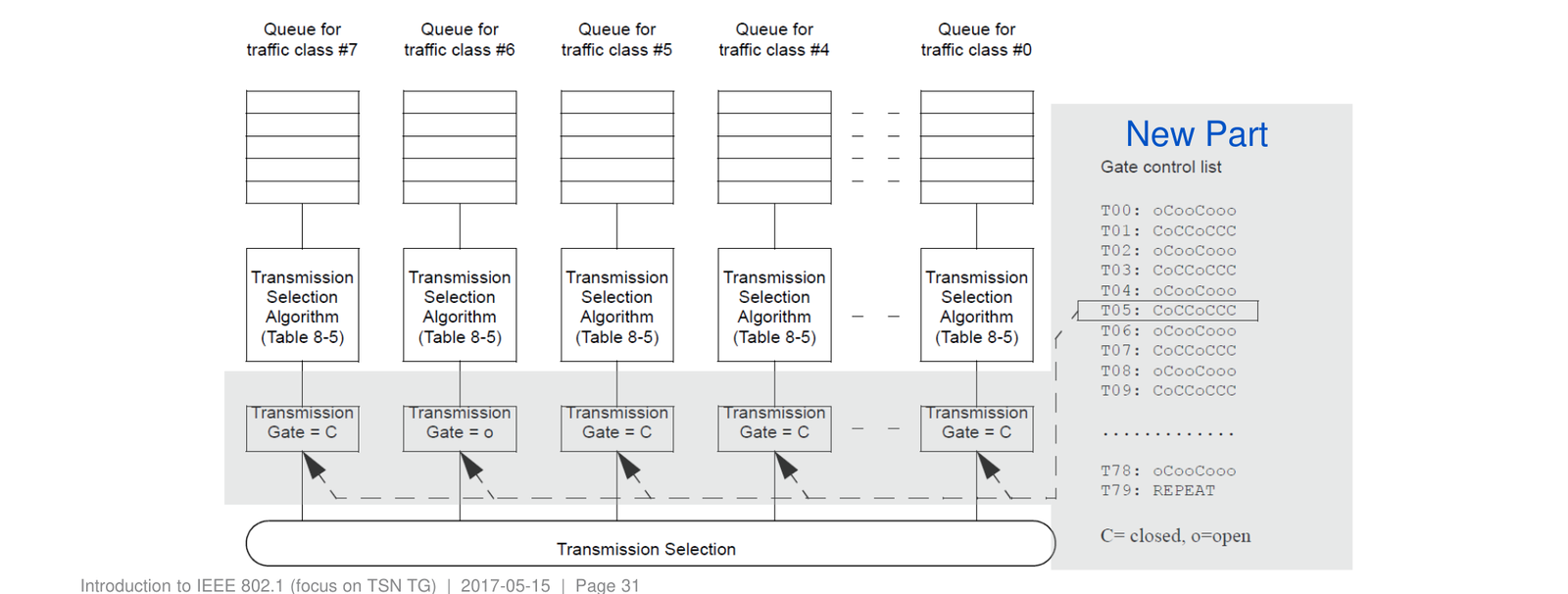
Scheduled traffic, IEEE 802.1Qbv (now part of IEEE 802.1Q), adds a transmission gate to each queue of an egress port [1][3]:
- a queue whose gate is closed is ignored by transmission selection;
- a queue whose gate is open competes as usual, under strict priority or a shaper.
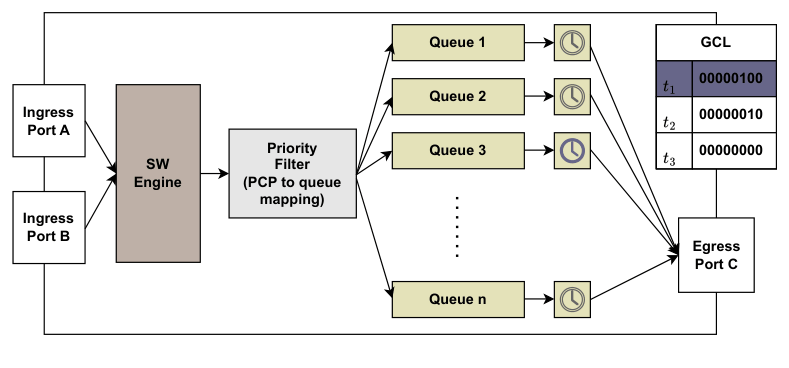
The gate states follow a gate control list (GCL). Each entry holds the open/closed state of every gate and a duration. The list repeats with a fixed cycle time, from a base time expressed in the synchronised time of 802.1AS. The result is a time-division schedule on each link, with windows reserved for given priorities [2].
The GCL is built centrally. In the configuration model of 802.1Qcc, the CNC computes a schedule for the whole network and installs a list on every bridge [4]. The SDN post describes that controller.
2. Slices, infringement and the guard band
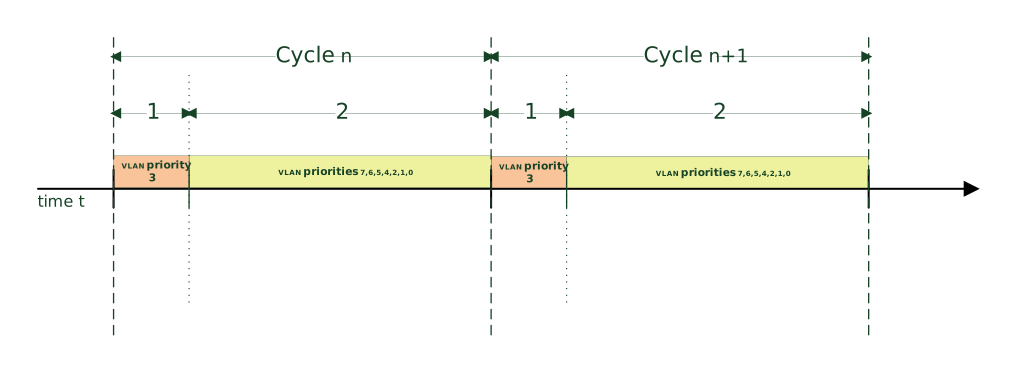

In Figure 2, frames of priority 3 never wait behind other traffic. During slice 1 their queue is the only one with an open gate. But the gate only decides when a frame may start. A frame that has already started is not stopped when its gate closes.
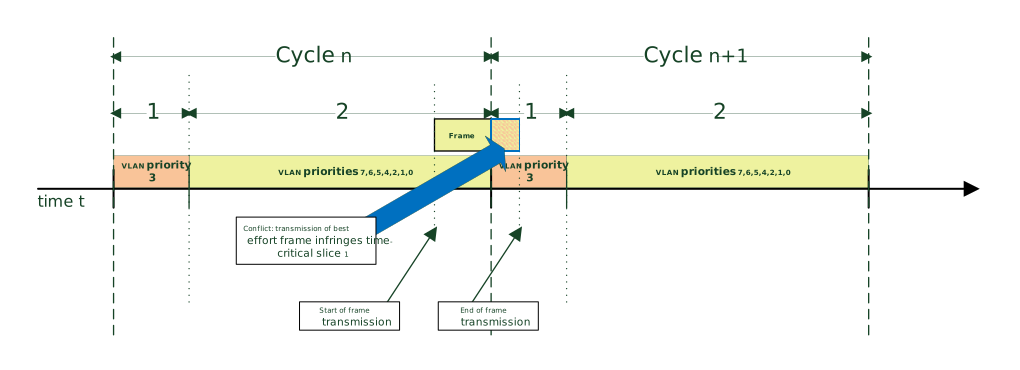

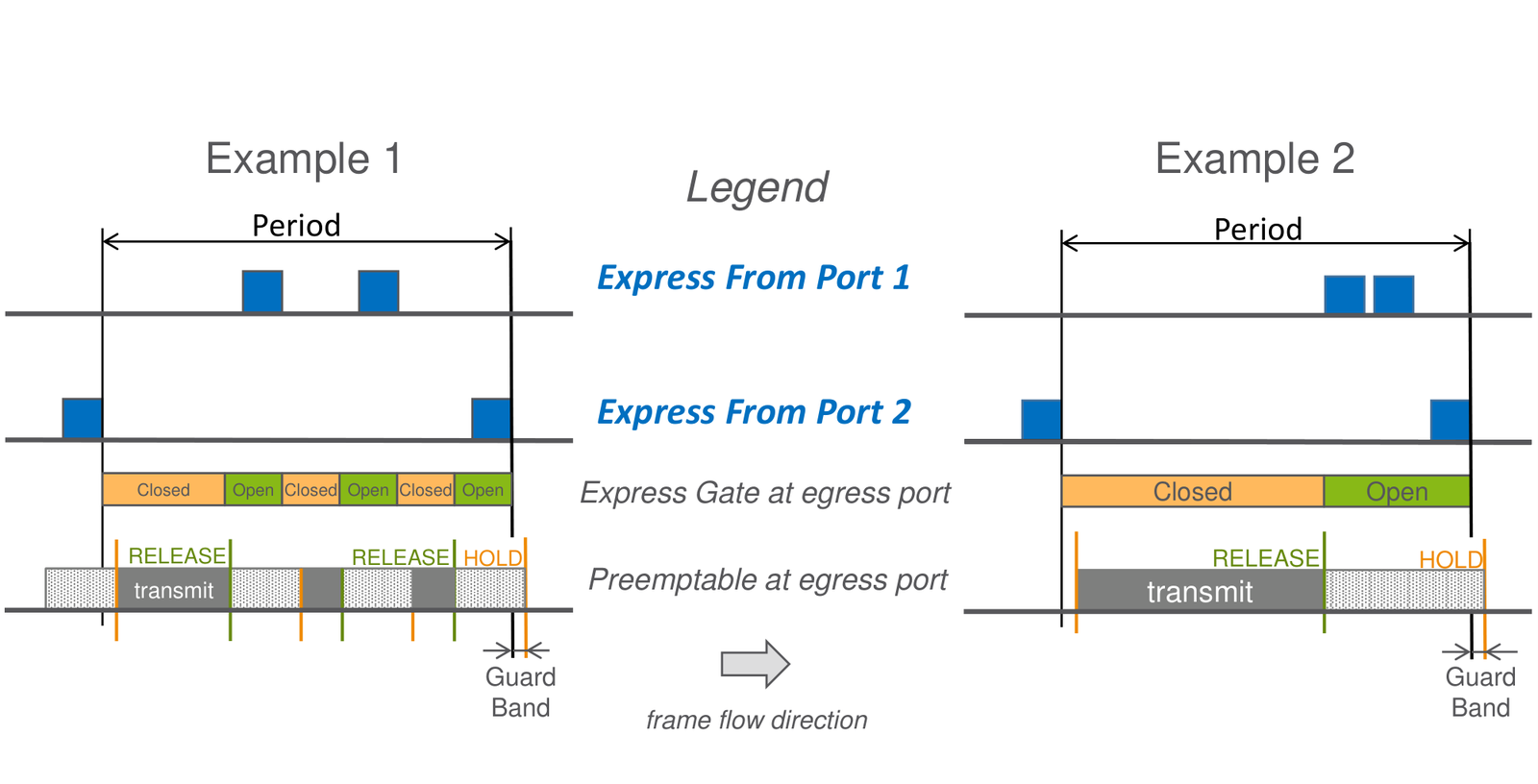
The remedy is a guard band: before each protected slice, no new frame of the other queues may start. To be safe the guard band must be as long as the largest interfering frame. For a full-size Ethernet frame with preamble and inter-frame gap, that is about 12 µs at 1 Gbit/s and about 123 µs at 100 Mbit/s.
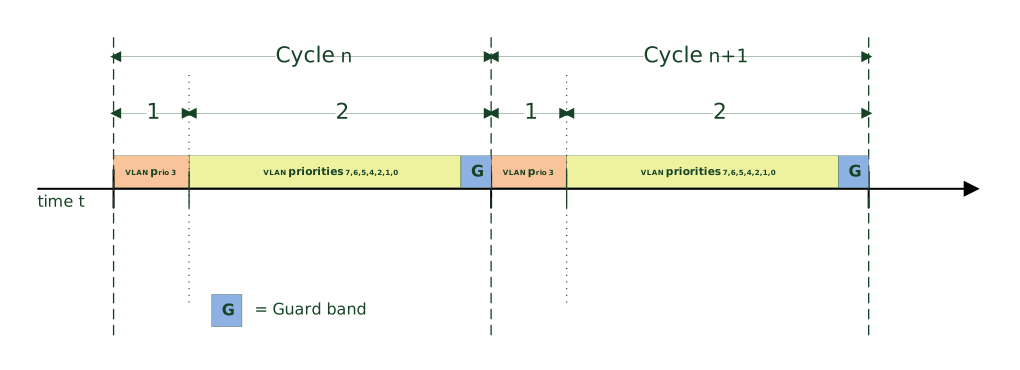

The guard band is bandwidth lost on every cycle. Frame preemption reduces it from a whole frame to a small fragment.
3. What a schedule has to know
A 2023 systematic review and experimental study of TAS scheduling [4] starts from a precise statement of what a scheduler is given. Some of the inputs are practical constraints that are easy to forget:
- GCL length is bounded. Bridges support only a limited number of entries, typically between 8 and 1024.
- Priority-to-queue mapping may differ from bridge to bridge, so the same stream can sit in different queues along its path.
- Traffic models differ. A fully schedulable model lets the scheduler choose the release time of each stream at the talker. A partially schedulable model takes release times as given.
- Delay models differ. In a no-wait schedule, frames are forwarded without queuing at any hop. Wait-allowed schedules let frames wait in egress queues and have a larger solution space. Window-based models reserve windows for groups of streams and allow some jitter.
- Queue isolation. If two streams share a queue, the FIFO order must match the schedule. Otherwise a lost or delayed frame shifts the others. Methods enforce FIFO, frame-based or stream-based isolation, with stream-based the strictest.
The 17 methods then split along three lines: fixed routing or joint routing and scheduling, no-wait or wait-allowed, and exact solutions (SMT or ILP solvers) or heuristics [4].
4. Lessons from the experimental study
The study ran all 17 methods on the same stream sets, in simulation and on an eight-bridge testbed [4]. Its main conclusions:
- No method dominates. Each method wins only under some settings. Comparisons in earlier papers were often valid only for the setting they used.
- Simple models scale better. No-wait models and simple heuristics, such as list scheduling, handled large workloads better than exact formulations.
- Joint routing and scheduling can backfire. On large networks it can do worse than fixed routing, because the problem becomes too large to solve.
- Flexibility at the talker pays more than flexibility in the bridges. Letting the scheduler choose release times helped more than letting frames wait in bridges.
- With few queues, prefer no-wait.
- Real hardware adds constraints the models omit. These include collisions between scheduled frames and PTP messages, a minimum gap between frames at end stations (about 50 µs on the testbed, far more than in bridges), and the time granularity of GCL entries.
5. Where TAS fits
TAS can isolate a critical stream completely from all other traffic. A review of industrial technologies notes that a well-configured TAS gives extremely low delay variation and a transmission delay bound of the order of 100 µs. It also notes that a small time error can desynchronise the windows and delay scheduled traffic by a whole cycle, and that TAS requires central management [5]. A 2026 tutorial on decentralised reservation leaves TAS out of its models for that reason. It adds that a lowest-latency schedule is not the same as a schedule that admits the most streams, because TAS reserves the link for a stream even when that stream sends nothing [6].
For worst-case analysis, a queue behind a gate sees a service that is zero while the gate is closed and the full link rate while it is open. The service curves post derives that service curve, and the TSN shapers post uses it.
6. Summary
| Property | Time-Aware Shaper |
|---|---|
| Standard | IEEE 802.1Qbv, now in IEEE 802.1Q |
| Acts on | Transmission selection at an egress port, one gate per queue |
| State | Gate control list, cycle time, base time |
| Needs time synchronisation | Yes |
| Configured by | Usually a CNC that computes a network-wide schedule |
| Main cost | Guard bands, central computation, sensitivity to time errors |
References
- IEEE 802.1, Time-Sensitive Networking (TSN) Task Group. Web page
- Wikipedia, "Time-Sensitive Networking," section on scheduling and traffic shaping. Article
- J. Farkas, "TSN Basic Concepts," DetNet–TSN workshop, 11 November 2018. Slides
- C. Xue, T. Zhang, Y. Zhou, M. Nixon, A. Loveless, S. Han, "Real-Time Scheduling for 802.1Qbv Time-Sensitive Networking (TSN): A Systematic Review and Experimental Study," arXiv:2305.16772, 2023 (v4, 2024), Sections I–III and VII. arXiv
- I. Behnke, H. Austad, "Real-Time Performance of Industrial IoT Communication Technologies: A Review," arXiv:2311.08852, 2023, Section III-D. arXiv
- A. Grigorjew, S. Geissler, J. Schmitt, T. Hossfeld, "Decentralized Latency Models and Information Flow for TSN Shapers – A Tutorial," arXiv:2610.11999, 2026, Section VIII. arXiv