IEEE 802.1Qat, 802.1Qcc and P802.1DD: stream reservation and admission control
A shaper bounds latency only if the traffic it serves stays within what it was configured for. Something must therefore decide, before a stream starts, whether the network can carry it. This post covers the distributed way of making that decision, in which the bridges themselves admit or reject streams. The centralised alternative is covered in the SDN post.
Abbreviations used in this post (10)
| Abbreviation | Stands for | Meaning |
|---|---|---|
| ATS | Asynchronous Traffic Shaping | IEEE 802.1Qcr: per-stream token-bucket shaping at every hop using local clocks only. |
| AVB | Audio Video Bridging | The predecessor of TSN: gPTP, the credit-based shaper and stream reservation, combined for audio and video (profile: IEEE 802.1BA). |
| CBS | Credit-Based Shaper | The IEEE 802.1Qav shaper that limits a traffic class to its reserved rate (idleSlope) with a per-queue credit. In MEF bandwidth profiles, CBS instead means Committed Burst Size. |
| CNC | Centralized Network Configuration | The 802.1Qcc entity that computes paths, schedules and reservations for the whole network and configures the bridges. |
| CQF | Cyclic Queuing and Forwarding | IEEE 802.1Qch: two queues per class alternate every cycle, so a frame advances one hop per cycle. |
| IEEE | Institute of Electrical and Electronics Engineers | The professional association whose Standards Association publishes the IEEE 802 LAN/MAN standards. |
| MAC | Medium Access Control | The lower sublayer of the data link layer, which frames data and controls access to the medium. A MAC address identifies a network interface. |
| RAP | Resource Allocation Protocol | IEEE P802.1DD: a newer reservation protocol for centralised and decentralised TSN networks, with token-bucket traffic specifications. |
| SDN | Software-Defined Networking | An architecture that separates the control plane, run by a logically centralised controller, from the data plane of the network elements (RFC 7426). |
| SRP | Stream Reservation Protocol | IEEE 802.1Qat: distributed admission control in which talkers advertise streams and listeners subscribe, reserving resources hop by hop. |
1. Definition
Stream reservation is distributed admission control. A talker declares a stream and its traffic, listeners declare interest, and every bridge on the path checks and commits its resources before the stream may send [2]. Three generations of standards do this [2][3]:
| Standard | Protocol | Status |
|---|---|---|
| IEEE 802.1Qat (now in 802.1Q) | Stream Reservation Protocol (SRP), built on the Multiple Registration Protocol | Published; the basis of AVB |
| IEEE 802.1Qcc (now in 802.1Q) | SRP enhancements, plus the user/network interface and the centralised models | Published |
| IEEE P802.1DD | Resource Allocation Protocol (RAP), a publish–subscribe protocol over the Link-local Registration Protocol (802.1CS), for centralised and decentralised networks | In development [4] |
2. SRP: advertise, then subscribe
The protocol itself is described in the SRP post; this section summarises what matters for the analysis.
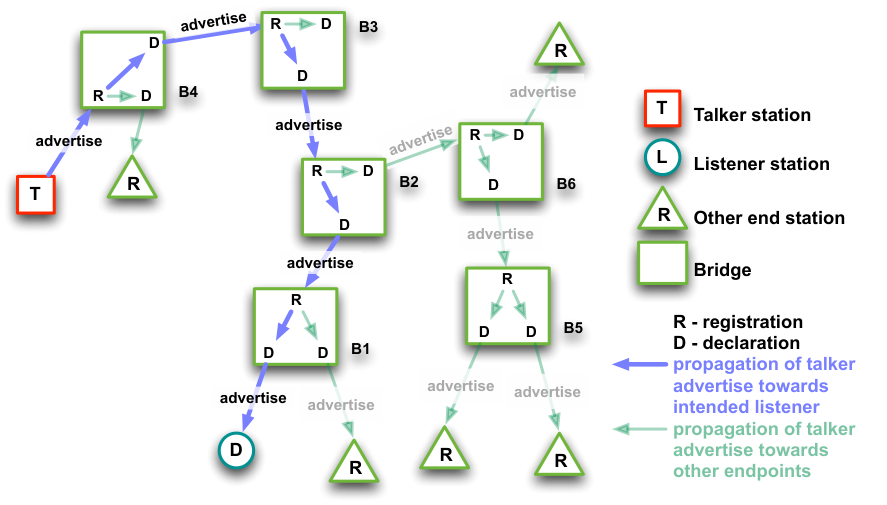
In SRP a talker sends a talker advertise carrying the stream identifier, its traffic class and frame rate, and an accumulated latency that each bridge increases. A listener that wants the stream answers with a listener ready, which travels back towards the talker. Each bridge it passes commits bandwidth for the stream. If a bridge lacks resources, the advertise becomes a talker failed and carries the reason [2]. Streams are identified by 64 bits: the talker's 48-bit MAC address and a 16-bit number [2].
The weakness of SRP was its analysis, not its signalling. The standards gave example latency formulas for the accumulated latency, but these lacked formal proof and were later shown to be inaccurate [4].
3. What a bridge must know to compute a local bound
The 2026 tutorial on decentralised latency models works out exactly what a bridge needs to bound the latency of its segment without global knowledge. It contributes this analysis to the RAP work [4]. Its list, paraphrased:
| Information | When | Purpose |
|---|---|---|
| Latency threshold per segment and priority | Configured beforehand | Upper limit on the latency a segment may consume; added to every stream's accumulated maximum latency |
| Shaper of each upstream traffic class, and its parameters (CBS idle slope, CQF cycle) | Exchanged with neighbours beforehand | Estimate the burstiness of incoming traffic |
| Stream identifier and header fields | Per stream, at reservation | Match frames to the stream and its priority |
| Traffic specification: burst , rate , minimum and maximum frame length | Per stream | Bound the traffic volume: |
| Accumulated maximum and minimum latency , | Per stream, updated at each hop | Bound the extra burstiness caused by delay variation |
| Upstream traffic class | Per stream | Compute the upstream queuing delay with the upstream bridge's own class mapping |
| Speed of the previous link | Per stream | Tighter bound using serialisation (optional) |
At each hop the accumulated latencies are updated as
The pre-configured threshold is used rather than the actual current bound. The actual bound changes with every new reservation, whereas the threshold stays valid as other streams come and go [4]. The traffic specification follows the token-bucket model of the arrival curves post, which replaces SRP's frames-per-interval description [4].
4. The bound a bridge computes
Two steps give the simplest bound of the tutorial, for strict priority without shaping [4].
Effective burst. A stream that has accumulated delay variation can arrive at a queue with a burst of at most
This is the output-burstiness result of the fundamental bounds post, applied with the jitter accumulated so far.
Per-class bound. Let be the streams in the observed upstream class, the streams of higher classes, the largest lower-priority frame and the link rate. Then the worst-case delay of the segment is bounded by
Admission control accepts a new stream only if, after adding it, still holds for every priority on the segment. The tutorial gives tighter network calculus versions and versions for CQF, ATS and CBS. All follow the same pattern: bound the workload from the traffic specifications and accumulated latencies, then divide by the service rate [4].
5. Distributed or centralised?
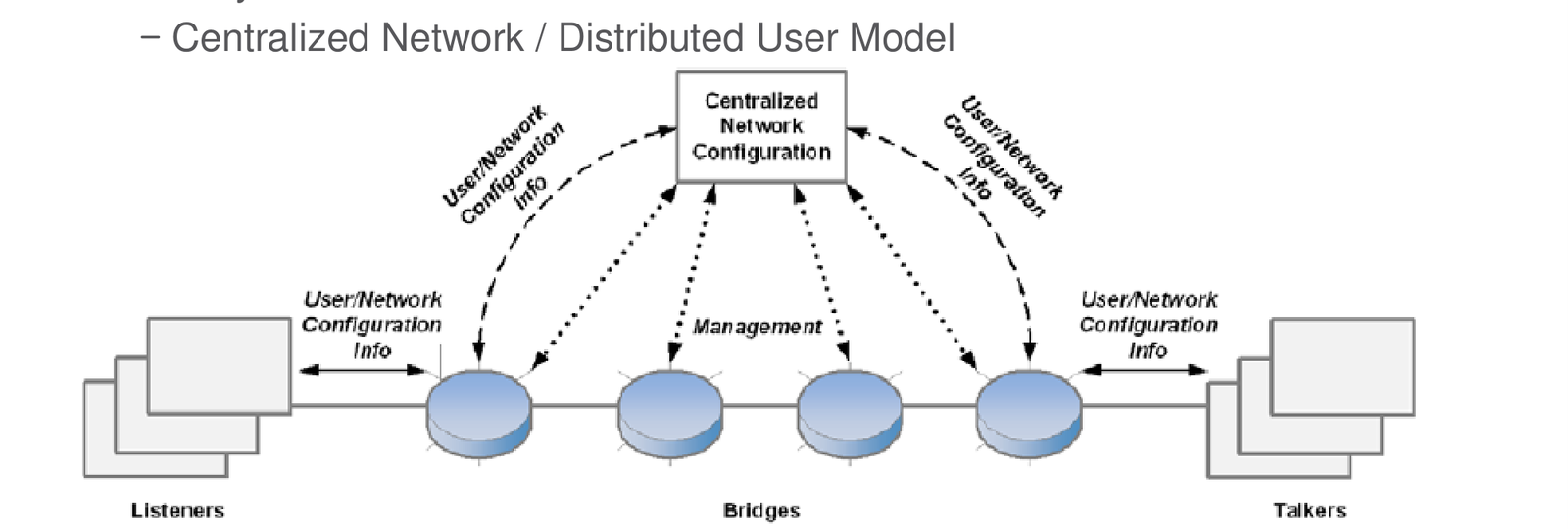
A distributed protocol has no single point of failure and copes with bridges whose internals a central controller would not know [4]. A review of industrial IoT technologies points out the other side. A reservation can fail at any bridge, and some failures only appear at run time. A small change in the network can reroute traffic and invalidate earlier reservations. This is the argument for a central controller that sees the whole network [5].
RAP is designed for both cases. Decentralised models can also join two centrally configured domains, as shown in the tutorial's motivating scenarios [4].
References
- IEEE 802.1, Time-Sensitive Networking (TSN) Task Group. Web page
- Wikipedia, "Time-Sensitive Networking," sections on AVB and stream reservation. Article
- J. Farkas, "TSN Basic Concepts," DetNet–TSN workshop, 11 November 2018, slide 18. Slides
- A. Grigorjew, S. Geissler, J. Schmitt, T. Hossfeld, "Decentralized Latency Models and Information Flow for TSN Shapers – A Tutorial," arXiv:2610.11999, 2026, Sections I, V, VI-A and VIII. arXiv
- I. Behnke, H. Austad, "Real-Time Performance of Industrial IoT Communication Technologies: A Review," arXiv:2311.08852, 2023, Section III-D. arXiv