IEEE 802.1Qcc and SDN: the CNC as a software-defined controller
TSN gives every bridge gates, shapers, filters and redundancy. Something still has to decide how all of them are set, in a consistent way, across the whole network. In most TSN deployments that is a central controller, and the architecture it fits into is software-defined networking (SDN).
Abbreviations used in this post (14)
| Abbreviation | Stands for | Meaning |
|---|---|---|
| CNC | Centralized Network Configuration | The 802.1Qcc entity that computes paths, schedules and reservations for the whole network and configures the bridges. |
| CUC | Centralized User Configuration | The 802.1Qcc entity that collects the stream requirements of end stations and passes them to the CNC. |
| DetNet | Deterministic Networking | The IETF architecture and working group for bounded-latency, low-loss flows over IP and MPLS (RFC 8655). |
| FRER | Frame Replication and Elimination for Reliability | IEEE 802.1CB: frames are numbered, sent over disjoint paths, and duplicates are removed. |
| IEEE | Institute of Electrical and Electronics Engineers | The professional association whose Standards Association publishes the IEEE 802 LAN/MAN standards. |
| IETF | Internet Engineering Task Force | The body that develops Internet standards, published as RFCs. |
| IS-IS | Intermediate System to Intermediate System | A link-state routing protocol (ISO/IEC 10589, RFC 1195); the control plane of SPB and PCR. |
| NETCONF | Network Configuration Protocol | The IETF protocol for installing and reading device configuration described in YANG (RFC 6241). |
| PTP | Precision Time Protocol | IEEE 1588, a protocol that synchronises clocks over a packet network using timestamped message exchanges. |
| RESTCONF | REST-based configuration protocol | An HTTP-based protocol for access to YANG-modelled data (RFC 8040). |
| SDN | Software-Defined Networking | An architecture that separates the control plane, run by a logically centralised controller, from the data plane of the network elements (RFC 7426). |
| TAS | Time-Aware Shaper | IEEE 802.1Qbv scheduled traffic: a gate per queue, opened and closed by a repeating gate control list. |
| TSN | Time-Sensitive Networking | The set of IEEE 802.1 standards that give Ethernet bounded latency, time synchronisation and high reliability. |
| YANG | Yet Another Next Generation (data modelling language) | The language in which network configuration and state are modelled for NETCONF and RESTCONF (RFC 7950). |
1. Definition of SDN
Software-defined networking separates the control plane, which decides where and how traffic is forwarded, from the data plane, which forwards it. The control plane is moved into a logically centralised controller. The controller programs the network elements through an open interface and offers the network to applications through another one [2].
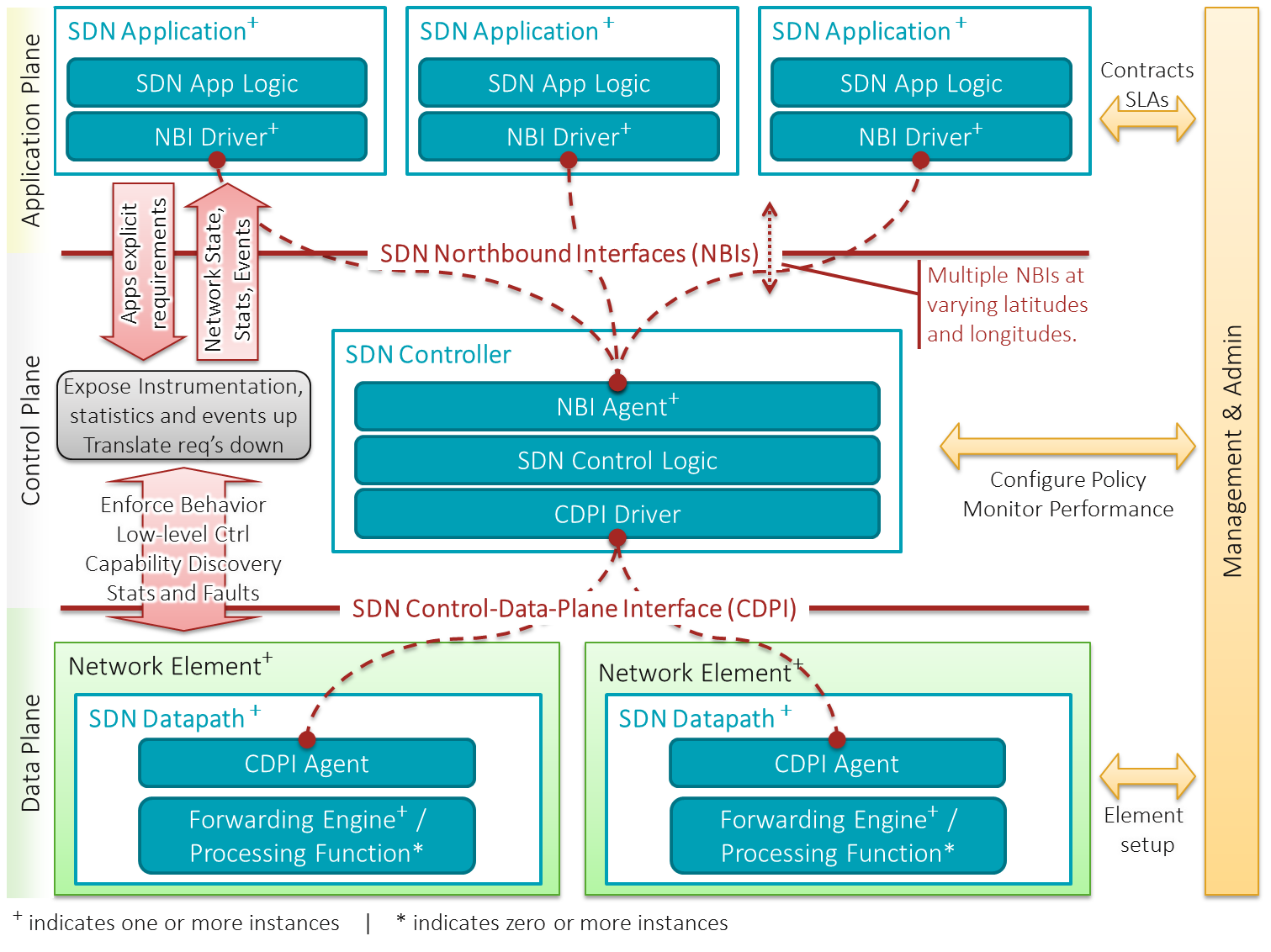

The vocabulary of Figure 2 maps directly onto the TSN components of Figure 1:
| SDN term | In TSN |
|---|---|
| SDN application | The CUC, Centralized User Configuration, which collects the requirements of the end stations; also monitoring and reconfiguration applications |
| Northbound interface | The user/network interface of 802.1Qcc, through which the CUC hands stream requirements to the CNC |
| SDN controller | The CNC, Centralized Network Configuration |
| Control–data-plane interface | NETCONF or RESTCONF with YANG data models; OpenFlow in SDN-native designs |
| Network element | A TSN bridge |
2. The three configuration models of 802.1Qcc
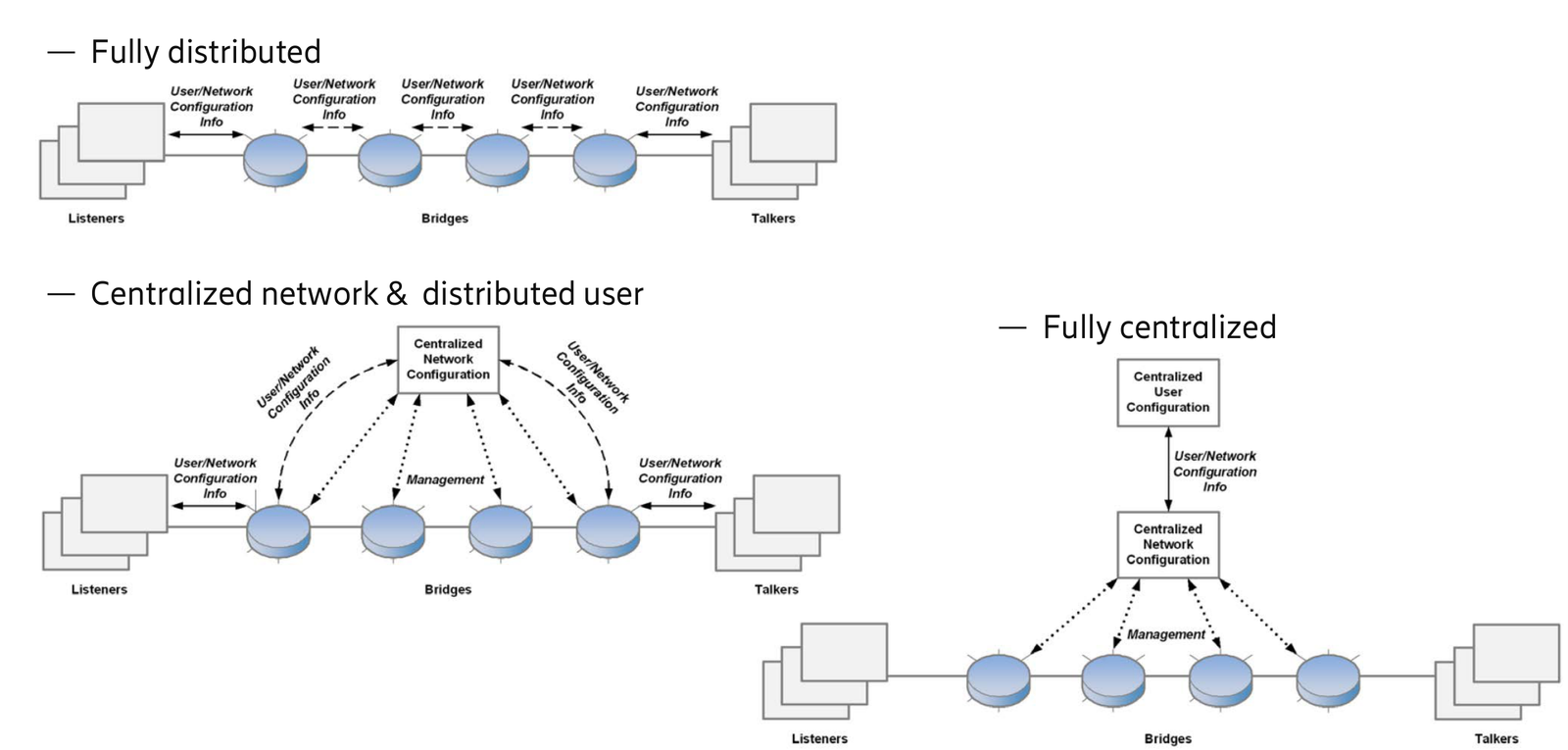
IEEE 802.1Qcc defines three ways to configure a TSN network [3][4]:
- Fully distributed. End stations and bridges exchange requirements hop by hop, with the reservation protocols of the stream reservation post. There is no central entity.
- Centralised network, distributed user. End stations still signal their streams to the first bridge, but a CNC with a view of the whole network computes and configures.
- Fully centralised. A CUC talks to the end stations, typically through an industrial engineering tool, and passes their requirements to the CNC. This is the SDN model of Figure 1.
3. What the CNC computes
Given the topology and the stream requirements, the CNC [3][4][5]:
- discovers the topology and the capabilities of each bridge;
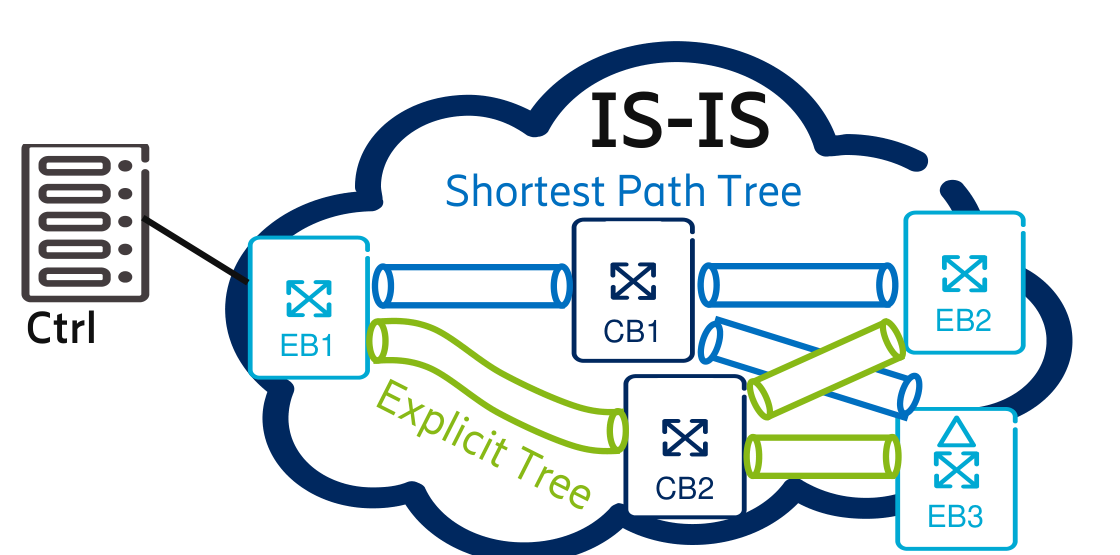
- computes paths, including the disjoint paths needed by FRER. It can install them as explicit trees with path control (802.1Qca), where IS-IS keeps the default paths and the controller adds the explicit ones [3];
- computes schedules, in particular the gate control lists of the Time-Aware Shaper;
- runs admission control, accepting a stream only if worst-case bounds still hold for all streams;
- configures the bridges through NETCONF or RESTCONF with YANG models [4].
For the Time-Aware Shaper a central controller is not optional. A review of industrial IoT networking states that the CUC and CNC are the single point of contact for end stations, and that the CNC configures every bridge before the end stations are told they may start. For scheduled traffic such a controller is a requirement [5]. The systematic study of TAS scheduling makes the same assumption: the network-wide schedule is generated by the CNC and then deployed on each bridge [6].
4. SDN in industrial real-time networks
The industrial review groups recent SDN work by what the controller adds [5]:
- Mixed computing loads. An SDN controller selects where tasks are offloaded and gives offloaded traffic a priority based on its real-time parameters.
- Traffic engineering. A controller monitors link quality and schedules delay-sensitive flows over multiple paths, adapting to the measured state.
- Time-slotted SDN Ethernet. PTP synchronisation plus time-slot switches managed by SDN make industrial Ethernet scalable and reconfigurable, without proprietary hardware.
The review concludes that combining TSN with its CNC and CUC and with SDN is a promising way to make deterministic networks reconfigurable, extending to Wi-Fi and 5G. The downside is the complexity of the combined systems [5].
5. Central or decentralised control
A central controller is not free. The 2026 tutorial on decentralised latency models lists the cases where it is a problem [7]:
- Single point of failure. If the CNC fails, no new stream can be admitted.
- Heterogeneous bridges. A CNC needs an exact model of each bridge's internals. Bridges built differently from what it expects break its calculations.
- Several domains. Two CNC-managed domains, each homogeneous but using different mechanisms, still need guarantees across the link between them.
Its answer is not to drop the CNC. It proposes latency models that each bridge can compute locally, usable in a fully decentralised network, between CNC domains, or alongside a CNC. When classifying 311 papers, it tagged a paper "central" if it needed a central authority such as an SDN controller or CNC, or global topology knowledge. Of the 58 scheduling papers, 20 required central control, 38 did not say, and none was explicitly decentralised [7].

6. Where this connects in the series
- At Layer 3, IETF DetNet has the same split. Its controller plane computes paths and resources and configures DetNet nodes, as described in the DetNet post.
- The CNC is where an admission test must run when the network changes while it is operating. The reconfiguration post looks at SDN-based path migration and at verifying a new configuration with network calculus before it is installed.
References
- IEEE 802.1, Time-Sensitive Networking (TSN) Task Group. Web page
- Wikipedia, "Software-defined networking." Article
- J. Farkas, "TSN Basic Concepts," DetNet–TSN workshop, 11 November 2018, slide 18. Slides
- Wikipedia, "Time-Sensitive Networking," section on TSN configuration (802.1Qcc). Article
- I. Behnke, H. Austad, "Real-Time Performance of Industrial IoT Communication Technologies: A Review," arXiv:2311.08852, 2023, Sections III-D, IV-A, IV-B and V. arXiv
- C. Xue, T. Zhang, Y. Zhou, M. Nixon, A. Loveless, S. Han, "Real-Time Scheduling for 802.1Qbv Time-Sensitive Networking (TSN): A Systematic Review and Experimental Study," arXiv:2305.16772, 2023 (v4, 2024), Section I. arXiv
- A. Grigorjew, S. Geissler, J. Schmitt, T. Hossfeld, "Decentralized Latency Models and Information Flow for TSN Shapers – A Tutorial," arXiv:2610.11999, 2026, Sections I and II. arXiv