IEEE 802.1s MSTP: one spanning tree per group of VLANs
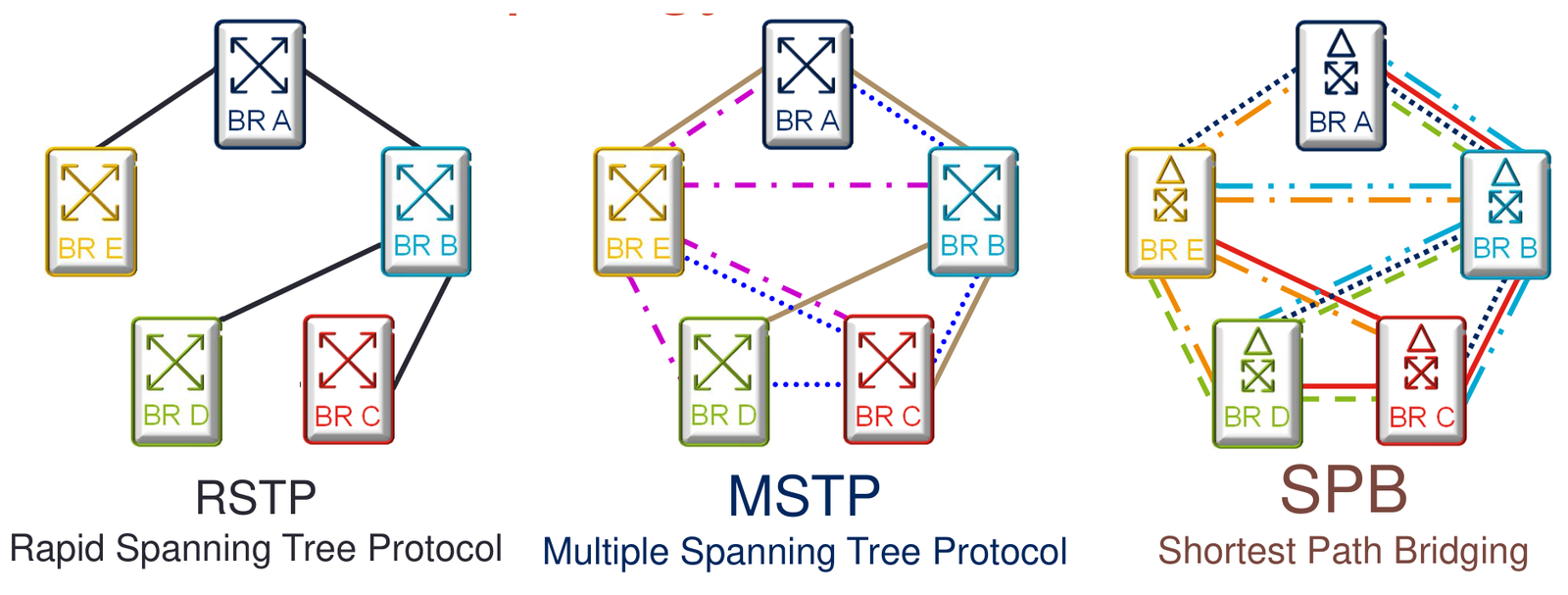
RSTP builds one tree for the whole network, so every redundant link stays idle. Once a network carries several VLANs, there is an obvious improvement: give different VLANs different trees, so that each link carries some traffic. That is what the Multiple Spanning Tree Protocol (MSTP) does.
Abbreviations used in this post (14)
| Abbreviation | Stands for | Meaning |
|---|---|---|
| BPDU | Bridge Protocol Data Unit | The message bridges exchange to run STP, RSTP and MSTP. |
| CNC | Centralized Network Configuration | The 802.1Qcc entity that computes paths, schedules and reservations for the whole network and configures the bridges. |
| CST | Common Spanning Tree | The tree that connects MSTP regions and single bridges; compatible with STP and RSTP. |
| IEEE | Institute of Electrical and Electronics Engineers | The professional association whose Standards Association publishes the IEEE 802 LAN/MAN standards. |
| IS-IS | Intermediate System to Intermediate System | A link-state routing protocol (ISO/IEC 10589, RFC 1195); the control plane of SPB and PCR. |
| IST | Internal Spanning Tree | The part of the common spanning tree inside one MSTP region. |
| MST | Multiple Spanning Tree | A spanning tree to which one or more VLANs are mapped under MSTP. |
| MSTI | MST Instance | One spanning tree inside an MSTP region, together with the VLANs mapped to it. |
| MSTP | Multiple Spanning Tree Protocol | IEEE 802.1s, now in 802.1Q: several spanning trees, each used by a group of VLANs. |
| RSTP | Rapid Spanning Tree Protocol | IEEE 802.1w, now in 802.1Q: a faster-converging spanning tree with alternate and backup port roles. |
| SPB | Shortest Path Bridging | IEEE 802.1aq: bridges compute shortest path trees with IS-IS, so all links can be used. |
| STP | Spanning Tree Protocol | The original 802.1D protocol that blocks redundant links to leave a loop-free tree; now replaced by RSTP. |
| TSN | Time-Sensitive Networking | The set of IEEE 802.1 standards that give Ethernet bounded latency, time synchronisation and high reliability. |
| VLAN | Virtual LAN | A logical LAN within a bridged network, identified by a 12-bit VLAN ID in the 802.1Q tag. |
1. Definition
The Multiple Spanning Tree Protocol was defined in IEEE 802.1s-2002 and merged into IEEE 802.1Q-2005. It is an extension of RSTP that makes VLANs more useful [1]. Under MSTP, a spanning tree can be defined for individual VLANs or for groups of VLANs [1]. In the words of the IEEE 802.1 tutorial, different VLANs may share different spanning trees [3].
2. Regions and instances
MSTP organises bridges and VLANs in two steps [1]:
- bridges are assigned to an MST region;
- VLANs are mapped to MST instances (MSTIs), each of which is a spanning tree.
Inside a region, frames of a VLAN follow the tree of the instance their VLAN is mapped to. The terms in the standard are as follows [1]:
| Term | Meaning |
|---|---|
| Multiple spanning tree (MST) | A spanning tree to which one or more VLANs are mapped |
| MST instance (MSTI) | A group of VLANs and the spanning tree they use inside a region |
| Common spanning tree (CST) | The tree that connects regions and single bridges; backward compatible with STP and RSTP |
| Internal spanning tree (IST) | The instance of the common tree inside a region |
| Boundary port | A port at the edge of a region, towards an RSTP or STP bridge or an end station |
3. One BPDU for all instances
Proprietary per-VLAN spanning trees send one set of BPDUs per VLAN. MSTP instead puts all of its information into one BPDU format [1]:
- the BPDU starts with a standard RSTP BPDU;
- an additional region section follows, with one message per MSTI (from 0 to 64 instances, although many bridges support fewer);
- instead of the full table of VLAN-to-instance mappings, the BPDU carries an MD5 digest of it. Two neighbours with the same digest and the same configured region values belong to the same region.
This keeps the number of BPDUs low. Because an RSTP bridge can read an MSTP BPDU as an RSTP BPDU, it also keeps compatibility with RSTP and with STP [1].
4. A region seen from outside
To RSTP bridges outside, a whole MST region looks like one RSTP bridge, however many bridges it contains. MSTP uses a remaining-hops counter inside the region instead of the message age timer of RSTP. The message age is incremented only once when spanning-tree information enters a region, so RSTP bridges see the region as a single hop [1]. As in RSTP, boundary ports facing end stations can be edge ports and start forwarding at once [1].
5. MSTP among the control options
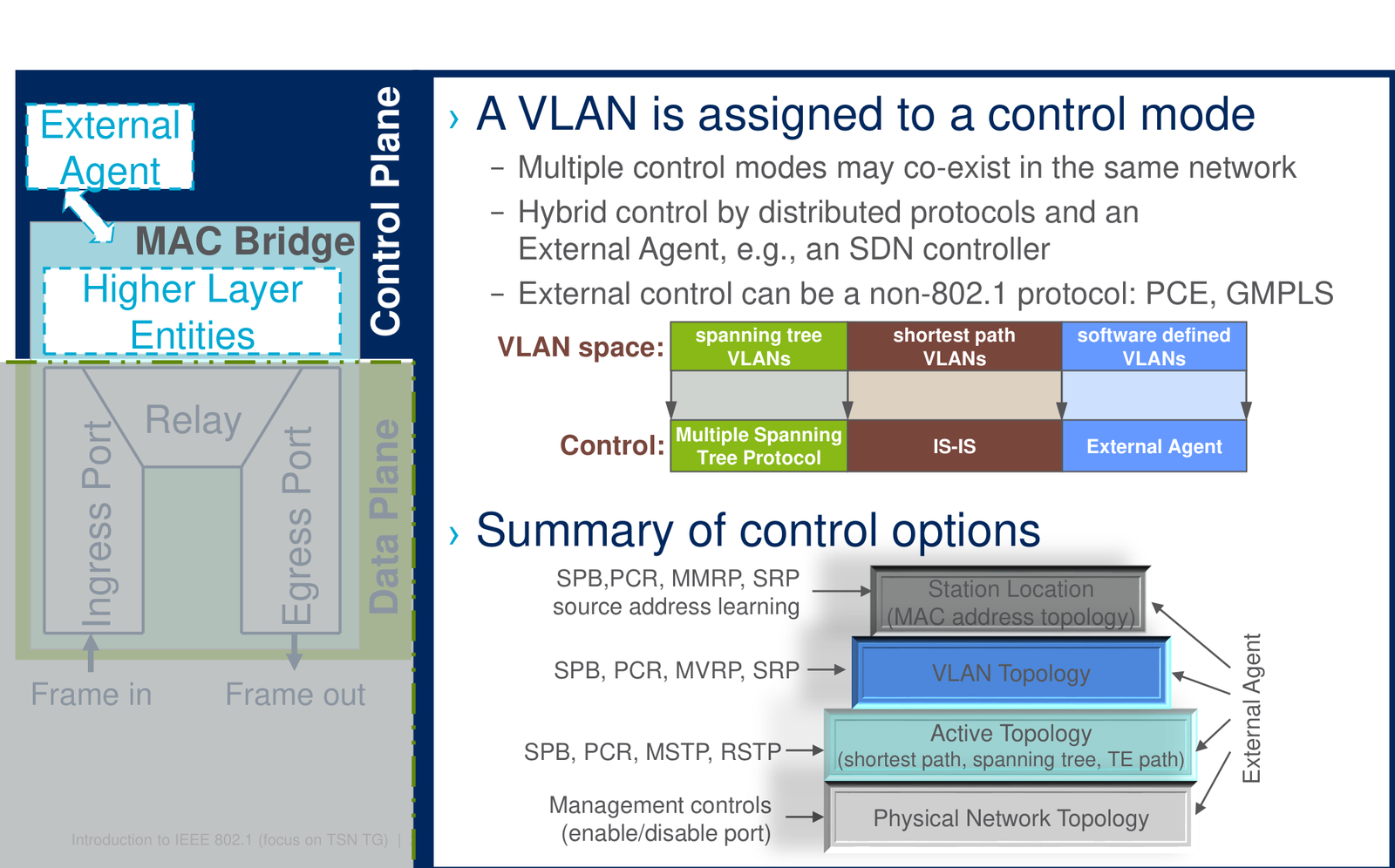
802.1Q assigns a control mode per VLAN. Spanning-tree VLANs are controlled by MSTP, shortest-path VLANs by IS-IS, and software-defined VLANs by an external agent, and the modes can coexist in one network [2]. A TSN network can therefore keep MSTP for its ordinary VLANs while a controller installs explicit paths for streams, with path control or a CNC.
For determinism, MSTP shares the properties of RSTP. Each VLAN has one active path between two bridges, and that path changes when the tree of its instance reconverges.
References
- Wikipedia, "Spanning Tree Protocol," section on the Multiple Spanning Tree Protocol. Article
- J. Farkas, "Introduction to IEEE 802.1: Focus on the Time-Sensitive Networking Task Group," 15 May 2017, slide 49. Slides
- P. Thaler, N. Finn, D. Fedyk, J. Farkas, G. Parsons, E. Gray, "IEEE 802.1Q: Media Access Control Bridges and Virtual Bridged Local Area Networks," IEEE 802.1 tutorial, IETF 86, 10 March 2013, slides 25–26. Slides