IEEE 802.1ak MRP and MVRP: registering VLANs across a bridged network
Once RSTP, MSTP or SPB has fixed the active topology, a bridge still needs to know where the members of each VLAN are, so that it does not flood VLAN traffic everywhere. The Multiple VLAN Registration Protocol (MVRP) learns this automatically. It is one application of a general framework, the Multiple Registration Protocol (MRP), which also carries stream reservations.
Abbreviations used in this post (19)
| Abbreviation | Stands for | Meaning |
|---|---|---|
| AVB | Audio Video Bridging | The predecessor of TSN: gPTP, the credit-based shaper and stream reservation, combined for audio and video (profile: IEEE 802.1BA). |
| GARP | Generic Attribute Registration Protocol | The 802.1D predecessor of MRP. |
| IEEE | Institute of Electrical and Electronics Engineers | The professional association whose Standards Association publishes the IEEE 802 LAN/MAN standards. |
| IP | Internet Protocol | The network-layer protocol of the Internet (IPv4, RFC 791; IPv6, RFC 8200). |
| IS-IS | Intermediate System to Intermediate System | A link-state routing protocol (ISO/IEC 10589, RFC 1195); the control plane of SPB and PCR. |
| LAN | Local Area Network | A network covering a limited area, such as a building or a vehicle; IEEE 802 standardises LANs. |
| MAC | Medium Access Control | The lower sublayer of the data link layer, which frames data and controls access to the medium. A MAC address identifies a network interface. |
| MAD | MRP Attribute Declaration | The per-port MRP state machine that declares attributes and registers those declared by neighbours. |
| MAP | MRP Attribute Propagation | The MRP function that turns a registration on one port into declarations on the other ports. |
| MMRP | Multiple MAC Registration Protocol | The MRP application that registers multicast MAC addresses. |
| MRP | Multiple Registration Protocol | IEEE 802.1ak, now in 802.1Q: the framework for declaring and registering attributes such as VLANs, multicast addresses and streams. |
| MSRP | Multiple Stream Registration Protocol | The MRP application at the core of SRP that registers streams and reserves bridge resources. |
| MSTP | Multiple Spanning Tree Protocol | IEEE 802.1s, now in 802.1Q: several spanning trees, each used by a group of VLANs. |
| MVRP | Multiple VLAN Registration Protocol | The MRP application that registers VLAN membership, so that VLAN traffic only goes where members are. |
| RSTP | Rapid Spanning Tree Protocol | IEEE 802.1w, now in 802.1Q: a faster-converging spanning tree with alternate and backup port roles. |
| SPB | Shortest Path Bridging | IEEE 802.1aq: bridges compute shortest path trees with IS-IS, so all links can be used. |
| SRP | Stream Reservation Protocol | IEEE 802.1Qat: distributed admission control in which talkers advertise streams and listeners subscribe, reserving resources hop by hop. |
| TSN | Time-Sensitive Networking | The set of IEEE 802.1 standards that give Ethernet bounded latency, time synchronisation and high reliability. |
| VLAN | Virtual LAN | A logical LAN within a bridged network, identified by a 12-bit VLAN ID in the 802.1Q tag. |
1. Definition
The Multiple Registration Protocol is a generic registration framework, defined by the IEEE 802.1ak amendment (2007) to IEEE 802.1Q. It lets bridges and end stations register and deregister attribute values, such as VLAN identifiers or multicast group membership, across a large LAN [1]. It replaced the older Generic Attribute Registration Protocol (GARP) of 802.1D. GARP-based VLAN registration could take an extremely long time to converge on a large network, consuming considerable bandwidth [1].
The IEEE 802.1 tutorial describes MRP as a flooding protocol, not unlike IS-IS or OSPF. On every bridge port, it registers the neighbours' ability to transmit, or need to receive, various kinds of data [2]. Three applications use it [1][2]:
| Application | Registers | Replaces |
|---|---|---|
| MVRP, Multiple VLAN Registration Protocol | VLAN membership: where frames flooded to a VLAN, such as broadcasts or unknown unicasts, must go | GVRP |
| MMRP, Multiple MAC Registration Protocol | Multicast MAC addresses, or VLAN and MAC pairs (not necessarily IP multicast) | GMRP |
| MSRP, Multiple Stream Registration Protocol (SRP) | Talkers that want to send and listeners that want to receive streams with bandwidth, latency and loss requirements | (new with AVB) |
In some networks, MRP is being supplanted by IS-IS [2]. For example, SPB distributes service membership through its link-state database.
2. Declarations and registrations
MRP separates two functions [1]:
- MRP Attribute Declaration (MAD) is the per-port state machine that declares attributes to a neighbour and registers the attributes declared by it;
- MRP Attribute Propagation (MAP) passes a registration on one port to declarations on the bridge's other ports, along the active topology.
Withdrawing a declaration deregisters the attribute along the same path. A registration therefore always reflects where the members currently are.
3. MVRP
MVRP is the MRP application for the VLAN registration service. It dynamically maintains the dynamic VLAN registration entries of the filtering database and propagates them to other bridges [1]. Each bridge thus learns which VLANs currently have active members, and through which ports they can be reached [1].
The practical effect is configuration at the edge only. To add a port to a VLAN, only the end port or the device connected to it needs to be configured. MVRP creates the necessary VLAN trunks on the other bridges [1]. 802.1Q allows VLAN membership to be configured statically, dynamically through MVRP, or as a mix of both [1].
4. Where it sits among the control protocols
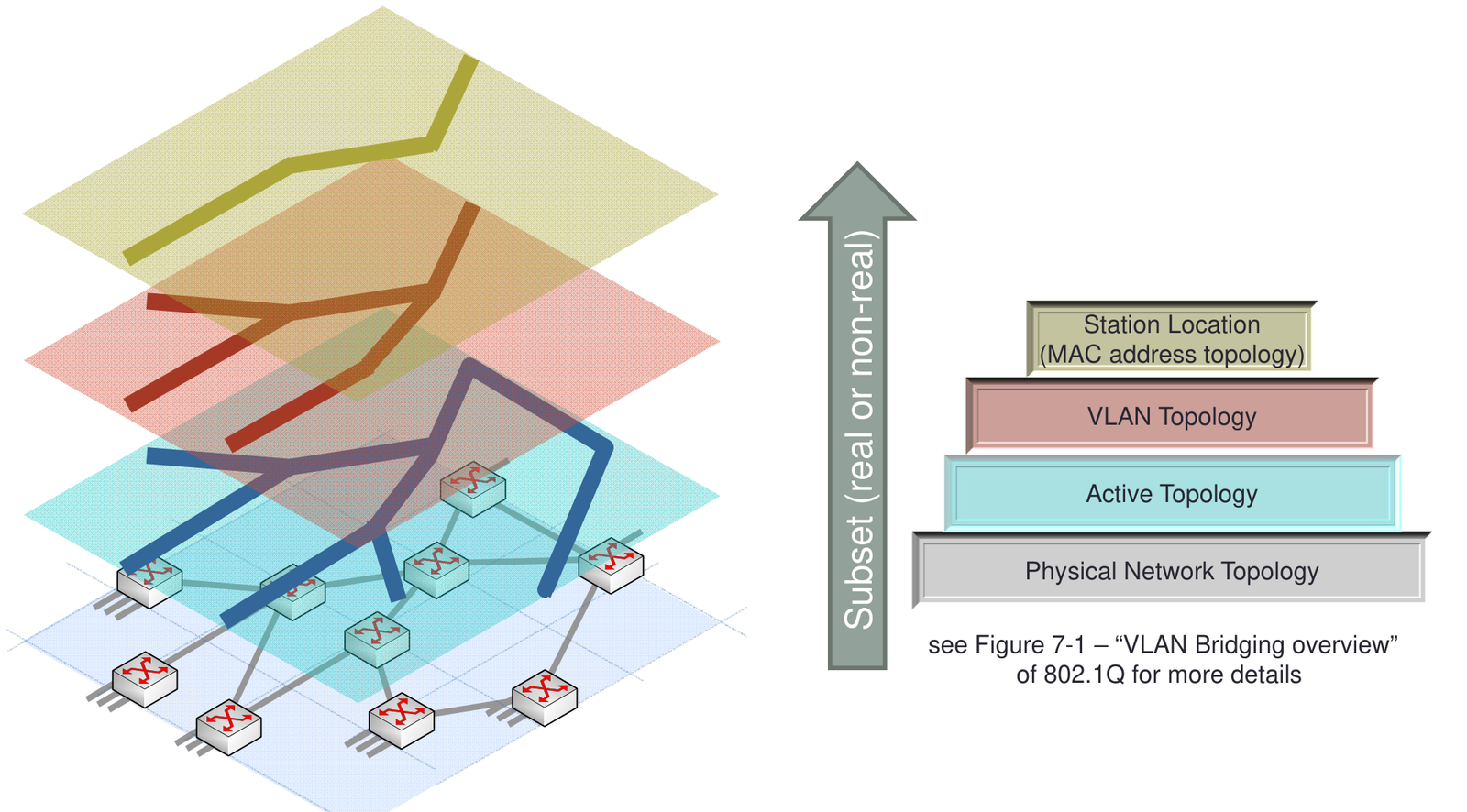
In the layered view of the bridge post, MVRP maintains the VLAN topology. That is the layer between the active topology (spanning tree, SPB or path control) and the station locations (source address learning, MMRP) [2][3]. For TSN, MRP matters mostly through its third application. The Stream Reservation Protocol uses the same declarations and registrations to reserve resources along a stream's path, and MVRP to make the bridges on that path members of the stream's VLAN [4].
References
- Wikipedia, "Multiple Registration Protocol," sections on history, MMRP and MVRP. Article
- P. Thaler, N. Finn, D. Fedyk, J. Farkas, G. Parsons, E. Gray, "IEEE 802.1Q: Media Access Control Bridges and Virtual Bridged Local Area Networks," IEEE 802.1 tutorial, IETF 86, 10 March 2013, slides 25 and 27. Slides
- J. Farkas, "Introduction to IEEE 802.1: Focus on the Time-Sensitive Networking Task Group," 15 May 2017, slide 49. Slides
- Wikipedia, "Stream Reservation Protocol." Article