IETF RFC 8655 DetNet: deterministic paths at Layer 3
TSN makes a bridged network deterministic. The IETF Deterministic Networking (DetNet) working group does the same for routed networks, and defines how the two fit together. This post summarises the charter and the architecture document, RFC 8655.
Abbreviations used in this post (16)
| Abbreviation | Stands for | Meaning |
|---|---|---|
| CPF | Controller Plane Function | In DetNet, the function that computes paths and resources and configures DetNet nodes (RFC 8655). |
| DetNet | Deterministic Networking | The IETF architecture and working group for bounded-latency, low-loss flows over IP and MPLS (RFC 8655). |
| GRE | Generic Routing Encapsulation | A tunnelling protocol that carries one packet inside another (RFC 2784). |
| IEEE | Institute of Electrical and Electronics Engineers | The professional association whose Standards Association publishes the IEEE 802 LAN/MAN standards. |
| IETF | Internet Engineering Task Force | The body that develops Internet standards, published as RFCs. |
| IP | Internet Protocol | The network-layer protocol of the Internet (IPv4, RFC 791; IPv6, RFC 8200). |
| MAC | Medium Access Control | The lower sublayer of the data link layer, which frames data and controls access to the medium. A MAC address identifies a network interface. |
| MPLS | Multiprotocol Label Switching | Forwarding of packets on short labels along label-switched paths (RFC 3031). |
| MPLS-TE | MPLS Traffic Engineering | Use of MPLS paths with reserved bandwidth to steer traffic (RFC 2702). |
| OAM | Operations, Administration and Maintenance | The tools for monitoring and troubleshooting a network, such as continuity checks and loss measurement. |
| PW | Pseudowire | An emulated point-to-point link carried over a packet network; one encapsulation of the DetNet service sub-layer. |
| RFC | Request for Comments | The document series in which IETF standards and related documents are published. |
| TSN | Time-Sensitive Networking | The set of IEEE 802.1 standards that give Ethernet bounded latency, time synchronisation and high reliability. |
| UDP | User Datagram Protocol | A connectionless transport protocol without congestion control (RFC 768). |
| VLAN | Virtual LAN | A logical LAN within a bridged network, identified by a 12-bit VLAN ID in the 802.1Q tag. |
| YANG | Yet Another Next Generation (data modelling language) | The language in which network configuration and state are modelled for NETCONF and RESTCONF (RFC 7950). |
1. Definition
DetNet is both a working group in the IETF Routing Area and the architecture it standardises. The group works on deterministic data paths that run over Layer 2 bridged and Layer 3 routed segments and that bound latency, loss, delay variation and reordering, with high reliability. It addresses the Layer 3 aspects and collaborates with IEEE 802.1 TSN, which is responsible for Layer 2, towards a common architecture [1].
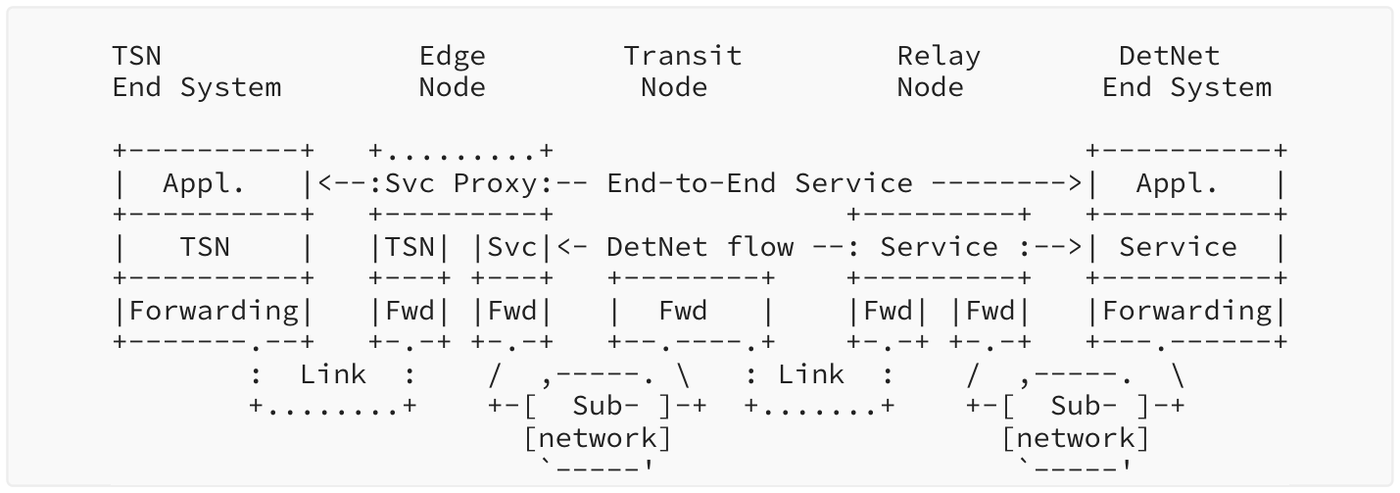
Figure 1 shows how DetNet integrates with what already exists. It does not replace IP or MPLS forwarding, and it does not replace TSN. It adds two sub-layers to the nodes on the path, and lets an end system that only speaks TSN take part through an edge node [2].
2. Scope of the working group
The charter draws the boundary carefully [1].
In scope
- unicast and multicast (point-to-multipoint) flows, over wired and wireless networks;
- networks under a single administrative control, or a closed group of administrative control, such as campus networks and private WANs;
- the overall architecture: data plane, OAM, time synchronisation, management, control and security;
- a data plane built on IP and MPLS, and on Layer 2 encapsulations that run over them, such as pseudowires and GRE;
- a flow information model and YANG models, independent of the protocol that carries them;
- the ability to reserve resources in advance, then release and reuse them.
Out of scope
- solutions for large groups of domains such as the Internet;
- a new path set-up protocol: the work is independent of the protocol used;
- in general, modifications of transport protocols, OAM, Layer 3 forwarding and encapsulations, which belong to other working groups with which DetNet coordinates.
The last item explains the shape of the architecture: DetNet composes existing IETF and IEEE mechanisms and specifies what is missing between them.
3. Two sub-layers
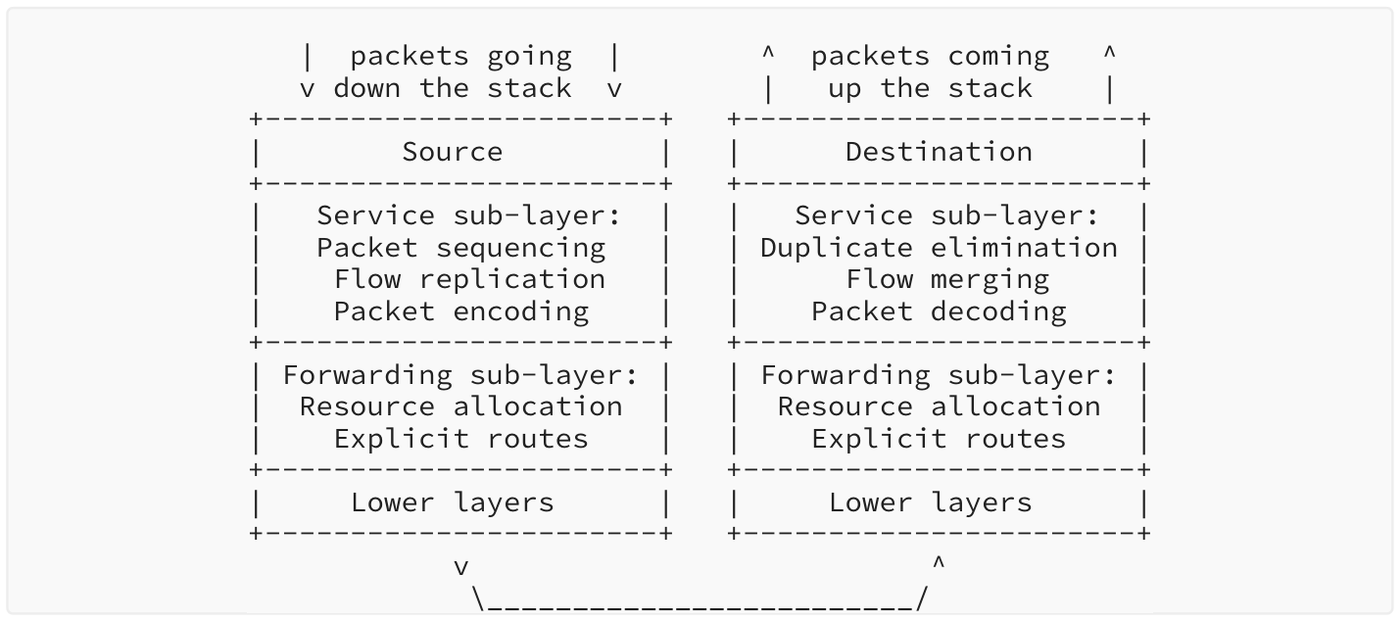
The data plane is described as two sub-layers above the existing lower layers [2].
- The service sub-layer provides service protection. At the source side it sequences packets, replicates flows and may encode packets; at the destination side it eliminates duplicates, merges flows and decodes.
- The forwarding sub-layer provides resource allocation and explicit routes. The actual queuing and shaping are normally performed by the underlying sub-network.
These map directly onto the three techniques described in the deterministic networking post. The model is conceptual: not every sub-layer is needed in every network, and the RFC states that the separation is not a formal requirement [2].
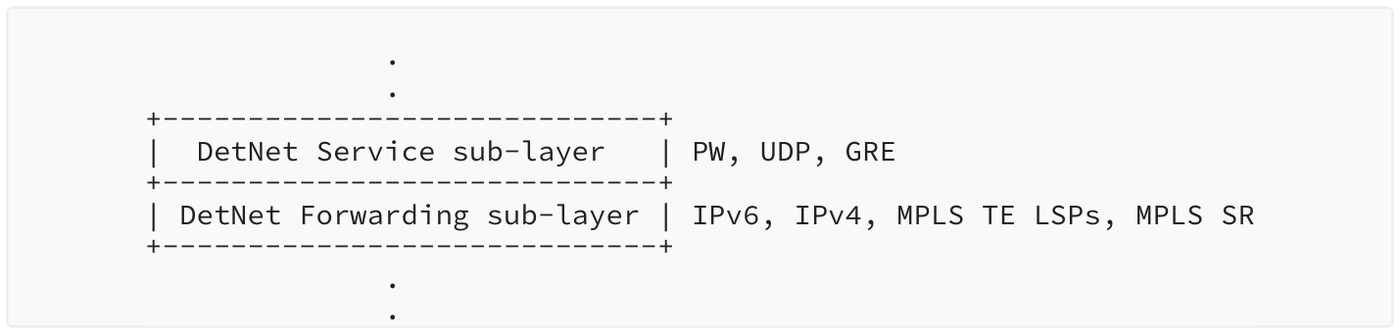
4. Node types
Reading Figure 1 from left to right gives the vocabulary [2]:
| Node | Sub-layers | Role |
|---|---|---|
| End system | Depends on the system | Source or destination of a flow. It may be unaware of DetNet, as the TSN end system in Figure 1 is |
| Edge node | Service and forwarding | Start or end of the DetNet service; can run a service proxy on behalf of an end system that is not DetNet-aware. Comparable to a provider edge router |
| Relay node | Service and forwarding | Interconnects forwarding paths to provide service protection, for instance replication and elimination |
| Transit node | Forwarding only | Carries the flow along its explicit route with its allocated resources, for instance an MPLS label switching router |
Two horizontal relations appear in the figure: the end-to-end service between applications, and the DetNet flow between the service sub-layers that implement it. Between nodes there is either a plain link or a sub-network, which may be a TSN bridged network, an MPLS-TE network or an optical transport network [2].
5. Three planes
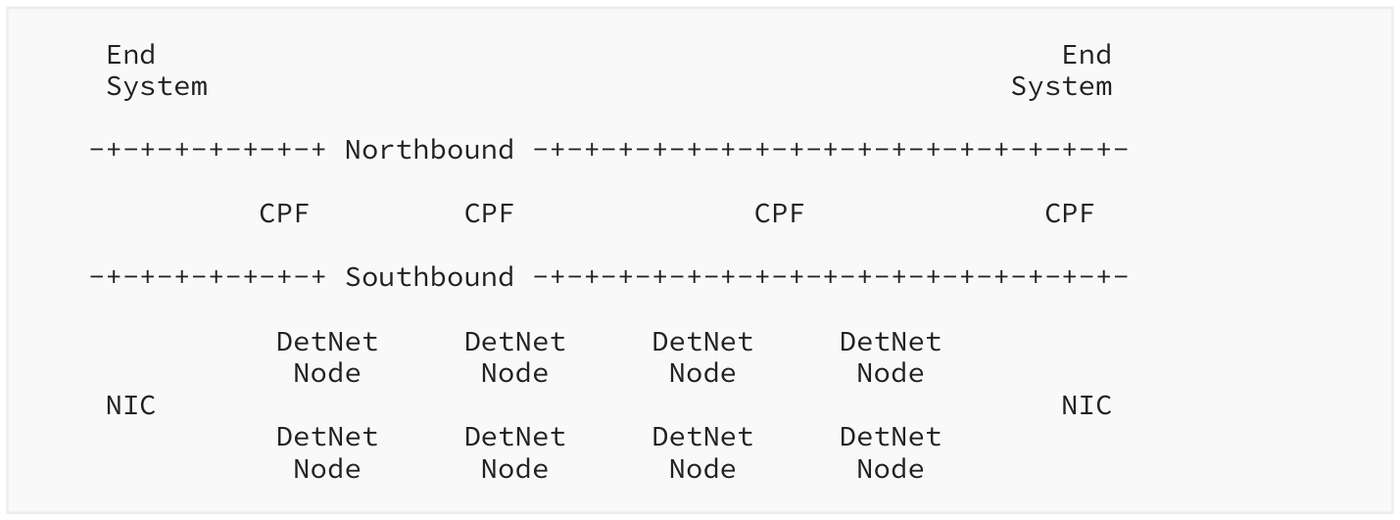
RFC 8655 separates three planes [2]:
- the application plane, where a user agent and a flow management entity express what flows are needed, as traffic specifications;
- the controller plane, the aggregation of the control and management planes. Its Controller Plane Functions compute deterministic paths and install per-flow, per-hop behaviour. A Path Computation Element is the standard example [1][2];
- the network plane, made of the network interfaces of end systems and of the DetNet nodes.
This is the same separation that makes centralised admission control possible. A controller that receives a flow request through the northbound interface must decide whether the flow can be admitted without breaking existing guarantees before it writes anything through the southbound interface. That decision is the problem studied in the reconfiguration post.
6. Crossing a TSN sub-network
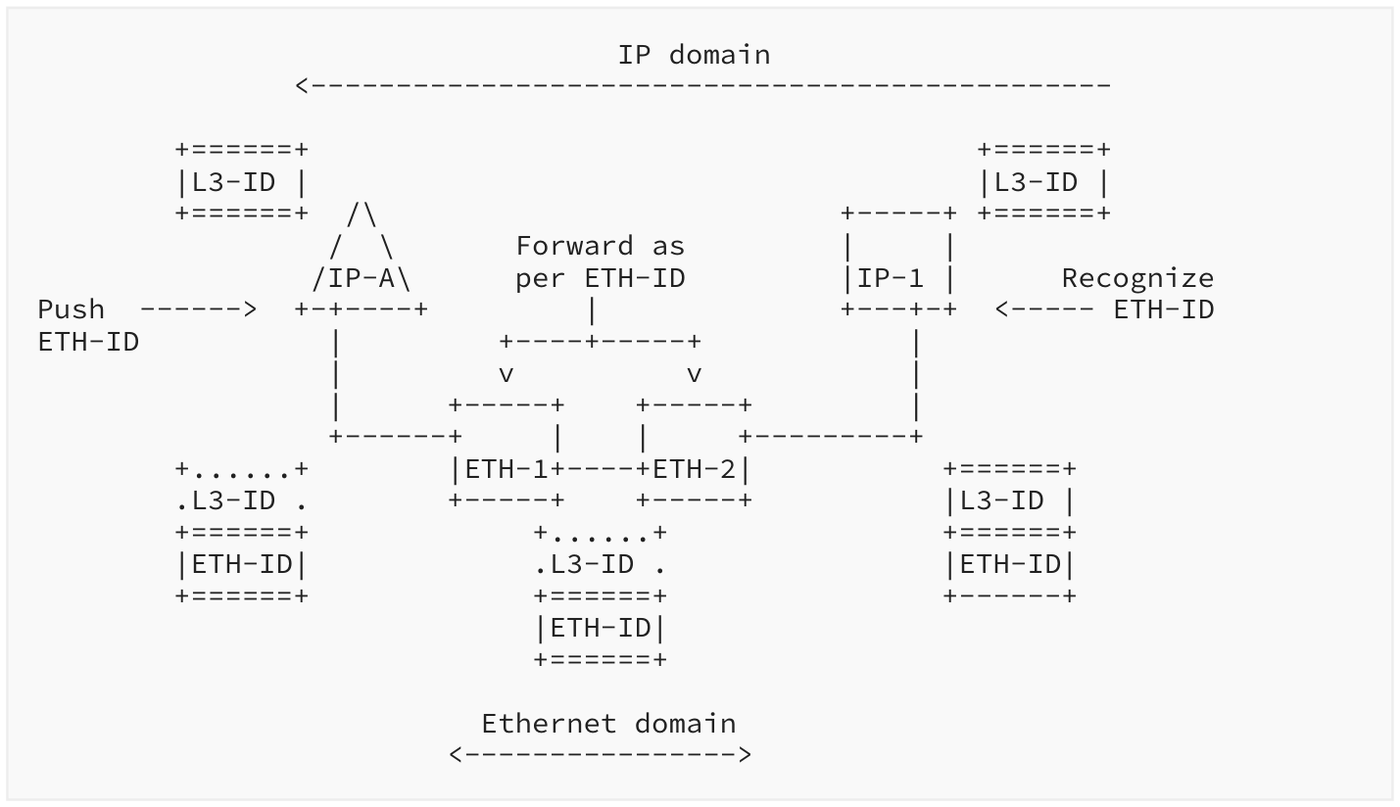
When DetNet nodes are interconnected by a TSN network, the DetNet flow has to be mapped to a TSN Stream [2]. In Figure 4 the first IP node adds a Layer 2 flow identifier, and the bridges forward on that identifier alone. Each domain uses an identifier that is unique within that domain, either derived from the application flow or assigned by the domain.
Within the bridged segment, the DetNet architecture relies on the IEEE 802.1 mechanisms rather than defining its own [2]: the credit-based shaper (802.1Qav), time-gated queues (802.1Qbv), cyclic queuing and forwarding (802.1Qch) and frame preemption (802.1Qbu with 802.3br). Bridges match a flow by destination MAC address, VLAN identifier and priority to find its Stream and quality-of-service requirements [3].
The vocabulary changes at the boundary, although the concepts do not [2]:
| TSN term | DetNet term |
|---|---|
| Talker | Source |
| Listener | Destination |
| Stream | Flow |
| Relay system (bridge) | Intermediate node |
7. Current work
Beyond the base architecture, the charter lists a controller plane framework, YANG models for device and link capabilities, and DetNet over wireless segments, naming IEEE 802.15.4 TSCH, 3GPP 5G URLLC, IEEE 802.11ax/be and LDACS as target radio technologies [1]. Two of these items are recorded as done on the working group page: the controller plane framework (RFC 9938) and the architecture for reliable and available wireless (RFC 9912). The remaining milestones concern an enhanced data plane and the requirements for scaling deterministic networks [1].
Use cases are collected in RFC 8578 and the problem statement in RFC 8557 [3].
DetNet says that resources must be allocated so that latency is bounded; it does not prescribe how to compute the bound. Network calculus is one way to compute it, hop by hop or end to end, for whatever queuing mechanism the sub-network uses.
References
- IETF, Deterministic Networking (detnet) working group: charter and milestones. Datatracker
- N. Finn, P. Thubert, B. Varga, J. Farkas, Deterministic Networking Architecture, RFC 8655, October 2019. RFC Editor
- Wikipedia, "Deterministic Networking." Article