IEEE 802.1 standards: base standards, amendments, revisions and families
Papers on TSN cite "802.1Qbv-2015", "802.1Q-2018" and "802.1Q-2022" for what looks like the same mechanism. They are not contradictory: the mechanism was written as an amendment, then merged into a new edition of the base standard, which was later revised again. This post explains how IEEE 802.1 documents are created, changed, merged and grouped, using 802.1Q as the running example.
Abbreviations used in this post (23)
| Abbreviation | Stands for | Meaning |
|---|---|---|
| ATS | Asynchronous Traffic Shaping | IEEE 802.1Qcr: per-stream token-bucket shaping at every hop using local clocks only. |
| CBS | Credit-Based Shaper | The IEEE 802.1Qav shaper that limits a traffic class to its reserved rate (idleSlope) with a per-queue credit. In MEF bandwidth profiles, CBS instead means Committed Burst Size. |
| Cor | Corrigendum | A document that only corrects errors or ambiguities in a standard, without adding new material, for example 802.1Q-2014/Cor 1-2015. |
| CQF | Cyclic Queuing and Forwarding | IEEE 802.1Qch: two queues per class alternate every cycle, so a frame advances one hop per cycle. |
| CSD | Criteria for Standards Development | The IEEE 802 criteria (such as broad market potential and technical feasibility) used to judge whether a PAR should go forward. |
| IEC | International Electrotechnical Commission | The international standards body for electrical and electronic technologies; co-owner of IEC/IEEE 60802. |
| IEEE | Institute of Electrical and Electronics Engineers | The professional association whose Standards Association publishes the IEEE 802 LAN/MAN standards. |
| LMSC | LAN/MAN Standards Committee | The IEEE Computer Society standards committee better known as IEEE 802; its working groups include 802.1, 802.3 and 802.11. |
| MRP | Multiple Registration Protocol | IEEE 802.1ak, now in 802.1Q: the framework for declaring and registering attributes such as VLANs, multicast addresses and streams. |
| MSTP | Multiple Spanning Tree Protocol | IEEE 802.1s, now in 802.1Q: several spanning trees, each used by a group of VLANs. |
| NesCom | New Standards Committee | The IEEE SA Standards Board committee that reviews PARs before work may start. |
| PAR | Project Authorization Request | The document that authorises work on a new standard, amendment or revision, stating its scope and purpose; approved by the IEEE SA Standards Board on the recommendation of NesCom. |
| PSFP | Per-Stream Filtering and Policing | IEEE 802.1Qci: stream filters, stream gates and flow meters that enforce each stream’s contract at ingress. |
| RevCom | Standards Review Committee | The IEEE SA Standards Board committee that checks a balloted draft followed due process before it is approved as a standard. |
| SASB | IEEE SA Standards Board | The board that approves PARs and standards and oversees the standards process. |
| SPB | Shortest Path Bridging | IEEE 802.1aq: bridges compute shortest path trees with IS-IS, so all links can be used. |
| SRP | Stream Reservation Protocol | IEEE 802.1Qat: distributed admission control in which talkers advertise streams and listeners subscribe, reserving resources hop by hop. |
| TAG | Technical Advisory Group | A group of experts on a topic that crosses working groups; it may write a recommended practice. |
| TAS | Time-Aware Shaper | IEEE 802.1Qbv scheduled traffic: a gate per queue, opened and closed by a repeating gate control list. |
| TG | Task Group | A part of a working group that focuses on one subject, such as the TSN task group of IEEE 802.1. |
| TSN | Time-Sensitive Networking | The set of IEEE 802.1 standards that give Ethernet bounded latency, time synchronisation and high reliability. |
| WG | Working Group | The group responsible for the standards of one area, such as IEEE 802.1 (higher layer LAN protocols); only its voting members vote in working-group ballots. |
| YANG | Yet Another Next Generation (data modelling language) | The language in which network configuration and state are modelled for NETCONF and RESTCONF (RFC 7950). |
1. Definition: three kinds of projects
IEEE 802.1 works on three kinds of standards projects [1][2]:
| Kind | What it is | How it is named | Example |
|---|---|---|---|
| Base standard | A stand-alone document | Upper-case letters after "802.1" (the rule since about 2003) | 802.1Q (bridging), 802.1AS (timing), 802.1CB (redundancy) |
| Amendment | A change to a base standard; only the amendment's changes are open to ballot comments | Lower-case letters added to the name of the base standard | 802.1Qbv (scheduled traffic), 802.1ASdm (hot standby), 802.1CBdb (extended stream identification) |
| Revision | A new edition of a base standard; the whole document may be open to comments | The base name followed by "-Rev" while in progress, then by the year | 802.1Q-Rev, a roll-up; 802.1AS-Rev, in which the entire document was open |
Two more conventions complete the picture [1]:
- A corrigendum ("Cor") fixes errors or ambiguities only and may not add material, for example 802.1Q-2014/Cor 1-2015.
- A leading P marks a project that is still a draft: P802.1Q is the revision now in progress, 802.1Q-2022 the published edition.
When a revision is used only to roll up amendments into a new edition, its scope forbids adding features [2]. New functions arrive through amendments; the roll-up gathers them into one document.
2. Who writes them
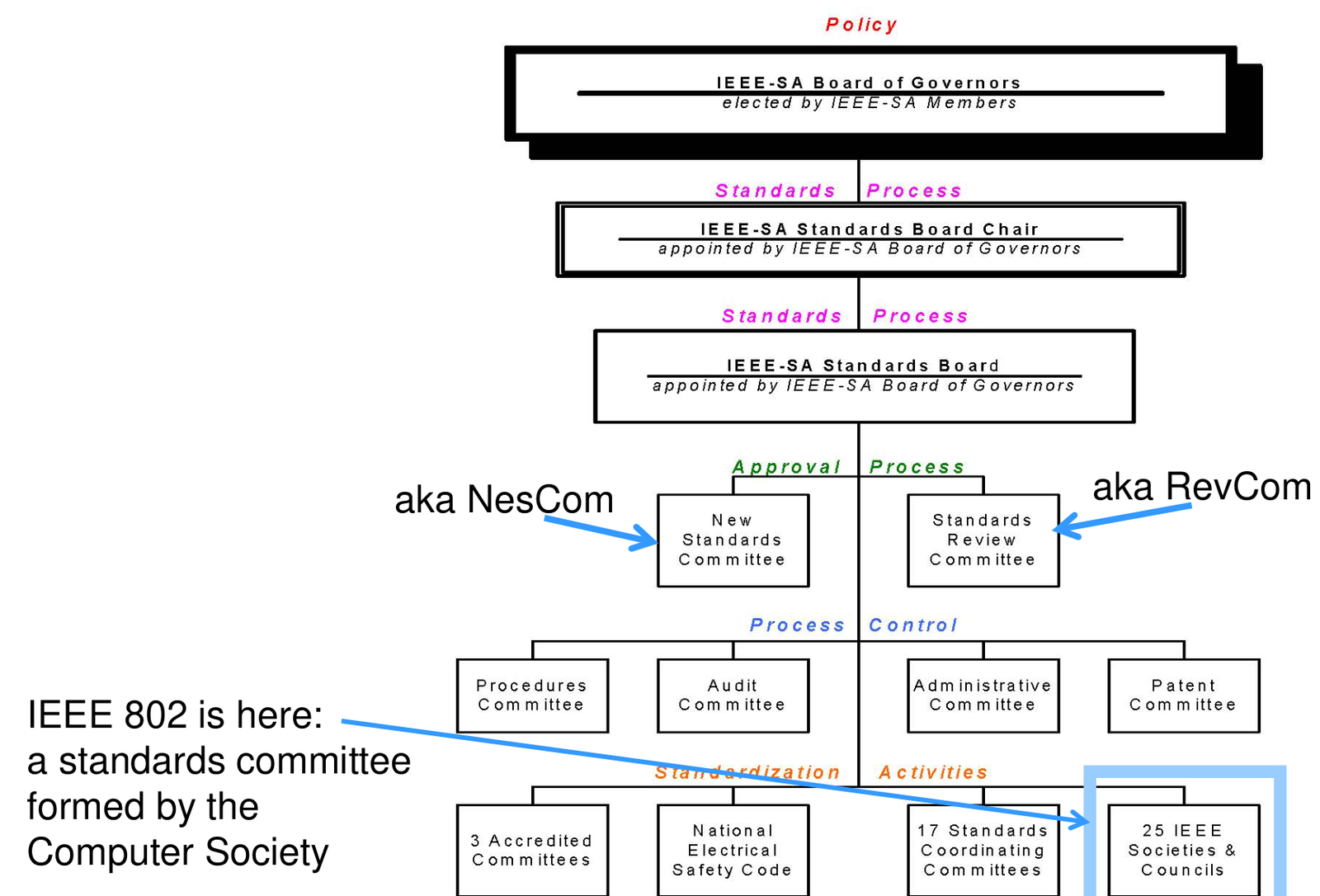
IEEE 802, the LAN/MAN Standards Committee, is one of the standards committees of the IEEE Computer Society. Its working groups each own an area: 802.1 bridging and architecture, 802.3 Ethernet, 802.11 wireless LANs [1]. Inside a working group, task groups focus on one subject, as the TSN task group does for time-sensitive networking [1]. The terms used along the way [1]:
| Term | Meaning |
|---|---|
| PAR, Project Authorization Request | The document that authorises work on a project |
| CSD, Criteria for Standards Development | The basis for deciding whether to forward a PAR |
| WG, Working Group | Responsible for developing the standards of one area |
| TG, Task Group (or task force) | Part of a working group, focused on one subject |
| TAG, Technical Advisory Group | Experts on a topic that crosses working groups; may write a recommended practice |
3. From idea to published standard

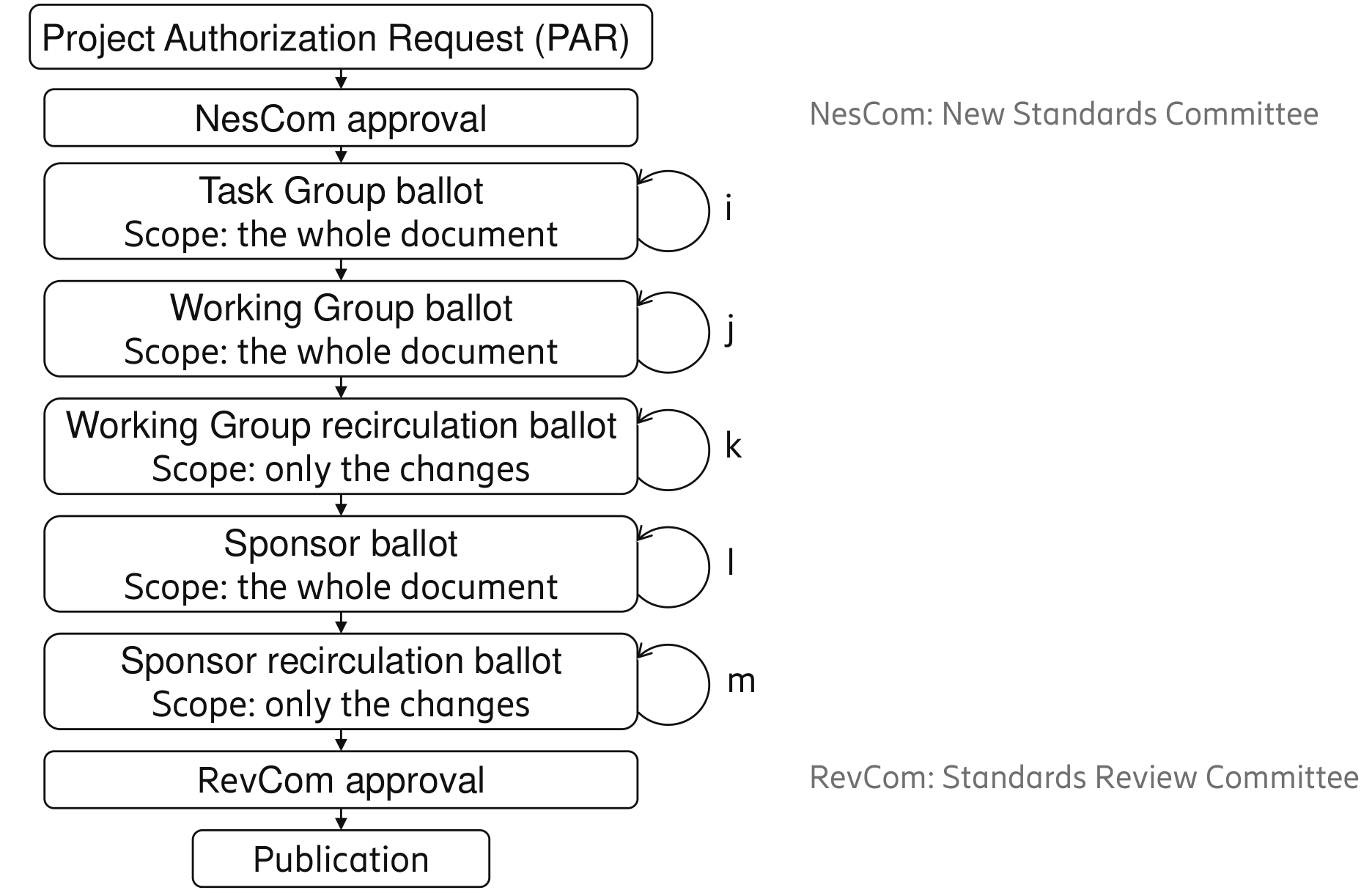
The stages, in the words of an 802.1 editor [2]:
- Ideas and presentations. Anyone may bring a problem within the scope of 802.1; the proposers must show there is a need and a market.
- PAR. Enough 802.1 voters must support it, and the IEEE approves it (through NesCom).
- Task group ballots. Requirements are collected and solutions worked out. Anyone can comment and vote.
- Working group ballots. The solutions are validated. Anyone can comment and every comment is answered, but only 802.1 voters' votes count.
- Standards Association (sponsor) ballots. The last step, checking that all IEEE procedures were followed. Anyone can join the ballot pool.
- Approval and publication, after RevCom has reviewed the process.
At each level a first ballot covers the whole document, and recirculations cover only the changes [3]. Technical decisions need agreement of at least 75 %. The process rests on due process, consensus, openness, balance between interested parties, and a right of appeal [3].
4. How amendments merge into editions
The IEEE 802.1 introduction to newcomers puts it in one sentence: periodically the amendments get merged into a revision of the main standard [1]. 802.1Q shows how this plays out over 25 years.
Reading the figure:
- Each TSN mechanism entered 802.1Q twice. First as an amendment (802.1Qbv-2015, 802.1Qbu-2016, 802.1Qci-2017), then as clauses of the next edition, 802.1Q-2018. A paper citing "802.1Q-2018" for scheduled traffic and one citing "802.1Qbv-2015" mean the same text.
- A whole standard can be absorbed. 802.1Q-2014 superseded not only 802.1Q-2011 but also 802.1D-2004, the separate standard for MAC bridges, whose content it took over [4].
- The cycle never stops. 802.1Q-2022 is the active edition. It already has six amendments (2023 to 2025) and three amendment projects, and a revision PAR approved on 5 June 2023 will supersede it [4].
Other base standards follow the same pattern. 802.1AS went from 802.1AS-2011 to 802.1AS-2020, a revision in which the whole document was open, and has since had amendments such as 802.1ASdm (hot standby) and a further revision [2][5]. 802.1CB-2017 was amended by 802.1CBdb-2021 and is being revised [5].
Because 802.1Q gathers so many former amendments, it can be considered many individual standards integrated into a single document. The introduction suggests a reading order [1]:
- clauses 6 to 9 for the general bridge architecture;
- the clause titled "Principles of …" for an unfamiliar area;
- clause 5, Conformance, to find the requirements of a given device.
5. Status and maintenance
Every approved IEEE standard has a 10-year life cycle [6]:
| Status | Meaning |
|---|---|
| Active | Being maintained |
| Superseded | Replaced by a revised edition, or by a compilation of the standard with all its amendments, corrigenda and errata |
| Inactive-reserved | Removed from active status because no revision was completed within 10 years |
| Inactive-withdrawn | Removed from active status by a ballot of the balloting group |
An active standard must go through a revision at least every 10 years to stay active [6]. Amendments and corrigenda change its content but do not reset that clock: only a revision does [6]. This is one reason why base standards such as 802.1Q are revised regularly even when no single amendment requires it.
6. How standards are grouped
The word "group" means several things in IEEE 802.1:
- By working group. The number after "802." names the working group that owns a standard: 802.1 for bridging and architecture, 802.3 for Ethernet [1]. Frame preemption, for example, needed one standard from each: 802.3br and 802.1Qbu.
- By base standard. A base standard, its amendments and its corrigenda form one family until the next revision merges them. The letters after the base name show the family: 802.1Qcc belongs to 802.1Q, 802.1CBdb to 802.1CB.
- By role in TSN. The TSN task group sorts its documents into three tiers.
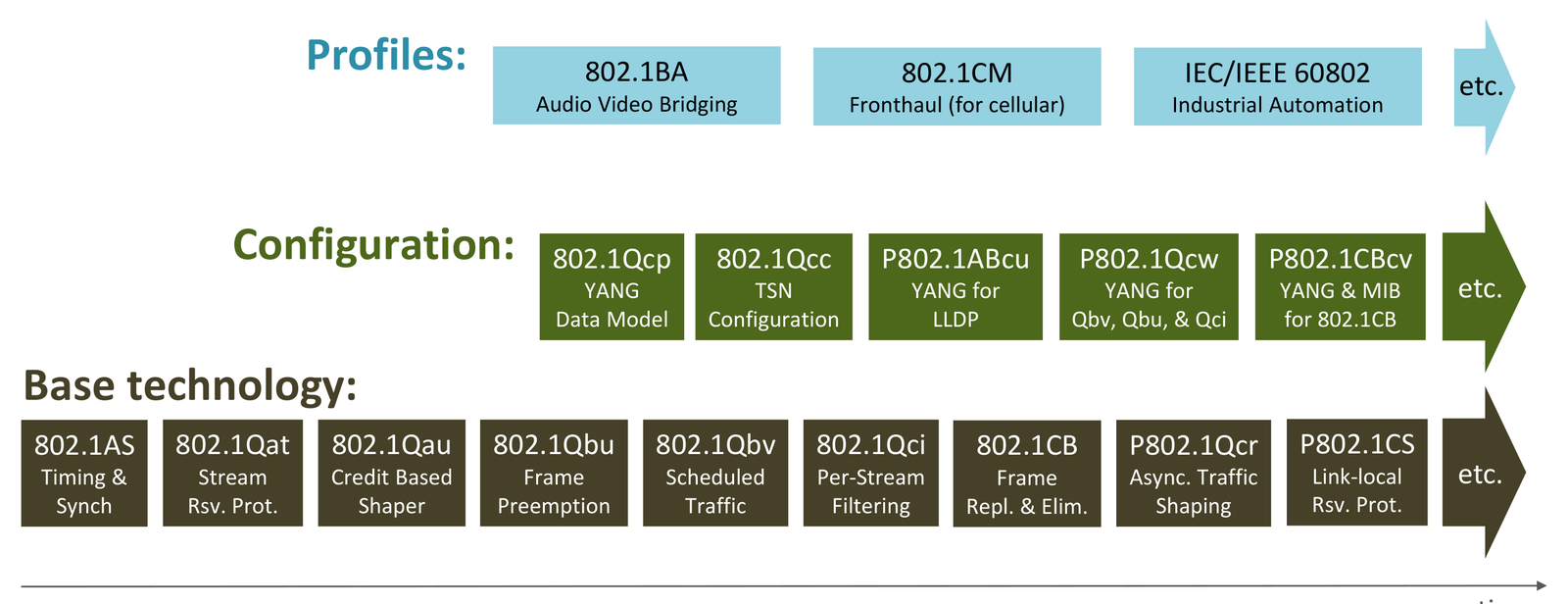
- Base technology: the tools themselves, for example 802.1AS, 802.1Qbv and 802.1CB.
- Configuration: how the tools are set up, for example 802.1Qcc and the YANG models 802.1Qcp and 802.1Qcw.
- Profiles: documents that select and constrain the tools for one application, for example 802.1BA, 802.1CM and IEC/IEEE 60802.
A profile may make an optional feature mandatory but may not create new features or protocols. A gap found while writing a profile becomes an amendment to a base standard [2]. In the other direction, mechanisms that change how a bridge forwards frames are written as amendments to 802.1Q, while functions also used outside the bridge, such as time synchronisation (802.1AS) or frame replication (802.1CB), are separate base standards.
Some standards are written jointly with another body and carry both logos. IEC/IEEE 60802 is a joint IEC SC65C/WG18 and IEEE 802 project that produces one dual-logo standard [7].
7. How to cite a standard
- Cite with a year for a specific text: "IEEE Std 802.1Q-2022". A designation without a year means the latest edition [1].
- Cite the amendment for history, the edition for the text: "introduced by 802.1Qbv-2015, now specified in 802.1Q-2022".
- Check the status first. An IEEE SA page states whether a standard is active, superseded or inactive, and lists its amendments and the edition that superseded it, as used for Figure 5.
- Free access. IEEE 802 standards become free to download through the IEEE GET Program some months after publication.
References
- J. Farkas, "Introduction to IEEE 802.1: Focus on the Time-Sensitive Networking Task Group," 15 May 2017, slides 10–16. Slides
- D. Pannell, "Status & Content of the IEEE TSN Auto Profile," IEEE Ethernet & IP @ Automotive Technology Day, September 2020, slides 4–6 and 9. Slides
- J. Farkas, "IEEE 802.1 TSN TG Overview," DetNet–TSN workshop, 11 November 2018, slides 3, 5, 7 and 9. Slides
- IEEE SA, pages of IEEE 802.1Q-1998, -2005, -2011, -2014, -2018, -2022 and of the P802.1Q revision project. 802.1Q-2014, 802.1Q-2022, P802.1Q
- IEEE 802.1, Time-Sensitive Networking (TSN) Task Group, list of standards and projects. Web page
- IEEE SA, "Maintenance of IEEE Standards FAQs." Web page
- IEEE 802.1, IEC/IEEE 60802 TSN Profile for Industrial Automation, project page. Web page