IEEE 802.1Qca PCR: path control with explicit trees in IS-IS
SPB computes shortest paths. Deterministic networks often need other paths: two disjoint routes for FRER, or a route that avoids a link already carrying critical streams. IEEE 802.1Qca, Path Control and Reservation (PCR), lets a controller impose such paths, while IS-IS keeps doing everything else.
Abbreviations used in this post (18)
| Abbreviation | Stands for | Meaning |
|---|---|---|
| CNC | Centralized Network Configuration | The 802.1Qcc entity that computes paths, schedules and reservations for the whole network and configures the bridges. |
| ECT | Equal Cost Tree | In SPB and PCR, an algorithm that chooses one tree among several of equal cost; each one is used through its own VID. |
| ET | Explicit Tree | In 802.1Qca, a loop-free tree imposed by a PCE instead of the shortest path tree. |
| FRER | Frame Replication and Elimination for Reliability | IEEE 802.1CB: frames are numbered, sent over disjoint paths, and duplicates are removed. |
| IEEE | Institute of Electrical and Electronics Engineers | The professional association whose Standards Association publishes the IEEE 802 LAN/MAN standards. |
| IETF | Internet Engineering Task Force | The body that develops Internet standards, published as RFCs. |
| IS-IS | Intermediate System to Intermediate System | A link-state routing protocol (ISO/IEC 10589, RFC 1195); the control plane of SPB and PCR. |
| MAC | Medium Access Control | The lower sublayer of the data link layer, which frames data and controls access to the medium. A MAC address identifies a network interface. |
| MSRP | Multiple Stream Registration Protocol | The MRP application at the core of SRP that registers streams and reserves bridge resources. |
| PCA | Path Control Agent | In 802.1Qca, the IS-IS participant that acts on behalf of a PCE outside the IS-IS domain. |
| PCE | Path Computation Element | An entity that computes paths or trees from the network topology and constraints (RFC 4655). |
| PCR | Path Control and Reservation | IEEE 802.1Qca: IS-IS extensions with which a controller installs explicit, non-shortest trees (RFC 7813). In ATM, PCR instead means Peak Cell Rate. |
| RFC | Request for Comments | The document series in which IETF standards and related documents are published. |
| SDN | Software-Defined Networking | An architecture that separates the control plane, run by a logically centralised controller, from the data plane of the network elements (RFC 7426). |
| SPB | Shortest Path Bridging | IEEE 802.1aq: bridges compute shortest path trees with IS-IS, so all links can be used. |
| SRP | Stream Reservation Protocol | IEEE 802.1Qat: distributed admission control in which talkers advertise streams and listeners subscribe, reserving resources hop by hop. |
| TSN | Time-Sensitive Networking | The set of IEEE 802.1 standards that give Ethernet bounded latency, time synchronisation and high reliability. |
| VLAN | Virtual LAN | A logical LAN within a bridged network, identified by a 12-bit VLAN ID in the 802.1Q tag. |
1. Definition
IEEE 802.1Qca, Path Control and Reservation, specifies explicit path control via IS-IS in Layer 2 networks, to go beyond the shortest paths of SPB. It provides the means to establish and control explicit forwarding trees in a Layer 2 domain [1]. The IETF documents the corresponding IS-IS sub-TLVs in RFC 7813 [1].
PCR relies on the SPB architecture and terminology and reuses several SPB sub-TLVs. A bridge does not have to implement full IS-IS SPB to support PCR; it can run both in the same IS-IS instance [1]. PCR covers point-to-point links only [1].
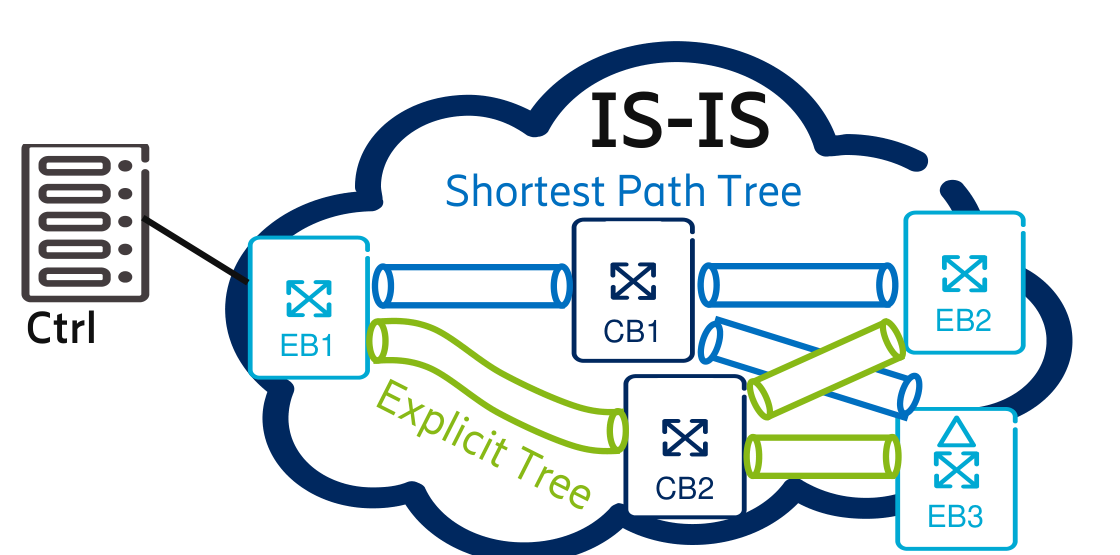
The task group describes it as a hybrid SDN approach: IS-IS provides the basic functions (topology discovery and default paths), and one or more controllers control the explicit trees. No protocol changes are needed, only a few new sub-TLVs and the reuse of existing ones [2][3].
2. Explicit trees and the PCE
An explicit tree (ET) is an undirected, loop-free topology. Its use is controlled by the path computation element (PCE) that owns it, which associates VLAN IDs and MAC addresses with the tree [1]:
- Ownership. One or more PCEs can compute trees for a domain, but each tree has exactly one owner PCE.
- Joining IS-IS. The PCE takes part in IS-IS itself, or through a path control agent (PCA) that does. Either way it receives the whole link-state database.
- Installing a tree. The PCE injects the tree description into IS-IS, which floods it like any other link-state information. The bridges store it in their explicit tree database and install the matching filtering entries.
How the PCE computes trees is deliberately left unspecified [1].
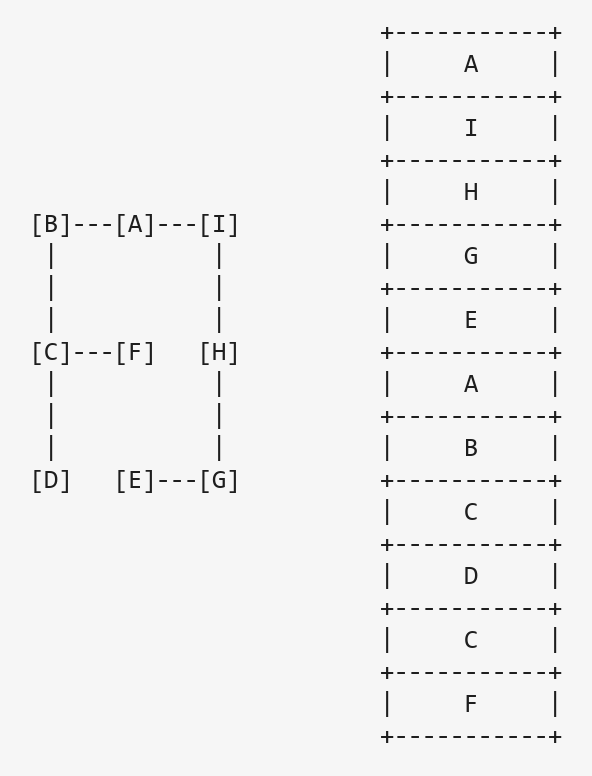
A tree is either strict, listing every bridge and link, or loose, listing only bridges with a special role (edge bridge, root, leaf, a bridge to avoid). Each bridge computes the loose segments itself: by default the shortest path, or a constrained shortest path when the tree carries constraints such as an administrative group of links [1].
3. Five control modes
A VLAN is put under explicit control by associating it with one of five explicit ECT algorithms [1]:
| Algorithm | Use |
|---|---|
| Strict Tree (ST) | A strict, static tree: only its owner PCE can change it, also after a topology change (required) |
| Loose Tree (LT) | A single loose tree, whose loose hops IS-IS restores after a topology change |
| Loose Tree Set (LTS) | A set of loose trees |
| MRT | Maximally redundant trees for fast reroute (RFC 7812) |
| MRT GADAG (MRTG) | The same, with part of the computation done centrally and distributed through IS-IS |
IS-IS can also record bandwidth assignments along an explicit tree. This must not be combined with a reservation protocol: in one domain, either MSRP (SRP) or IS-IS makes bandwidth assignments, never both [1].
4. Why TSN needs it
Path control fills a gap that the other topology protocols leave open:
- Disjoint paths for redundancy. FRER is only as reliable as its paths are disjoint. A strict tree pair, computed by a controller, guarantees that two member streams share no bridge or link.
- Paths chosen for latency. A controller can route a stream away from links whose delay bound is already tight. Shortest-path forwarding cannot.
- Paths that stay put. A strict tree does not move when the topology changes elsewhere, unless its owner moves it. For analysis, that is exactly the property needed: the path behind a bound changes only when the controller decides, and can recheck the bound first.
In 802.1Qcc terms, the CNC of the SDN post plays the role of the PCE, and path control is one of the ways it installs the paths it computes.
References
- J. Farkas (Ed.), N. Bragg, P. Unbehagen, G. Parsons, P. Ashwood-Smith, C. Bowers, RFC 7813, "IS-IS Path Control and Reservation," IETF, June 2016, Sections 1, 4 and 5. RFC Editor
- J. Farkas, "TSN Basic Concepts," DetNet–TSN workshop, 11 November 2018, slide 17. Slides
- J. Farkas, "Introduction to IEEE 802.1: Focus on the Time-Sensitive Networking Task Group," 15 May 2017, slide 37. Slides
- IEEE, IEEE 802.1Qca-2015, Path Control and Reservation. IEEE SA