IEEE 802.1Qat SRP: the Stream Reservation Protocol
The Stream Reservation Protocol (SRP) was AVB's answer to congestion loss: a stream is admitted only if every bridge on its path can carry it. This post covers the protocol itself. The stream reservation post places SRP among later reservation approaches and derives the latency bound that each bridge has to compute.
Abbreviations used in this post (12)
| Abbreviation | Stands for | Meaning |
|---|---|---|
| AVB | Audio Video Bridging | The predecessor of TSN: gPTP, the credit-based shaper and stream reservation, combined for audio and video (profile: IEEE 802.1BA). |
| gPTP | generalized Precision Time Protocol | The profile of PTP defined by IEEE 802.1AS, in which every bridge takes part in time distribution. |
| IEEE | Institute of Electrical and Electronics Engineers | The professional association whose Standards Association publishes the IEEE 802 LAN/MAN standards. |
| MAC | Medium Access Control | The lower sublayer of the data link layer, which frames data and controls access to the medium. A MAC address identifies a network interface. |
| MMRP | Multiple MAC Registration Protocol | The MRP application that registers multicast MAC addresses. |
| MRP | Multiple Registration Protocol | IEEE 802.1ak, now in 802.1Q: the framework for declaring and registering attributes such as VLANs, multicast addresses and streams. |
| MSRP | Multiple Stream Registration Protocol | The MRP application at the core of SRP that registers streams and reserves bridge resources. |
| MVRP | Multiple VLAN Registration Protocol | The MRP application that registers VLAN membership, so that VLAN traffic only goes where members are. |
| PCP | Priority Code Point | The 3-bit priority field of the 802.1Q tag (priorities 0 to 7). |
| SRP | Stream Reservation Protocol | IEEE 802.1Qat: distributed admission control in which talkers advertise streams and listeners subscribe, reserving resources hop by hop. |
| TSN | Time-Sensitive Networking | The set of IEEE 802.1 standards that give Ethernet bounded latency, time synchronisation and high reliability. |
| VLAN | Virtual LAN | A logical LAN within a bridged network, identified by a 12-bit VLAN ID in the 802.1Q tag. |
1. Definition
The Stream Reservation Protocol implements admission control for Ethernet. It was standardised as IEEE 802.1Qat in September 2010 and incorporated into IEEE 802.1Q-2011. Work started in 2006 [1][2]. SRP defines the concept of a stream at Layer 2. It provides end-to-end management of a stream's resources, so that its quality of service is guaranteed [1]. It is part of the AVB and TSN standards [1].
SRP is built from three MRP applications [1]:
- MSRP, the Multiple Stream Registration Protocol, registers and advertises streams and reserves bridge resources for them;
- MVRP makes the bridges on the path members of the stream's VLAN (see the MRP post);
- MMRP controls the propagation of group registrations.
2. Talkers, listeners and the reservation sequence
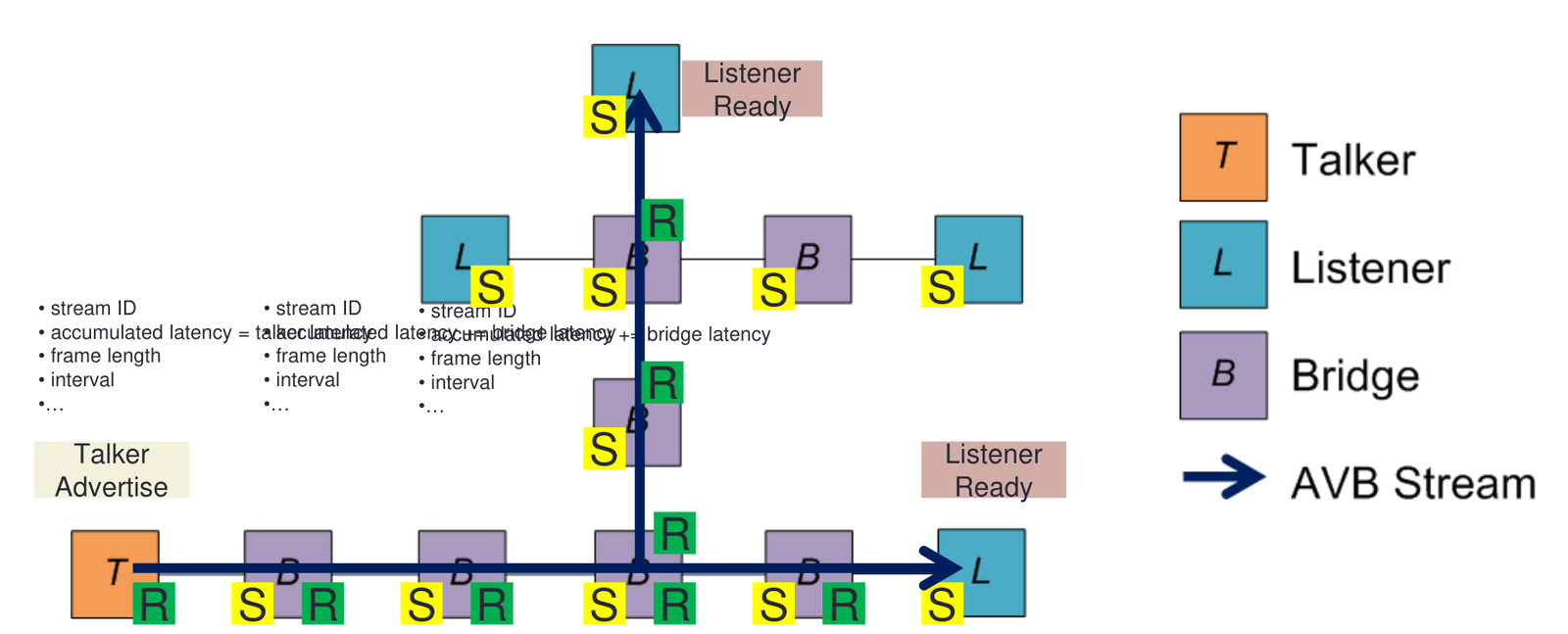
Two roles take part [1]:
- talkers announce the streams they can supply;
- listeners state which streams they want to receive.
SRP then works in five steps [1]:
- A talker advertises a stream.
- The bridges register the paths along the data flow.
- Each bridge calculates the worst-case latency.
- The bridges establish an AVB domain.
- The bridges reserve the bandwidth for the stream.
If a bridge can reserve the required resources, it propagates the advertisement further. Otherwise a talker failed message is raised, carrying the identity of the bridge and a failure code. When the advertise reaches a listener, the listener answers with listener ready, which propagates back to the talker [1].
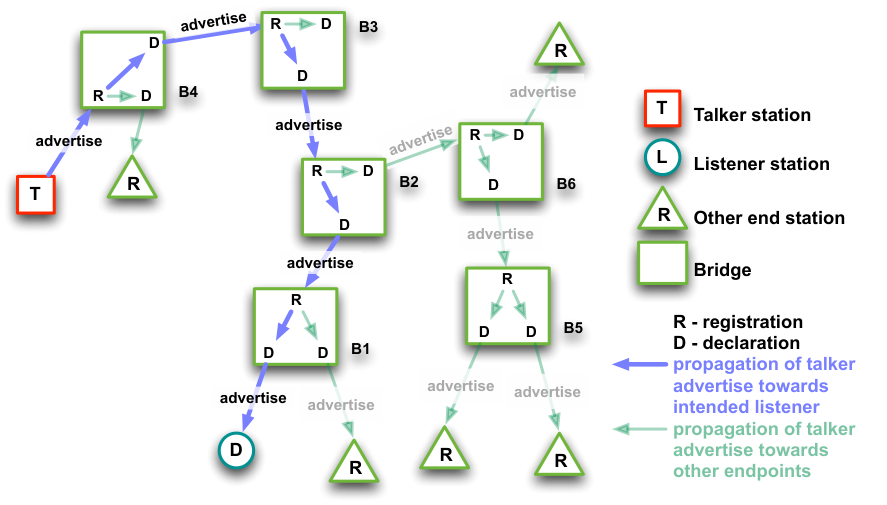
Either message can be deregistered, which ends the stream. Periodic re-declarations detect devices that stop responding [1].
3. What a talker advertise carries
| Field | Changes along the path? |
|---|---|
| Stream ID: the talker's 48-bit MAC address plus a 16-bit unique ID | No |
| Stream destination address (or a multicast group MAC address) | No |
| VLAN ID (used by MVRP) and priority (PCP) | No |
| Rank (emergency or not) | No |
| Traffic specification: maximum frame size, maximum frames per measurement interval | No |
| Accumulated latency | Increased at every bridge |
| Failure information: bridge ID and failure code | Set where the reservation fails |
The required bandwidth is the maximum frame size multiplied by the maximum number of frames per interval [1]. For the credit-based shaper, SR class A has a 2 ms worst-case latency target and a 125 µs measurement interval, and class B 50 ms and 250 µs, over at most 7 hops [1]. Each bridge adds its residence delay and the peer delay measured by gPTP to the accumulated latency. Higher layers can use the result for media synchronisation [1].
4. AVB domains
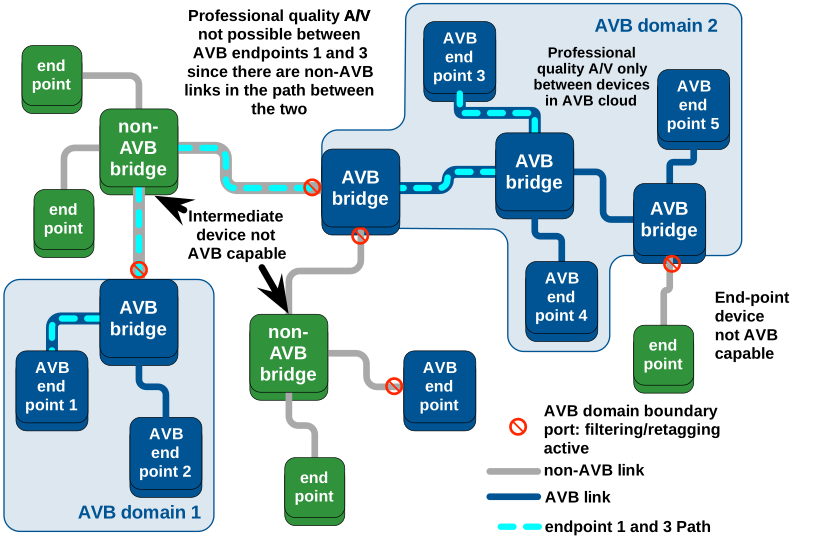
Reservations are made only inside an SRP domain, in which every bridge supports SRP and the stream's SR class; the domain is part of the reservation sequence above [1].

5. From SRP to newer reservation
SRP set the pattern of distributed admission control that later standards keep. Its limitations shaped them [3][4]:
- Configuration without the protocol. 802.1Qcc enhances SRP and also allows reservations configured at boot time, without running the protocol.
- Proofs for the latency fields. The example latency formulas behind the accumulated latency lacked formal proof and were later shown to be inaccurate.
- Token buckets instead of frame counts. The Resource Allocation Protocol (P802.1DD) replaces the frames-per-interval traffic specification with a token bucket, which suits network calculus better.
The stream reservation post develops these points and the per-bridge latency bound.
References
- Wikipedia, "Stream Reservation Protocol." Article
- IEEE, IEEE 802.1Qat-2010, Stream Reservation Protocol. IEEE SA
- D. Pannell, "An Introduction to AVB (Audio Video Bridging), the 1st TSN Profile," IEEE SA TSN webinar series, June 2022, slides 18 and 28. Slides
- A. Grigorjew, S. Geissler, J. Schmitt, T. Hossfeld, "Decentralized Latency Models and Information Flow for TSN Shapers – A Tutorial," arXiv:2610.11999, 2026, Section V. arXiv
- P. Thaler, N. Finn, D. Fedyk, J. Farkas, G. Parsons, E. Gray, "IEEE 802.1Q: Media Access Control Bridges and Virtual Bridged Local Area Networks," IEEE 802.1 tutorial, IETF 86, 10 March 2013, slide 53. Slides