IEEE 802.1Q: the bridge, its architecture, data-plane actions and forwarding process
Every TSN mechanism in this series is described as an addition to "the bridge". This post opens that box. It uses the figures with which the IEEE 802.1 working group itself explains the bridge: in its 2013 tutorial to the IETF, and in its 2017 and 2018 introductions to TSN.
Abbreviations used in this post (26)
| Abbreviation | Stands for | Meaning |
|---|---|---|
| ATS | Asynchronous Traffic Shaping | IEEE 802.1Qcr: per-stream token-bucket shaping at every hop using local clocks only. |
| CBS | Credit-Based Shaper | The IEEE 802.1Qav shaper that limits a traffic class to its reserved rate (idleSlope) with a per-queue credit. In MEF bandwidth profiles, CBS instead means Committed Burst Size. |
| CNC | Centralized Network Configuration | The 802.1Qcc entity that computes paths, schedules and reservations for the whole network and configures the bridges. |
| CQF | Cyclic Queuing and Forwarding | IEEE 802.1Qch: two queues per class alternate every cycle, so a frame advances one hop per cycle. |
| FRER | Frame Replication and Elimination for Reliability | IEEE 802.1CB: frames are numbered, sent over disjoint paths, and duplicates are removed. |
| IEEE | Institute of Electrical and Electronics Engineers | The professional association whose Standards Association publishes the IEEE 802 LAN/MAN standards. |
| IETF | Internet Engineering Task Force | The body that develops Internet standards, published as RFCs. |
| IS-IS | Intermediate System to Intermediate System | A link-state routing protocol (ISO/IEC 10589, RFC 1195); the control plane of SPB and PCR. |
| LAN | Local Area Network | A network covering a limited area, such as a building or a vehicle; IEEE 802 standardises LANs. |
| MAC | Medium Access Control | The lower sublayer of the data link layer, which frames data and controls access to the medium. A MAC address identifies a network interface. |
| MMRP | Multiple MAC Registration Protocol | The MRP application that registers multicast MAC addresses. |
| MRP | Multiple Registration Protocol | IEEE 802.1ak, now in 802.1Q: the framework for declaring and registering attributes such as VLANs, multicast addresses and streams. |
| MSTP | Multiple Spanning Tree Protocol | IEEE 802.1s, now in 802.1Q: several spanning trees, each used by a group of VLANs. |
| MVRP | Multiple VLAN Registration Protocol | The MRP application that registers VLAN membership, so that VLAN traffic only goes where members are. |
| PCE | Path Computation Element | An entity that computes paths or trees from the network topology and constraints (RFC 4655). |
| PCR | Path Control and Reservation | IEEE 802.1Qca: IS-IS extensions with which a controller installs explicit, non-shortest trees (RFC 7813). In ATM, PCR instead means Peak Cell Rate. |
| PSFP | Per-Stream Filtering and Policing | IEEE 802.1Qci: stream filters, stream gates and flow meters that enforce each stream’s contract at ingress. |
| QoS | Quality of Service | The treatment a network gives to a flow or class, in terms of bandwidth, delay, jitter and loss. |
| RSTP | Rapid Spanning Tree Protocol | IEEE 802.1w, now in 802.1Q: a faster-converging spanning tree with alternate and backup port roles. |
| SDN | Software-Defined Networking | An architecture that separates the control plane, run by a logically centralised controller, from the data plane of the network elements (RFC 7426). |
| SPB | Shortest Path Bridging | IEEE 802.1aq: bridges compute shortest path trees with IS-IS, so all links can be used. |
| SRP | Stream Reservation Protocol | IEEE 802.1Qat: distributed admission control in which talkers advertise streams and listeners subscribe, reserving resources hop by hop. |
| TAS | Time-Aware Shaper | IEEE 802.1Qbv scheduled traffic: a gate per queue, opened and closed by a repeating gate control list. |
| TSN | Time-Sensitive Networking | The set of IEEE 802.1 standards that give Ethernet bounded latency, time synchronisation and high reliability. |
| VID | VLAN Identifier | The 12-bit field of the 802.1Q tag that names a frame’s VLAN. |
| VLAN | Virtual LAN | A logical LAN within a bridged network, identified by a 12-bit VLAN ID in the 802.1Q tag. |
1. Definition
A bridge relays Ethernet frames between two or more LANs at Layer 2. The bridges of TSN are specified in IEEE 802.1Q, Bridges and Bridged Networks, which also defines virtual LANs [1][4].
Four principles from the IEEE 802.1 tutorial frame everything else [1]:
- MAC addresses identify, they do not locate. A MAC address names a station, not where it is. The tutorial calls this a major Layer 2 value, not a defect.
- Forwarding uses the destination MAC address and the VLAN ID.
- Unknown destinations are flooded, known ones are filtered. A frame whose destination location is not known is sent to every port of its VLAN except the one it arrived on. Once the location is known, the other ports are filtered out.
- Quality of service comes after the forwarding decision. It is based on the frame's priority, its drop eligibility, and time.
The last principle is where TSN enters: almost every TSN tool acts after the bridge has decided where a frame goes, and decides when and whether it goes there.
2. Architecture: control plane and data plane
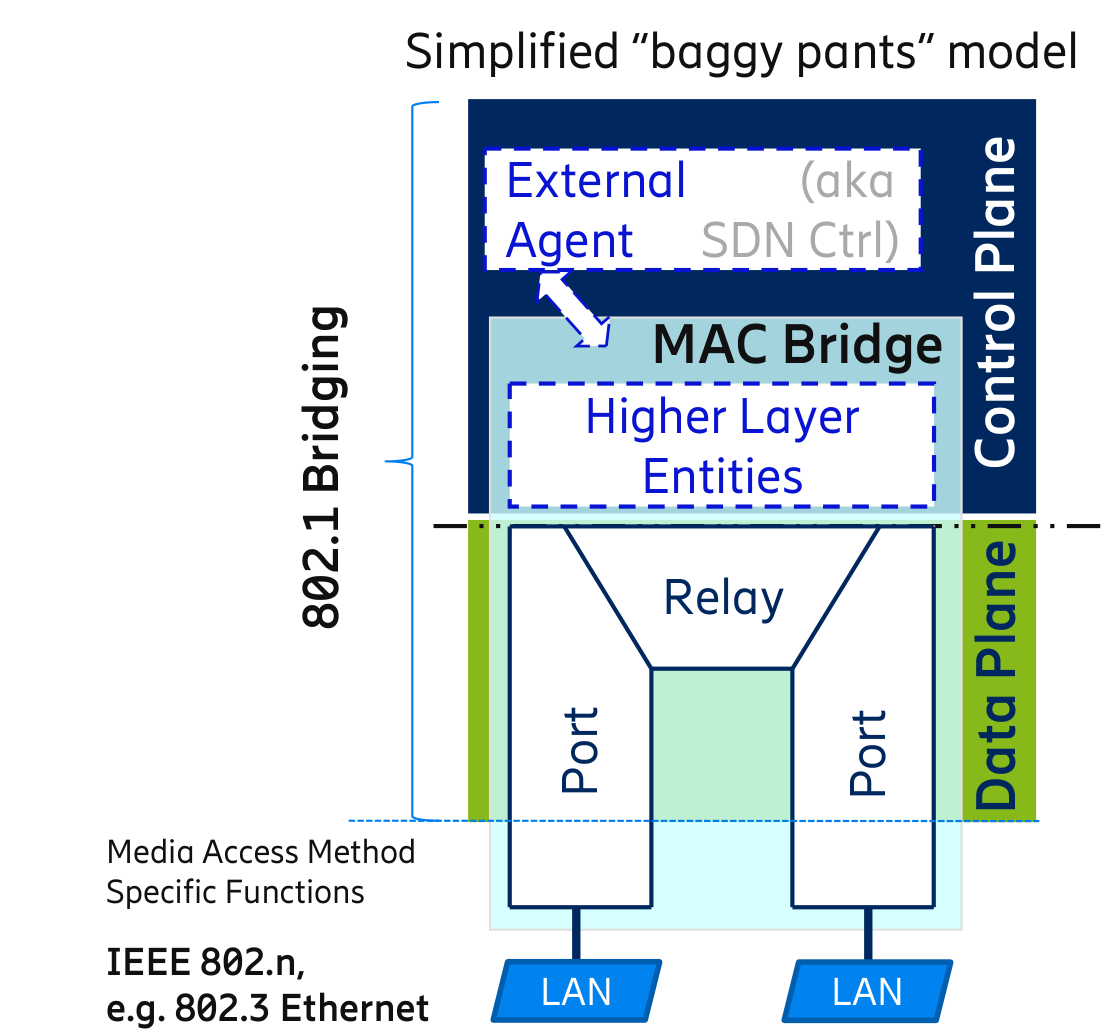
Figure 1 separates the two planes [2][3]:
- the control plane runs the control protocols as higher layer entities inside the bridge. Alternatively, an external agent, such as an SDN controller, provides the control instead of the distributed protocols;
- the data plane is made of a MAC relay and at least two ports.
The external agent is what the SDN post calls the CNC. The standard's own, more detailed picture is Figure 8-2, "VLAN-aware Bridge architecture", of 802.1Q [2].
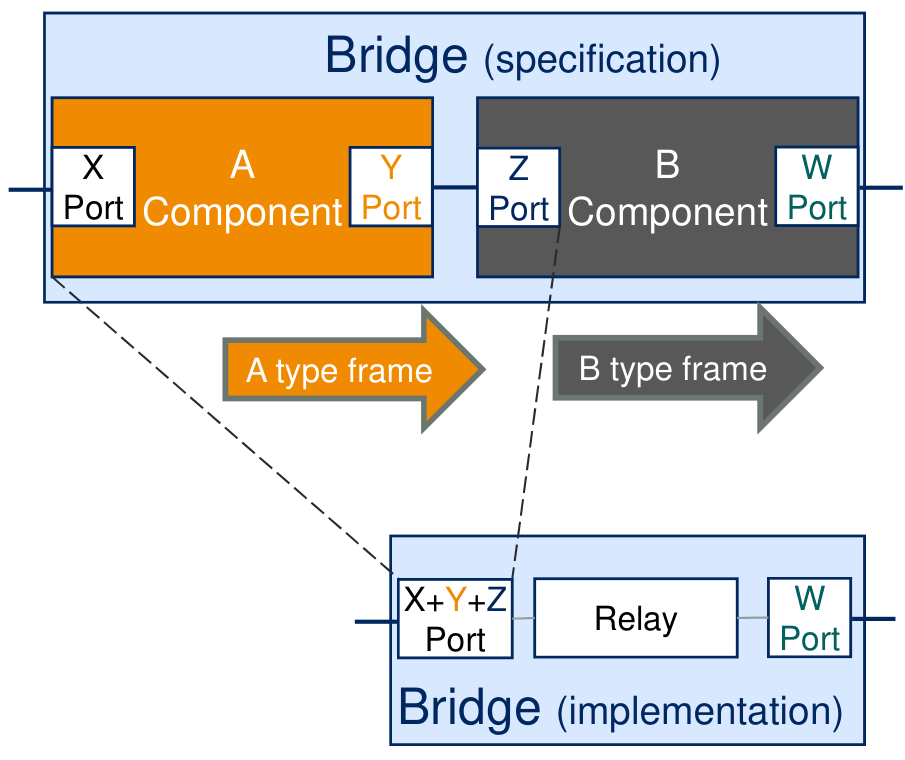
The standard describes a bridge as a set of components, one per type of Layer 2 virtual network, each with typed ports. This is a description language: it specifies the operation in distinct steps. It does not prescribe an implementation. Implementations often use a single MAC relay, and one physical port may implement several port functions. When the outermost EtherType of a frame does not match the component type, the reception port assigns the frame to a VLAN [1].
3. Data-plane actions
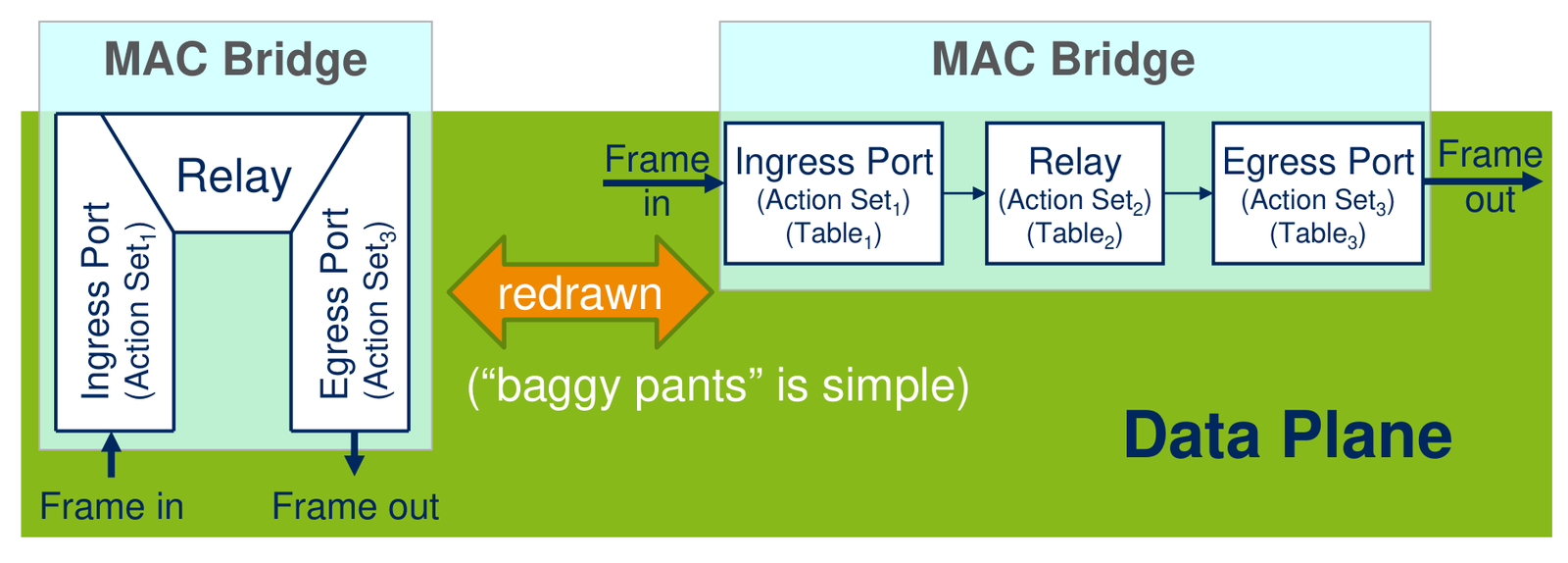
The baggy-pants drawing can be unfolded into a pipeline of three stages. Each applies an action set driven by a table [2][3]:
| Stage | Action set | Actions | TSN additions at this stage |
|---|---|---|---|
| Ingress port | Action set 1 | Filtering (drop), tagging and untagging, VID translation, de- and encapsulation | Stream identification, PSFP, the ingress side of FRER |
| Relay | Action set 2 | Forwarding, filtering | Explicit trees (802.1Qca), replication and elimination |
| Egress port | Action set 3 | Filtering, tagging and untagging, VID translation, de- and encapsulation, metering, queuing, transmission selection | CBS, ATS, TAS, CQF, preemption |
Most TSN tools therefore act on the egress port, where queuing and transmission selection happen.
4. The forwarding process
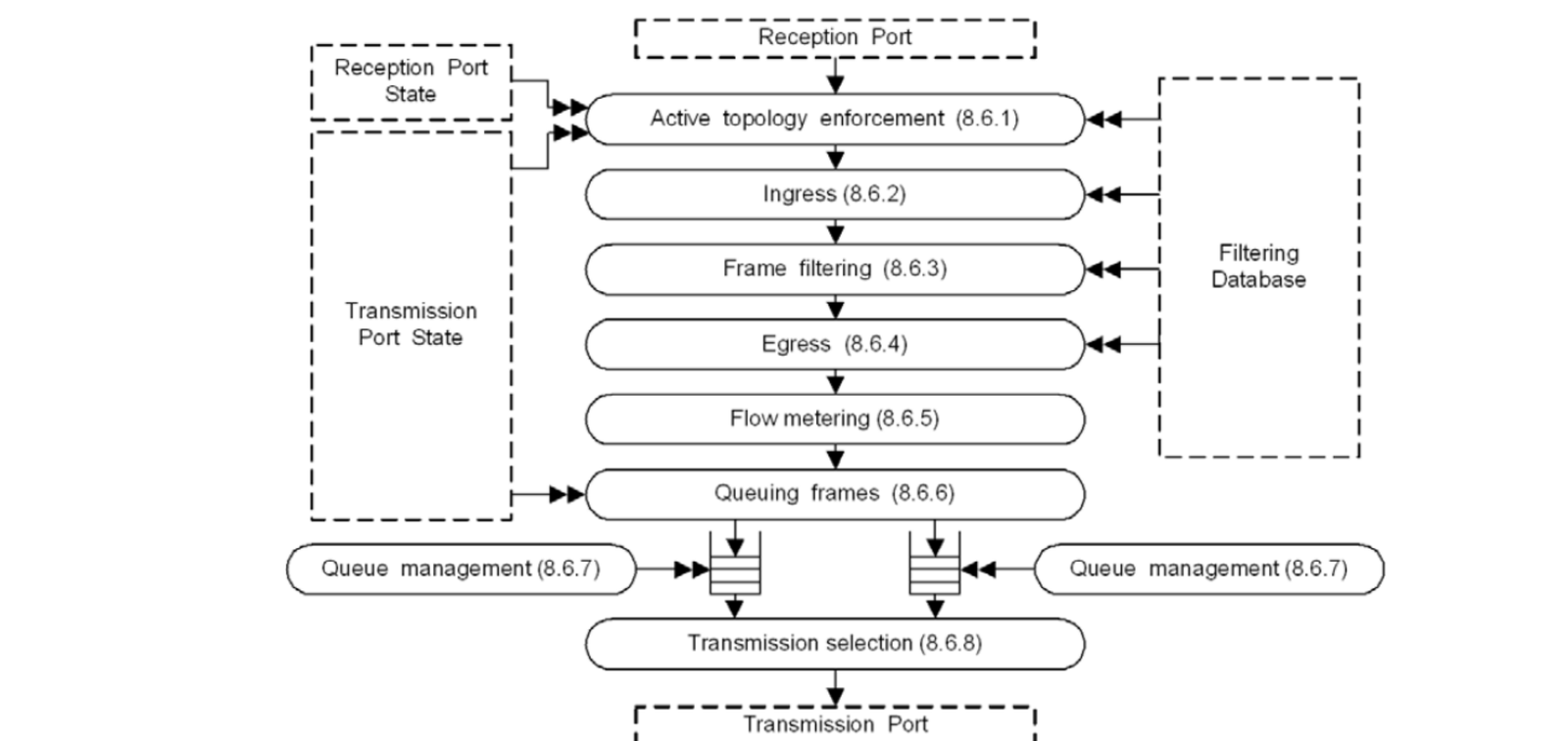
Inside the data plane, 802.1Q specifies the forwarding process as a fixed sequence of steps, each in its own sub-clause of clause 8.6 [2][3]:
| Step | Sub-clause | What it does |
|---|---|---|
| Active topology enforcement | 8.6.1 | Discards frames that would use a port not in the active topology for that frame, for example a port blocked by the spanning tree |
| Ingress | 8.6.2 | Assigns a VLAN to frames that arrive without one, and drops frames from ports that are not members of the frame's VLAN |
| Frame filtering | 8.6.3 | Looks up the destination MAC address and VLAN ID in the filtering database to choose the output ports |
| Egress | 8.6.4 | Applies the output port's VLAN membership and tagging rules |
| Flow metering | 8.6.5 | Meters frames against a bandwidth profile; per-stream filtering and policing extends this step |
| Queuing frames | 8.6.6 | Places each frame in the queue of its traffic class at the output port |
| Queue management | 8.6.7 | Removes frames from the queues, for example frames held too long |
| Transmission selection | 8.6.8 | Chooses the next frame to send, among the queues allowed to transmit |
Reading the TSN standards becomes much easier with this list in mind. Each amendment says which of these sub-clauses it changes. For example, scheduled traffic adds gates to transmission selection (8.6.8), and asynchronous traffic shaping adds a shaper in front of it.
5. Quality-of-service functions
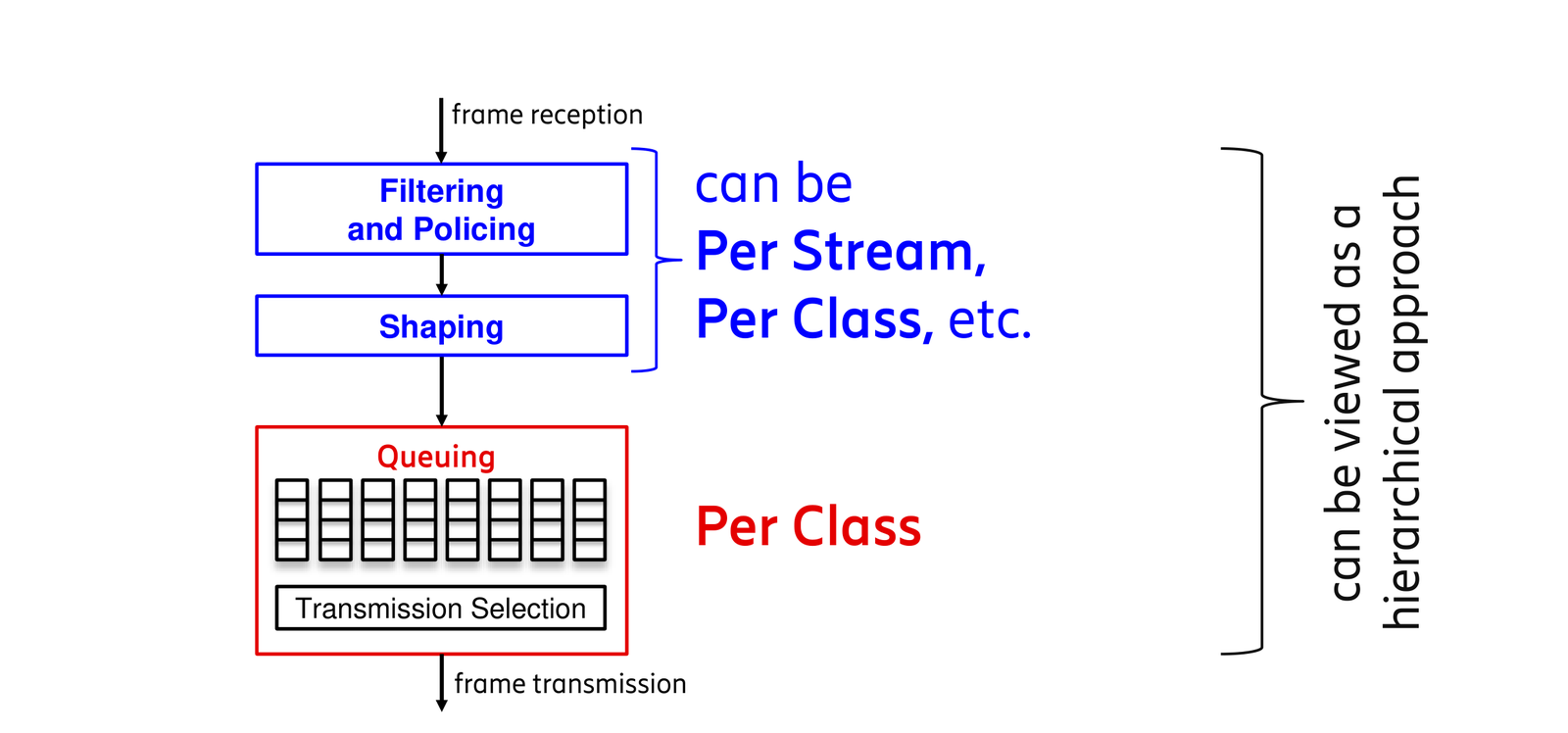
Figure 5 isolates the quality-of-service functions of a port [2]:
- Filtering and policing, which can be per stream or per class;
- Shaping, also per stream or per class;
- Queuing and transmission selection, which are per class.
The order matters for analysis. Policing makes a stream respect its arrival curve before it meets other traffic. Shaping changes the curve. Queuing and transmission selection then define the service curve that each class receives.
6. What the control plane controls
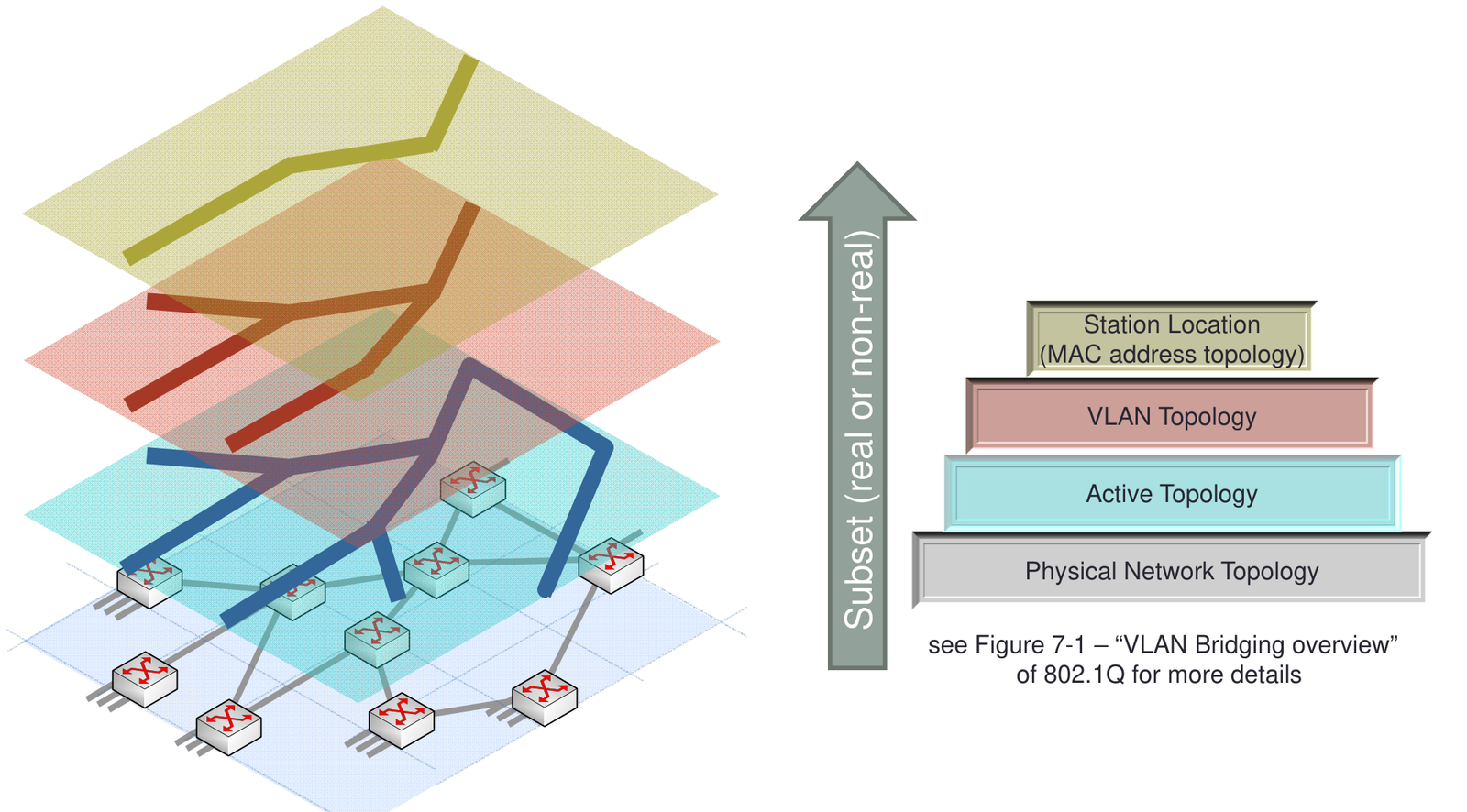
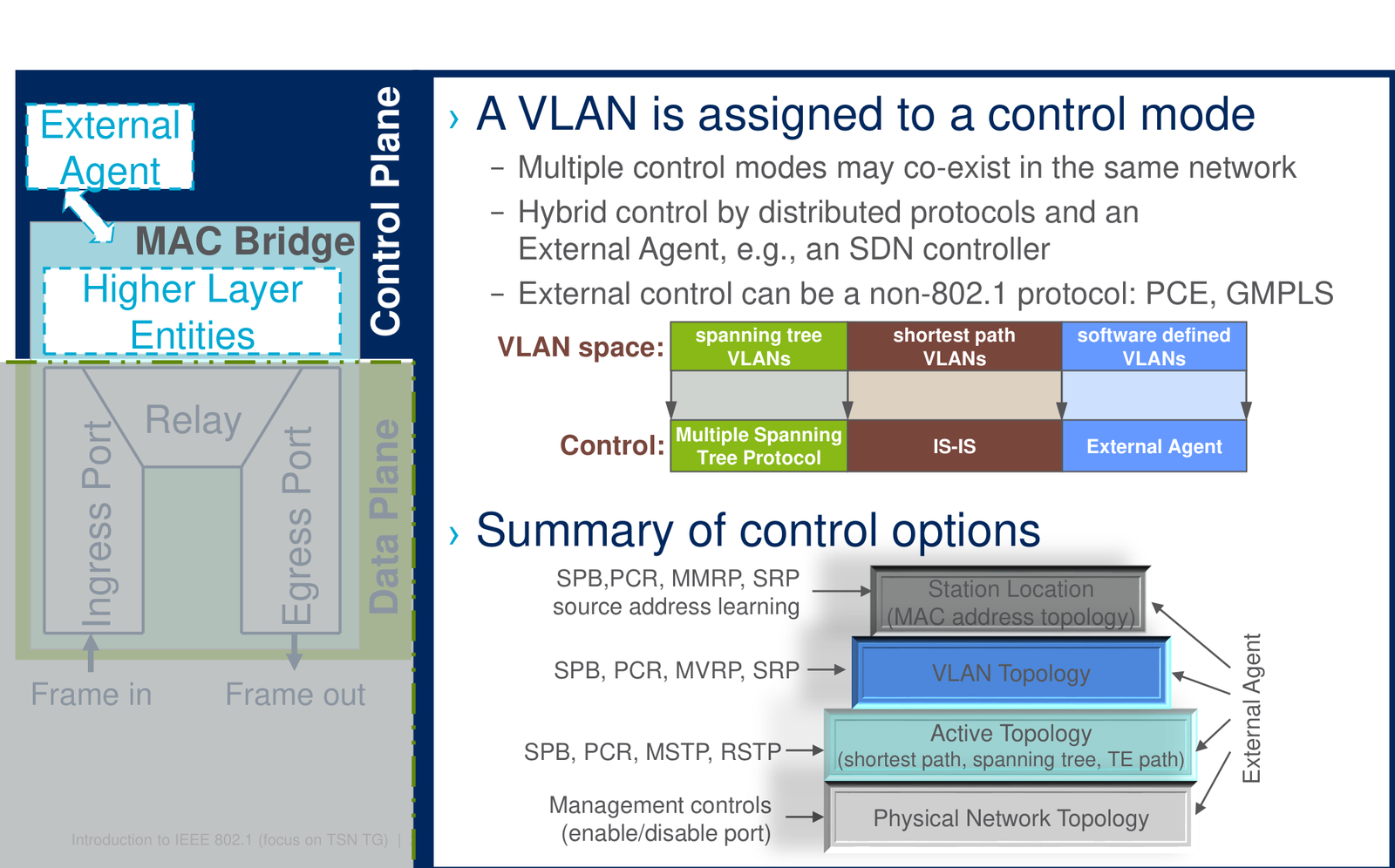
The control plane maintains four layered views of the network [1][3]:
| Layer | Content | Maintained by, for example |
|---|---|---|
| Physical network topology | All links and bridges | Management (enabling and disabling ports) |
| Active topology | The links actually used: a spanning tree, shortest paths, or traffic-engineered paths | RSTP, MSTP, SPB, path control (PCR) |
| VLAN topology | Which bridges and ports belong to each VLAN | MVRP, SPB, PCR, SRP |
| Station location | Where each MAC address is | Source address learning, MMRP, SPB, PCR, SRP |
Each of these protocols has its own post: RSTP, MSTP, SPB, path control, MRP and MVRP, and SRP.
Control modes are assigned per VLAN. Distributed protocols and an external agent can therefore coexist in the same network, each controlling its own VLANs. The external control can even be a non-802.1 protocol, such as PCE or GMPLS [3]. This hybrid model is what lets a TSN network keep spanning tree for ordinary traffic while a CNC installs explicit paths for streams.
7. Where TSN plugs in
The TSN toolbox post goes through the tools of Figure 8 one by one. Each has its own post in the TSN topic.
References
- P. Thaler, N. Finn, D. Fedyk, J. Farkas, G. Parsons, E. Gray, "IEEE 802.1Q: Media Access Control Bridges and Virtual Bridged Local Area Networks," IEEE 802.1 tutorial, IETF 86, 10 March 2013, slides 12, 14 and 25. Slides
- J. Farkas, "TSN Basic Concepts," DetNet–TSN workshop, 11 November 2018, slides 7–10. Slides
- J. Farkas, "Introduction to IEEE 802.1: Focus on the Time-Sensitive Networking Task Group," 15 May 2017, slides 28 and 47–49. Slides
- IEEE, IEEE 802.1Q-2022, Bridges and Bridged Networks. IEEE SA. IEEE 802 standards are available free of charge through the IEEE GET Program.