IEEE 802.1CM: the TSN profile for mobile fronthaul
In a mobile network, the link between a radio unit at the antenna and the equipment that controls it, the fronthaul, used to be a dedicated fibre with a dedicated protocol. IEEE 802.1CM shows how to carry it over ordinary bridged Ethernet, and which TSN features that takes.
Abbreviations used in this post (16)
| Abbreviation | Stands for | Meaning |
|---|---|---|
| CPRI | Common Public Radio Interface | The fronthaul interface of the CPRI industry cooperation (Ericsson, Huawei, NEC, Nokia), used for most 2G, 3G and 4G fronthaul. It sends time-domain IQ samples over a dedicated point-to-point link at a constant bit rate set by sample width, sample rate and number of antennas: line-rate option 7 (9.8304 Gbit/s) carries one 20 MHz LTE carrier on 4 antennas (4T4R), and a 100 MHz carrier on 8 antennas (8T8R) needs option 10 (24.33024 Gbit/s). Because the rate grows linearly with bandwidth and antennas, CPRI does not scale to 5G massive MIMO. |
| eCPRI | the packet-based CPRI interface (the specification uses “eCPRI” as a name; it is often read as “enhanced CPRI”) | The CPRI cooperation’s packet-based fronthaul interface, first published in 2017. The split is moved inside the physical layer, so the link carries frequency-domain IQ symbols or bits instead of time-domain samples, as messages over Ethernet or IP/UDP (IQ data, bit sequence, real-time control, remote memory access, one-way delay measurement and others). The data rate then follows the actual radio load rather than a fixed CPRI rate, and the fronthaul can be switched and shared. |
| eRE | eCPRI Radio Equipment | Radio equipment that speaks eCPRI; it holds the radio functions and the lower part of the physical layer. |
| eREC | eCPRI Radio Equipment Control | Radio equipment control that speaks eCPRI; it holds the upper part of the physical layer and the higher protocol layers. |
| IEEE | Institute of Electrical and Electronics Engineers | The professional association whose Standards Association publishes the IEEE 802 LAN/MAN standards. |
| IQ | In-phase and Quadrature | Each sample of a radio signal is a complex number: I is its in-phase (real) part and Q its quadrature (imaginary) part. CPRI carries IQ samples in the time domain; eCPRI usually carries frequency-domain IQ symbols, which can also be compressed to fewer bits per sample. |
| ITU-T | International Telecommunication Union, Telecommunication Standardization Sector | The UN body that writes telecommunication recommendations; its Study Group 15 defines the telecom profiles of PTP used for fronthaul. |
| MEF | Metro Ethernet Forum (now MEF Forum) | An industry forum that defines carrier Ethernet services and their bandwidth profiles, such as MEF 10.3. |
| PHY | Physical layer | Layer 1: the transmission of bits over a medium such as copper, fibre or radio. |
| PHY-L | lower part of the physical layer | The physical-layer functions that move to the eRE in the eCPRI split. |
| PHY-U | upper part of the physical layer | The physical-layer functions that stay at the eREC in the eCPRI split. |
| RE | Radio Equipment | The part of a radio base station at the antenna site, with the radio-frequency functions (CPRI terminology). |
| REC | Radio Equipment Control | The part of a radio base station that controls the radio equipment and runs the baseband and higher-layer processing (CPRI terminology). |
| TSN | Time-Sensitive Networking | The set of IEEE 802.1 standards that give Ethernet bounded latency, time synchronisation and high reliability. |
| UNI | User–Network Interface | The boundary between a user’s equipment and a network service. In 802.1Qcc, the interface through which users state stream requirements to the network. |
| VLAN | Virtual LAN | A logical LAN within a bridged network, identified by a 12-bit VLAN ID in the 802.1Q tag. |
1. Definition
IEEE 802.1CM, Time-Sensitive Networking for Fronthaul, defines profiles that select the features, options, configurations, defaults, protocols and procedures of bridges, stations and LANs needed to carry fronthaul streams [1]. Its main points [1]:
- Interfaces. It supports fronthaul interfaces such as the eCPRI specification.
- Partners. It was developed with the CPRI Cooperation, which contributed the requirements. The synchronisation solutions come from ITU-T Question 13 of Study Group 15.
- Dates. It was approved on 7 May 2018 and published on 8 June 2018. Amendment 802.1CMde-2020 adds support for new fronthaul interface, synchronisation and syntonisation standards.
- Recognition. It is the first IEEE standard to connect a cellular network's radio equipment to its remote controller through a packet network, in particular a bridged IEEE 802.3 Ethernet network. It earned the IEEE 802.1 working group the 2020 IEEE SA Emerging Technology Award.
It is available free of charge through the IEEE GET Program [1].
2. What fronthaul is
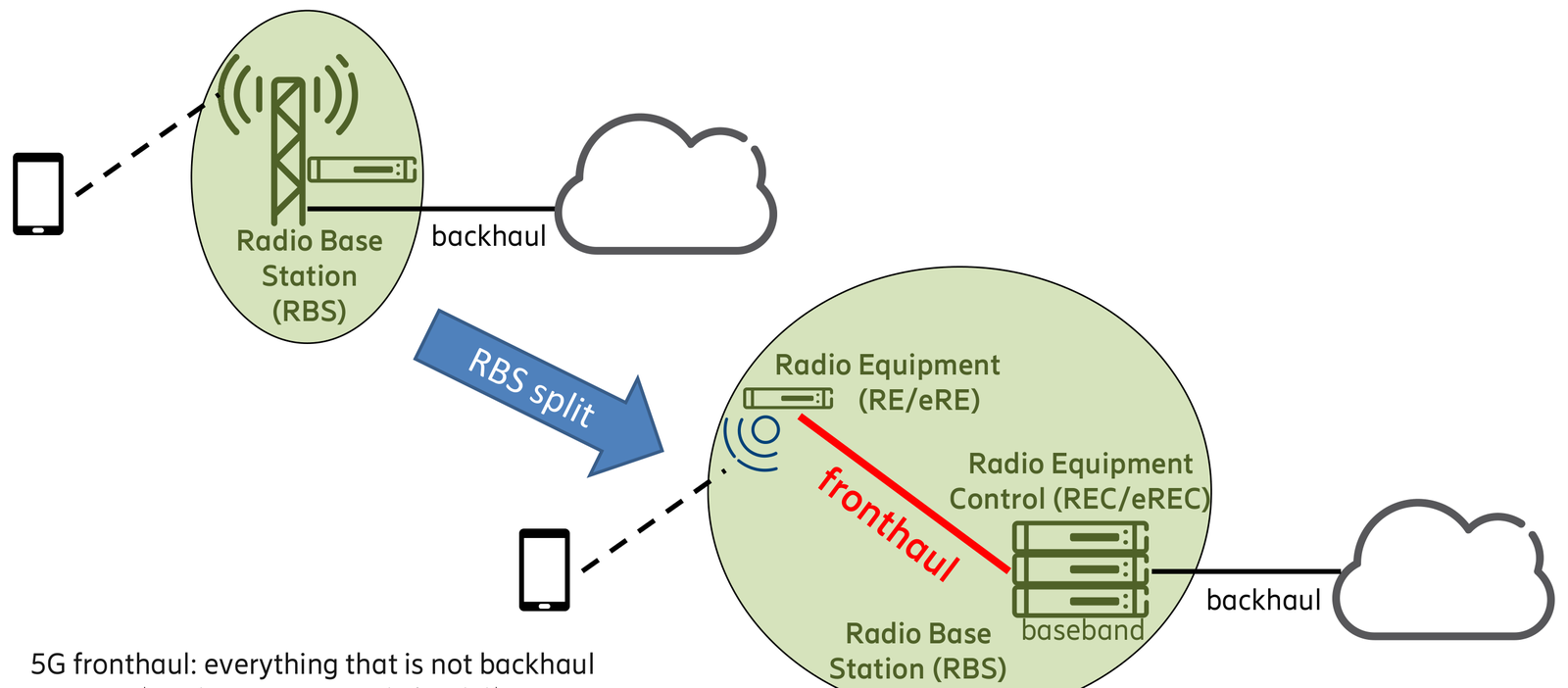
A radio base station is split into radio equipment (RE, or eRE for eCPRI) near the antenna and radio equipment control (REC or eREC) further away. Fronthaul is the link between the two. In the overview's words, 5G fronthaul is "everything that is not backhaul" [2].
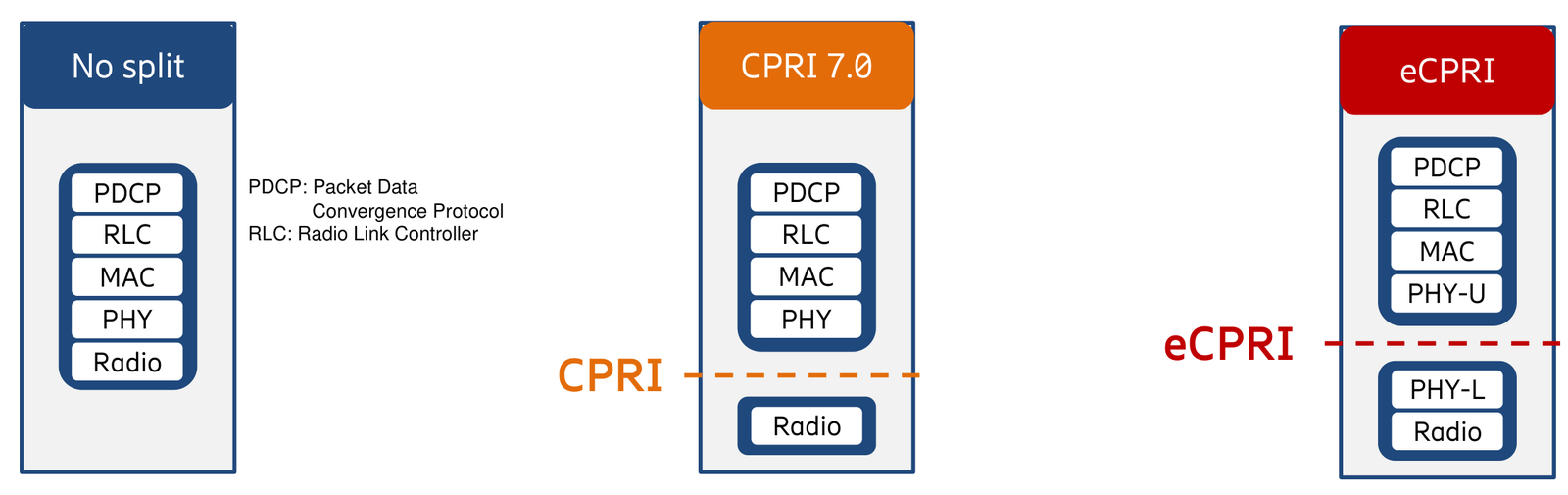
Where the split is made decides what crosses the fronthaul. In the CPRI split, everything above the radio stays at the controller, and the link carries radio samples. In the eCPRI split, part of the physical layer (PHY-L) moves to the radio side, which reduces the bandwidth needed. Both are in the scope of 802.1CM; further splits can be added by amendment [2].
CPRI and eCPRI in brief
CPRI (Common Public Radio Interface) is the interface that carried most 2G, 3G and 4G fronthaul. It sends IQ samples (the in-phase and quadrature parts of the sampled radio signal) in the time domain, over a dedicated point-to-point fibre, at a constant bit rate. That rate depends only on the sample width, the sample rate and the number of antennas, whether or not any user is active [4]:
| Example | CPRI line rate needed |
|---|---|
| One 20 MHz LTE carrier, 4 transmit and 4 receive antennas (4T4R) | Option 7: 9.8304 Gbit/s |
| One 100 MHz carrier, 8 transmit and 8 receive antennas (8T8R) | Option 10: 24.33024 Gbit/s |
Because the rate grows linearly with bandwidth and antenna count, CPRI does not scale to 5G massive MIMO: an industry estimate gives about 157 Gbit/s for 64 antennas on a 100 MHz carrier [4]. CPRI links are also point to point, so they cannot be switched like ordinary Ethernet [4].
eCPRI is the packet-based interface of the same cooperation. The specification uses the name without expanding the "e"; it is often read as "enhanced CPRI". It moves the split inside the physical layer, so that the eRE (eCPRI Radio Equipment) performs the lower physical-layer functions and the link carries frequency-domain IQ symbols or bits instead of time-domain samples. These travel as messages over Ethernet or IP/UDP. In the specification's words, this lowers the data rate between eREC (eCPRI Radio Equipment Control) and eRE while keeping the eRE simple [3]. With IQ compression, practical 5G fronthaul rates drop to a few tens of Gbit/s, which fit 25 or 50 Gbit/s Ethernet [4].
Being packet traffic, eCPRI can share a switched network with other traffic. That is exactly the situation 802.1CM addresses: it bounds the delay of fronthaul frames in such a network.
3. Ethernet-based fronthaul
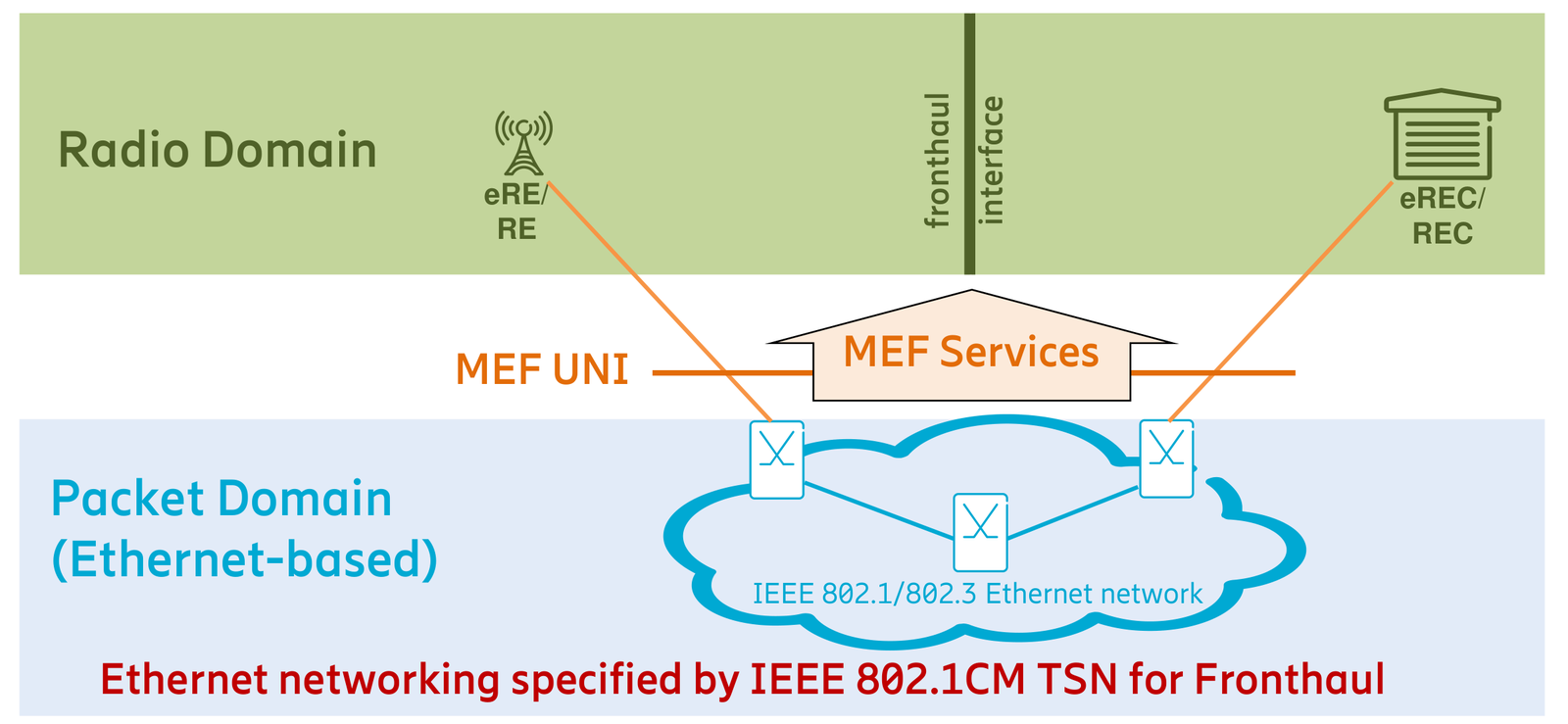
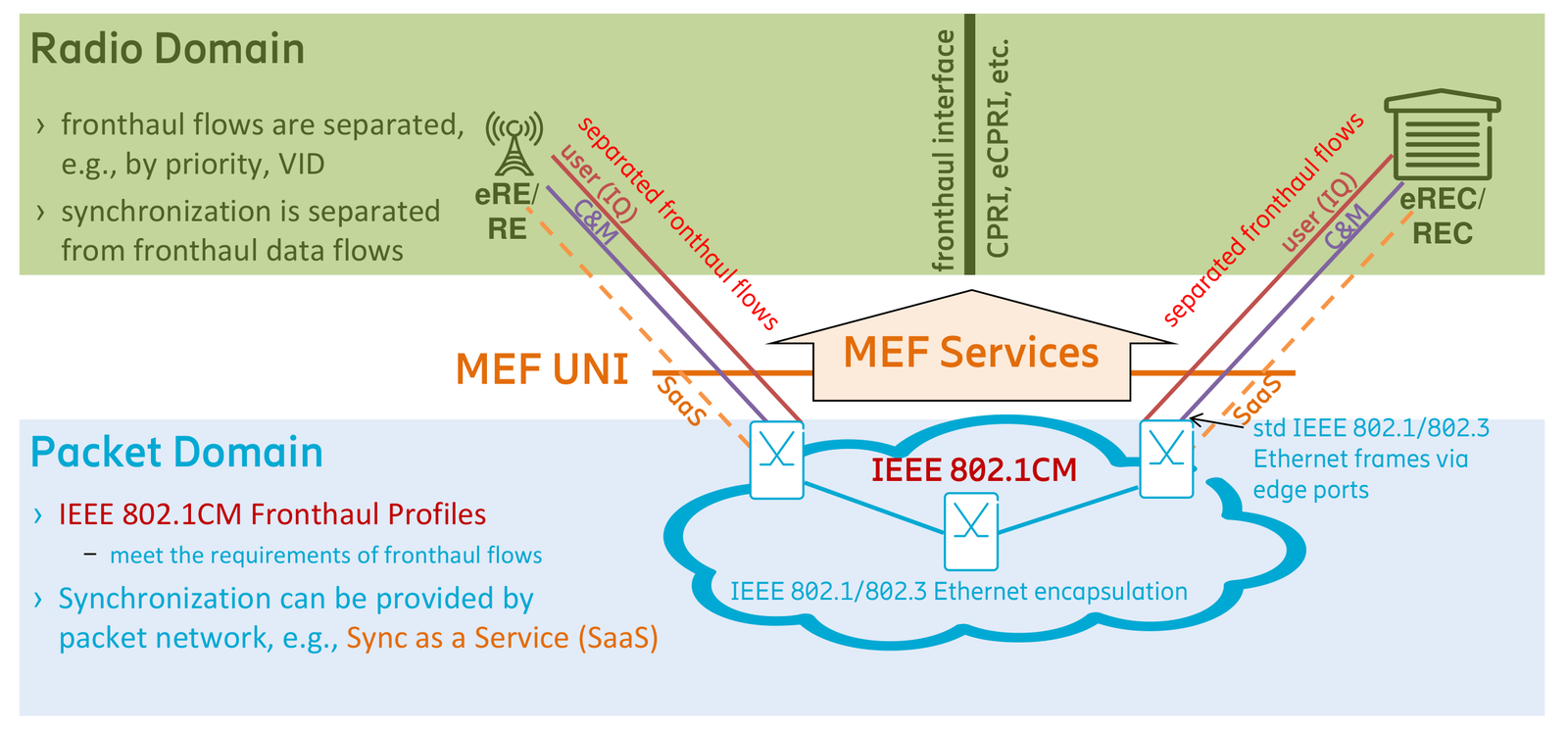
The design keeps the radio and packet domains apart [2]:
- fronthaul flows are separated, for example by priority and VLAN ID;
- synchronisation is separated from the fronthaul data flows and can be provided by the packet network itself ("sync as a service");
- standard IEEE 802.1/802.3 Ethernet frames enter and leave through edge ports.
4. The top-down approach
802.1CM was built from the requirements down [2]:
- Requirements, from the CPRI Cooperation. Class 1 uses the CPRI split and Class 2 the eCPRI split, with the same synchronisation requirements for both.
- Features that can meet them: bridging features, TSN features, and synchronisation solutions from ITU-T Q13/15, for example how to use the telecom profile of IEEE 1588.
- Profiles that state exactly how an Ethernet network meets the fronthaul requirements.
5. The two profiles
Both profiles are engineered for the worst case and apply to both classes [2]:
| Profile A | Profile B | |
|---|---|---|
| Principle | Keep it as simple as possible | Add one simple TSN feature |
| Scheduling | Strict priority | Strict priority + frame preemption (802.3br and 802.1Qbu) |
| Fronthaul user data (IQ) | High-priority traffic class | High-priority class, express |
| Control and management / other traffic | Lower-priority traffic class | Lower-priority class, preemptable |
| Frame size | At most 2000 octets for all traffic | 2000 octets for fronthaul; flexible for other traffic |
The difference is the blocking term of a worst-case analysis. Under Profile A, a fronthaul frame can wait behind one lower-priority frame of up to 2000 octets at every hop, so all traffic must keep its frames short. Under Profile B, preemption reduces that wait to a short fragment. Other traffic can then use large frames without hurting the fronthaul bound. The 802.1Qbu post quantifies this blocking.
References
- IEEE 802.1, 802.1CM-2018: Time-Sensitive Networking for Fronthaul, project page; 802.1CMde. 802.1CM, 802.1CMde
- J. Farkas, "IEEE Std 802.1CM Time-Sensitive Networking for Fronthaul: An Overview," IEEE 802.1, July 2018, slides 3–9. Slides
- CPRI Cooperation, eCPRI Specification V1.1 and Requirements for the eCPRI Transport Network V1.1, January 2018. Specification, Requirements
- "5G Fronthaul Interface: eCPRI, CPRI, O-RAN Transport & Bandwidth Optimization," Superb Automation, technical article, June 2026. Article. Industry article, used for the CPRI line rates and bandwidth estimates.