IEEE 802.1AS gPTP: one clock for the whole network
Gates, cyclic queues and time-gated policing all assume that every bridge reads the same time. IEEE 802.1AS is the standard that provides that time. This post traces how it grew out of the Precision Time Protocol of IEEE 1588, explains how it works, and states what an analysis has to assume about it.
Abbreviations used in this post (17)
| Abbreviation | Stands for | Meaning |
|---|---|---|
| AVB | Audio Video Bridging | The predecessor of TSN: gPTP, the credit-based shaper and stream reservation, combined for audio and video (profile: IEEE 802.1BA). |
| BMCA | Best Master Clock Algorithm | The PTP algorithm that compares the clocks of a domain and elects the grandmaster. |
| CSN | Coordinated Shared Network | A shared medium where a coordinator schedules access, such as MoCA over in-home coaxial cable; 802.1AS defines a media-dependent layer for it. |
| EPON | Ethernet Passive Optical Network | IEEE 802.3 point-to-multipoint access over a passive fibre tree, with its own ranging and timing mechanism that 802.1AS can reuse. |
| FTM | Fine Timing Measurement | The IEEE 802.11 procedure that timestamps frames between two Wi-Fi stations, first for location; 802.1AS-2020 uses it to carry time over Wi-Fi. |
| GM | Grandmaster | The clock that is the time reference of a PTP or gPTP domain. |
| gPTP | generalized Precision Time Protocol | The profile of PTP defined by IEEE 802.1AS, in which every bridge takes part in time distribution. |
| IEEE | Institute of Electrical and Electronics Engineers | The professional association whose Standards Association publishes the IEEE 802 LAN/MAN standards. |
| IP | Internet Protocol | The network-layer protocol of the Internet (IPv4, RFC 791; IPv6, RFC 8200). |
| LAN | Local Area Network | A network covering a limited area, such as a building or a vehicle; IEEE 802 standardises LANs. |
| MAC | Medium Access Control | The lower sublayer of the data link layer, which frames data and controls access to the medium. A MAC address identifies a network interface. |
| MoCA | Multimedia over Coax Alliance | A home networking technology that carries Ethernet frames over coaxial cable; an example of a coordinated shared network. |
| PHY | Physical layer | Layer 1: the transmission of bits over a medium such as copper, fibre or radio. |
| PTP | Precision Time Protocol | IEEE 1588, a protocol that synchronises clocks over a packet network using timestamped message exchanges. |
| TAI | International Atomic Time (Temps Atomique International) | The continuous atomic timescale without leap seconds; the PTP timescale counts seconds of TAI from the 1970 epoch. |
| TSN | Time-Sensitive Networking | The set of IEEE 802.1 standards that give Ethernet bounded latency, time synchronisation and high reliability. |
| UDP | User Datagram Protocol | A connectionless transport protocol without congestion control (RFC 768). |
1. Definition
IEEE 802.1AS, Timing and Synchronization for Time-Sensitive Applications, defines the generalised Precision Time Protocol (gPTP). gPTP is a tightly constrained profile of IEEE 1588 PTP. It distributes time from one reference clock, the grandmaster, through bridges and end stations, with sub-microsecond precision [1][2].
Two properties set it apart from using PTP over an ordinary LAN:
- Every device takes part. Each bridge on the path is a time-aware system that measures its links and its own residence time. It is not a transparent box that adds unknown delay [2].
- Time travels with the network. No separate timing network is needed. The messages are ordinary Ethernet frames between neighbours.
The table in the TSN toolbox post shows which TSN tools depend on gPTP. Scheduled traffic (802.1Qbv), cyclic queuing (802.1Qch) and time-based stream gates (802.1Qci) need it. The credit-based shaper and asynchronous traffic shaping do not.
2. From PTP to gPTP
Where PTP came from
IEEE 1588 moves precise time across a packet network by a two-way exchange of timestamped messages. It also contains the BMCA, which picks the best clock and builds the tree along which time flows [6]. Three kinds of PTP clock appear in a network [2]:
- an ordinary clock has one port and is either the source of time or a receiver of it;
- a boundary clock has several ports: it recovers time on one port and serves it again on the others;
- a transparent clock forwards PTP messages and writes its own residence time into them, so the receiver can remove it.
The protocol and its offshoots evolved in steps:
| Year | Standard | What it brought |
|---|---|---|
| 2002 | IEEE 1588-2002 (PTP version 1) | Precise time for small LANs in test and measurement |
| 2008 | IEEE 1588-2008 (PTP version 2) | Generalised for telecom, audio/video, industrial automation, power utilities and finance; transparent clocks, peer delay, unicast and the notion of a profile; not interoperable with version 1 |
| 2011 | IEEE 802.1AS-2011 | gPTP: a profile of 1588-2008 for Audio Video Bridging, with every bridge time-aware |
| 2019 | IEEE 1588-2019 (version 2.1) | New optional features, among them the use of a medium's own timing mechanism; backward compatible with 2008 if the new options are not used |
| 2020 | IEEE 802.1AS-2020 | A profile of 1588-2019: multiple domains, one-step ports, Wi-Fi fine timing measurement, external port configuration |
| from 2020 | 802.1AS amendments | YANG data model (P802.1ASdn), half-duplex 10 Mb/s links (P802.1ASds), inclusive terminology (P802.1ASdr), hot standby grandmasters (P802.1ASdm) |
The movement therefore runs both ways. 802.1AS took the 2008 protocol and narrowed it, and 1588-2019 took back an idea that 802.1AS had introduced: carrying time with the native timing mechanism of a medium such as Wi-Fi [6][2].
Why a profile was needed
IEEE 1588 is a menu, not a single protocol. A deployment has to choose [6]:
- which of the two delay measurement modes to use;
- whether the best clock is elected by the standard BMCA, by an alternate algorithm, or set from outside by a higher-layer entity;
- the transport: Ethernet, IPv4 or IPv6, and multicast, unicast or both;
- the timescale: the PTP timescale based on TAI, or an arbitrary one chosen by the application;
- whether several timing domains are needed.
1588 also sets no performance targets, because these depend on the application. Every application of PTP therefore conforms to a PTP profile: a fixed choice of the options that are required and those that are forbidden, together with the allowed ranges and default values of the configurable attributes. 1588 itself describes how an organisation may write such a profile [6].
802.1AS is more than a profile. It contains [6]:
- a PTP profile, of 1588-2008 in the 2011 edition and of 1588-2019 in the 2020 edition;
- performance requirements, written for audio and video before industrial and automotive TSN existed (newer applications define their own, for example in their TSN profiles);
- protocol features that are not part of 1588, such as time transport over IEEE 802.11, EPON and coordinated shared networks.
When AVB was standardised, gPTP was the only 1588 profile that worked plug-and-play and also ran over 802.11 [8].
PTP and gPTP side by side
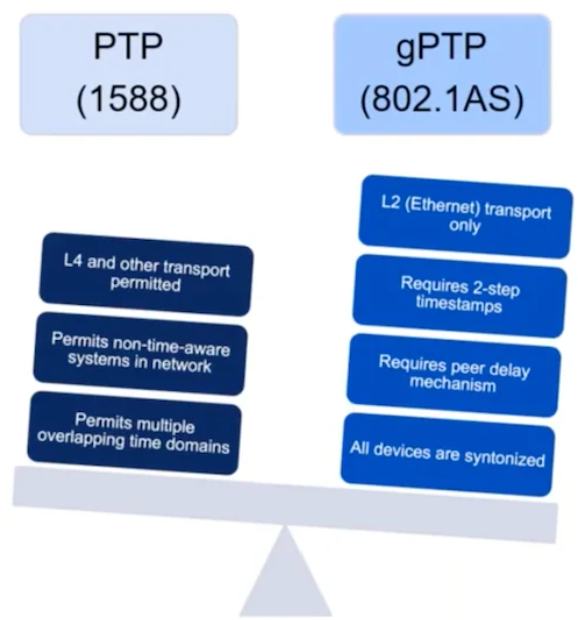
Figure 2 summarises the differences [7]. The table below expands them and marks where the 2020 revision narrowed the gap:
| Aspect | PTP (IEEE 1588) | gPTP (IEEE 802.1AS) |
|---|---|---|
| Transport | Ethernet, or UDP over IPv4 or IPv6 (event messages on port 319, general messages on port 320), plus other mappings [2] | Layer 2 only. On Ethernet, frames go to a link-local multicast address that bridges never forward, so each message crosses exactly one link. Wi-Fi, EPON and CSN links use their own timing mechanisms [6] |
| Devices between clocks | Switches and routers that ignore PTP may sit on the path; their queuing appears as unknown delay | Every device on the path is time-aware. A port whose neighbour cannot run 802.1AS does not carry time |
| Delay measurement | End-to-end delay request–response (Figure 5) or peer delay | Peer delay only, on every link (Figure 6) [7] |
| Timestamps | One-step or two-step | Two-step only in 802.1AS-2011; one-step ports allowed since 802.1AS-2020 [6][7] |
| Frequency | Not every device has to follow the grandmaster's rate | All devices are syntonised: each link measures the rate ratio to its neighbour, and the ratios accumulate to the rate ratio to the grandmaster [6] |
| Domains | Several domains may overlap on one network | Domain 0 only in 802.1AS-2011; several domains since 802.1AS-2020 (Figure 8) [6] |
| Choice of grandmaster | Standard BMCA, alternate BMCA, or external choice | BMCA that matches the port-role logic of RSTP; external port configuration added in 2020 [6] |
| Performance targets | None; left to the profile | In the standard, and tightened by the TSN profiles that use it |
Syntonised means equal in frequency; synchronised means equal in time. A syntonised clock ticks at the grandmaster's rate even between two Sync messages, which is what lets a bridge convert its own residence time into grandmaster time.
The 802.1AS architecture
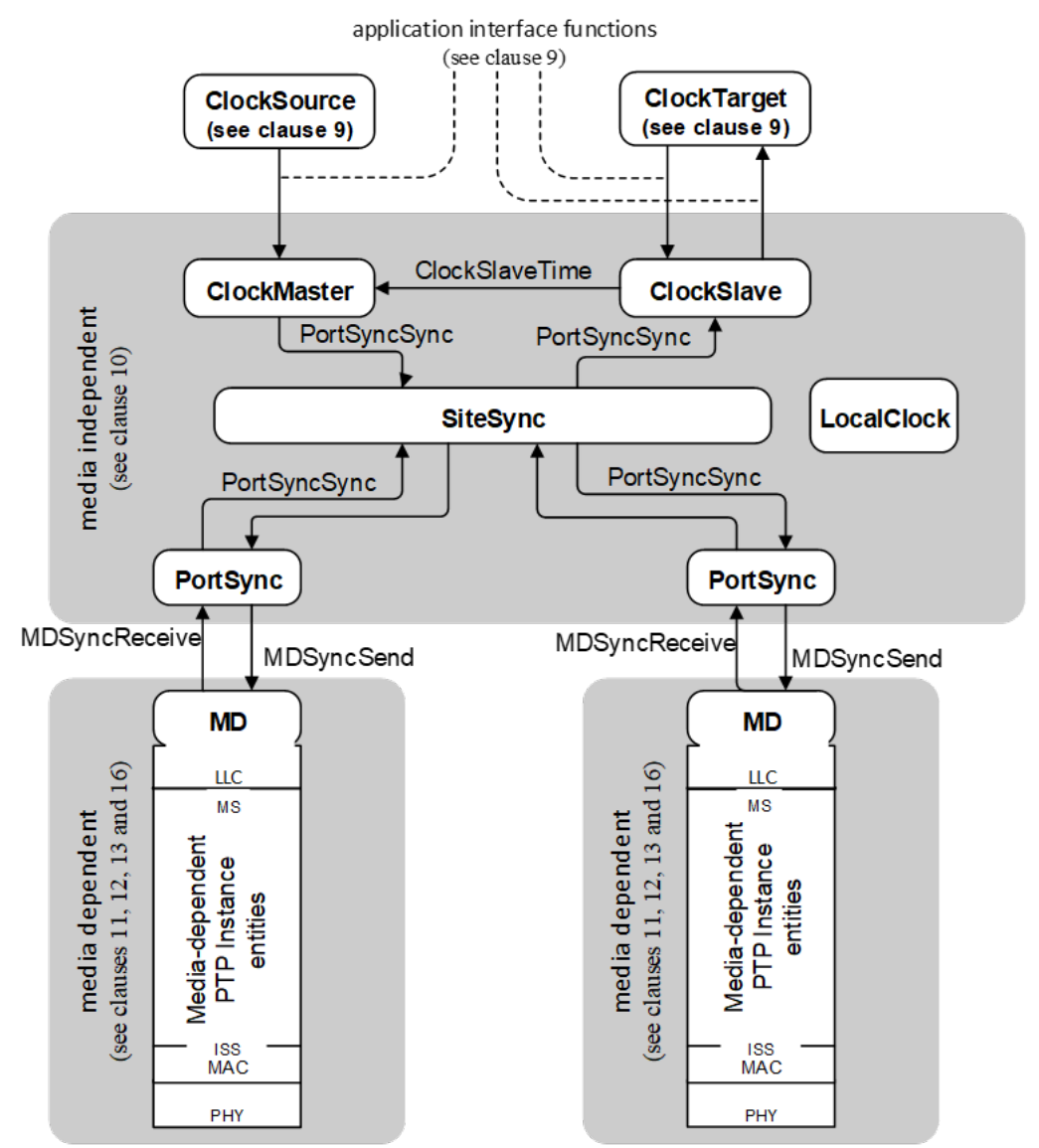
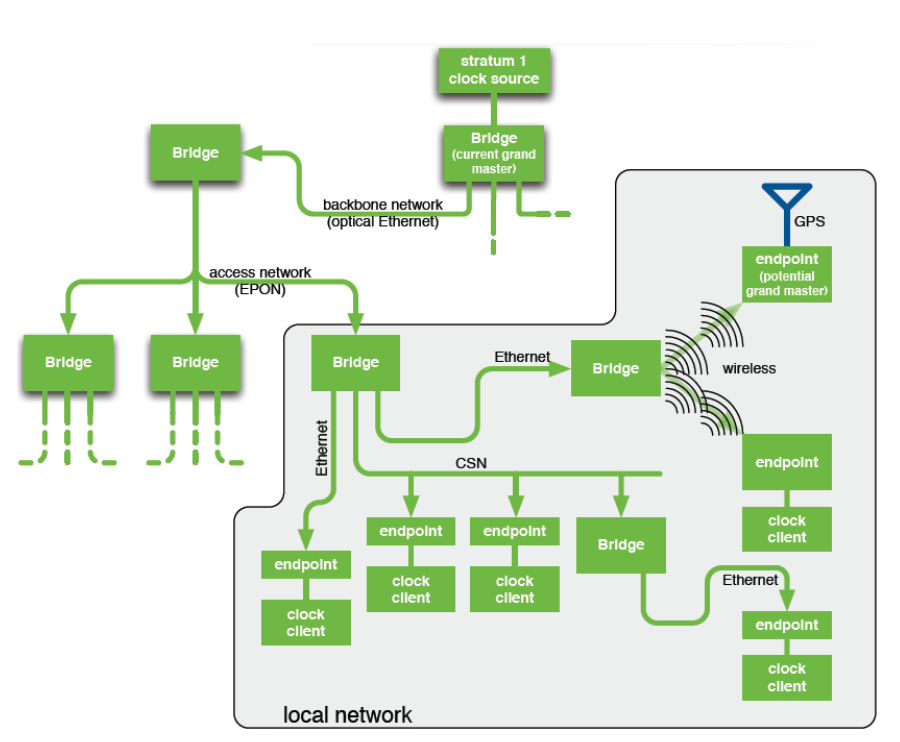
The split in Figure 3 is what made gPTP portable across media [6]. Wi-Fi, EPON and coordinated shared networks such as MoCA already have a way to align the two ends of a link; Wi-Fi developed it for location finding. Such mechanisms align one link only, not the whole network. 802.1AS reuses them in the media-dependent layer and chains the links together in the media-independent layer. Full-duplex Ethernet has no timing of its own, so its media-dependent layer uses the 1588 messages described in Section 4. Each media-dependent entity reports to the layer above in one common format, and the application sees the same abstract interface whatever the medium.
3. Who is the master
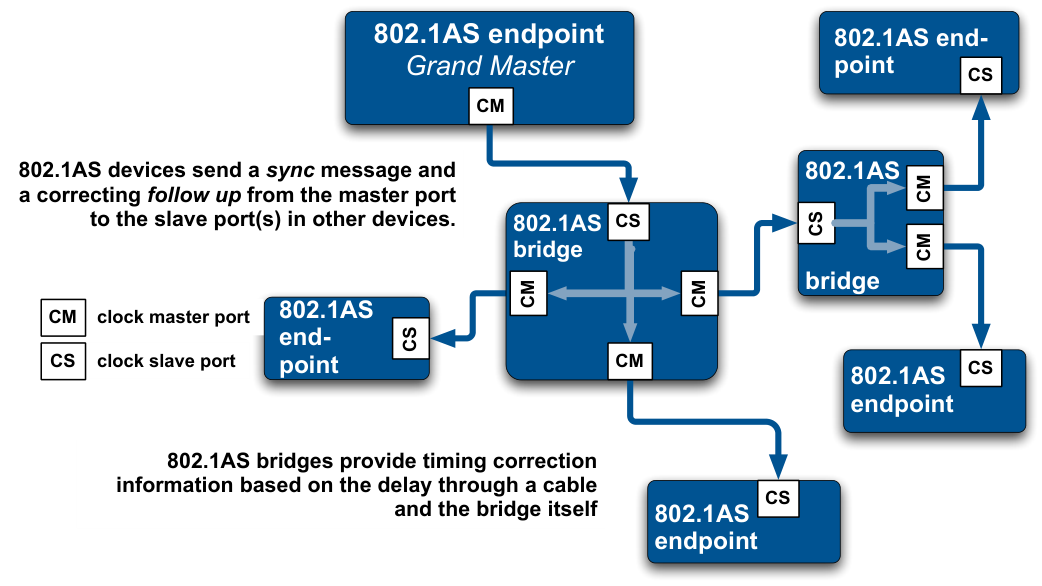
The best master clock algorithm (BMCA) compares the clocks it hears about and elects a grandmaster. Each port then becomes a master port (sending time downstream) or a slave port (receiving time from upstream). Ports on redundant links become passive. The result is a spanning tree of time, as in Figure 4 [2].
In 802.1AS the BMCA plays the same role as the port-role part of RSTP in 802.1Q: a master port corresponds to a designated port, a slave port to the root port, and a passive port to an alternate port [6]. The difference is what is being elected. RSTP elects a root bridge for forwarding; the BMCA elects a grandmaster by its clock attributes, such as priority, clock class and accuracy.
The figure uses the master/slave port names of the original standards. Recent revisions of IEEE 1588 also allow the names timeTransmitter and timeReceiver, and the P802.1ASdr amendment brings the same change to 802.1AS [6].
4. Measuring a link
The PTP exchange
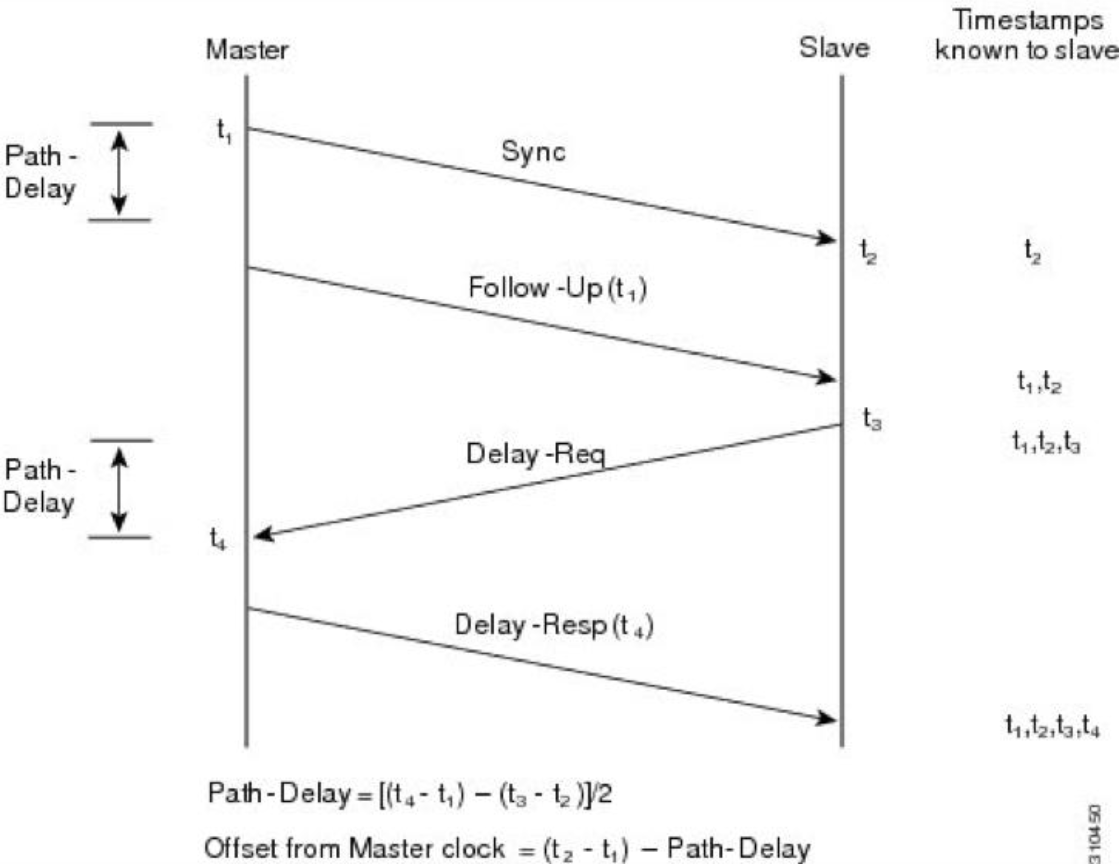
The offset is how far the slave clock is from the master clock at the same instant: an offset of +3 µs means the slave reads 3 µs ahead, so it must step or slow its clock by 3 µs. The path delay is the time a message takes on the wire between them. The exchange of Figure 5 measures both:
- The master sends Sync at (master time); the slave receives it at (slave time). In two-step clocks, a Follow_Up message carries the exact .
- The slave sends Delay_Req at (slave time); the master receives it at (master time) and returns in Delay_Resp.
Write for the path delay, assumed equal in both directions, and for the offset. Then and , which give
For example, with µs, µs, µs and µs, the round trip outside the slave is µs, so µs and µs: the slave is 3 µs ahead.
The symmetry assumption is the weak point: any difference between the two directions goes straight into the offset as an error of half that difference.
Peer delay in 802.1AS
gPTP does not measure the delay from master to slave end to end. Each pair of neighbours measures only the link between them, using the peer-to-peer delay mechanism of Figure 6. The same message exchange also yields the neighbour rate ratio, the frequency of the neighbour's clock relative to the local one [6]. The time itself then travels in Sync and Follow_Up messages. At each hop the bridge adds to a correction field:
- the measured delay of the link the message arrived on;
- its own residence time, from reception to forwarding;
- a correction for the rate ratio, the frequency difference between neighbouring clocks.
A receiving port thus finds its offset from the grandmaster as the receive timestamp, minus the grandmaster time carried in the message, minus the mean link delay, minus a known asymmetry correction if there is one. The servo (a phase-locked loop) smooths the result for the application, but the unfiltered value is what the bridge passes on to the next hop [6].
Errors therefore accumulate hop by hop. Queuing does not add error, because each bridge measures how long the message stayed inside it and adds exactly that time to the correction field.
5. What changed in the 2020 revision
The 2020 revision rebased 802.1AS on 1588-2019 and removed several limits of the 2011 edition [6]:
- Multiple domains. 1588-2008 already allowed several domains, but 802.1AS-2011 ran in domain 0 only. In 2020 each domain a node supports is a separate PTP instance. Every time-aware system still supports domain 0, for compatibility with 2011 devices.
- Common mean link delay service. The delay of an Ethernet link depends on the cable, not on the domain, so it is measured once and shared by all domains.
- One-step ports, where the Sync message carries its own precise timestamp and no Follow_Up is needed.
- External port configuration, an alternative to the BMCA in which a management entity sets the port states. This suits redundancy through several domains.
- Fine timing measurement for Wi-Fi, more accurate than the timing measurement of the 2011 edition.
- Asymmetry measurement by line-swapping, supported through management.
- Automatic detection of whether the device at the other end of a link runs 802.1AS.
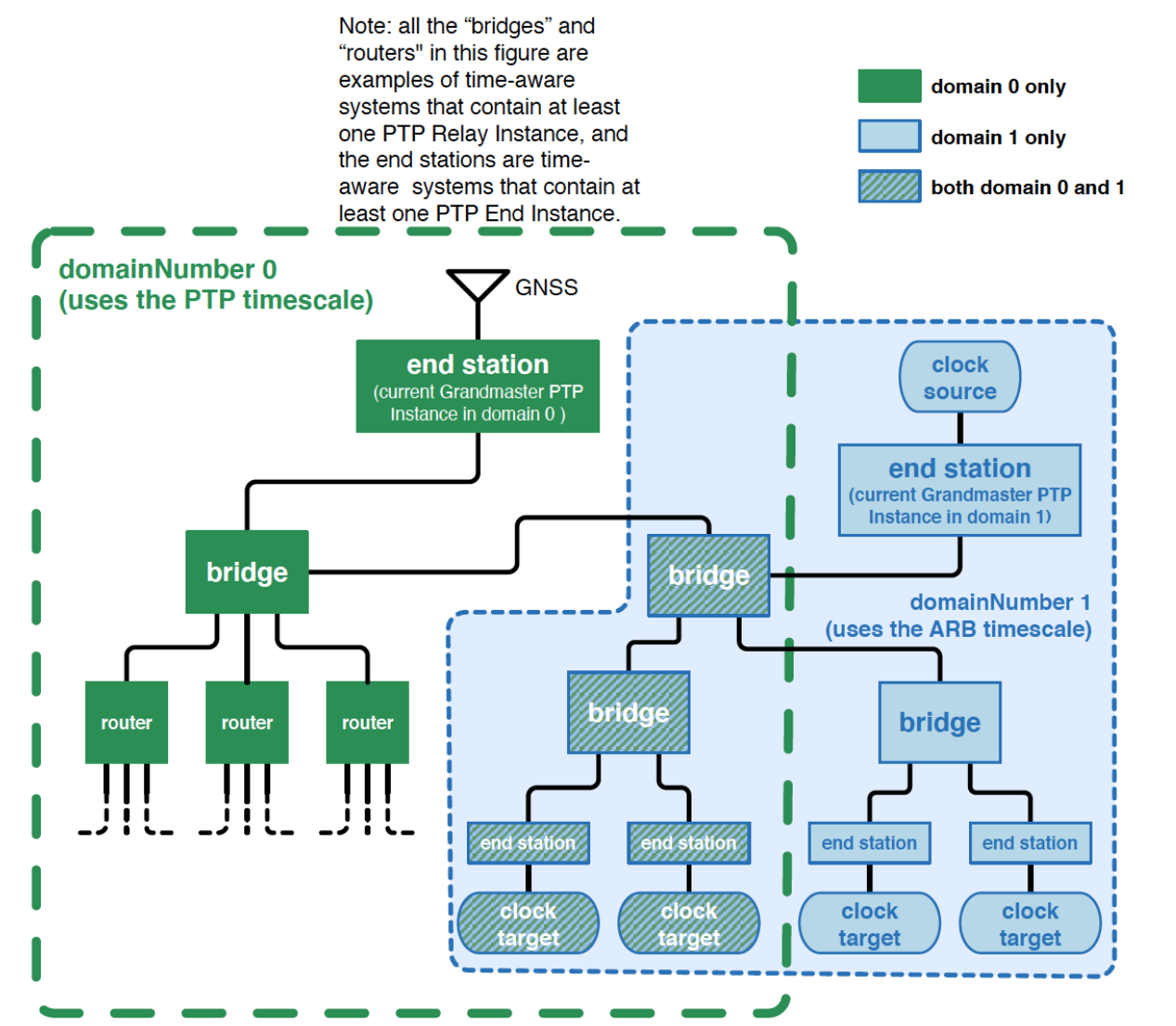
Figure 8 shows the result. Some systems belong to both domains but use only one at a time, and each domain may run on its own timescale [6]. Industrial automation uses exactly this split: a global time traceable to TAI, and a working clock for the control cycles [6]. The task group's work on the revision also covered link aggregation, faster changeover between grandmasters, and redundant paths [3]. The P802.1ASdm amendment then adds a hot standby grandmaster: two domains run in parallel, and a node switches to the second without interrupting the time its applications see [6].
6. What an analysis must assume about time
A schedule computed for perfectly synchronised clocks fails on real hardware. The literature on scheduled traffic therefore models a maximum synchronisation error: the largest offset between two non-faulty clocks. Windows are widened by that margin [4]. The 802.1AS revision allows a finer model, with an error per node that depends on its role and its hop distance from the grandmaster [4]. Profiles set the number. For its working clock, IEC/IEEE 60802 requires the absolute time error between the grandmaster and any end instance to stay within 1 µs, over a chain of at least 64 and ideally 100 nodes [6].
Two practical lessons come from a testbed study of 17 scheduling methods [4]:
- Synchronisation messages are traffic too. If time-triggered frames collide with PTP messages, synchronisation can fail within its period. The runtime error then exceeds the bound the schedule assumed, causing missed deadlines or network failure. The schedule must leave room for gPTP.
- The error bound is an input to the guarantee. A worst-case delay computed for scheduled traffic is only as valid as the synchronisation error it assumed.
A review of industrial IoT technologies makes the same point from the other side. With even small time errors, carefully aligned windows can drift apart. Scheduled traffic is then delayed by a whole cycle, and the problem grows with the size of the network [5].
7. Summary
| Element | Role |
|---|---|
| IEEE 1588 PTP | General protocol with many options and no performance targets |
| gPTP (802.1AS) | A profile of PTP plus extra features: layer 2, peer delay, every device time-aware and syntonised |
| Grandmaster | Reference clock of a gPTP domain, elected by the BMCA |
| Master and slave ports | Direction of time on each link |
Pdelay_Req, Pdelay_Resp, Pdelay_Resp_Follow_Up | Measure the delay and rate ratio of one link between neighbours |
Sync, Follow_Up | Carry time down the tree, with accumulated corrections |
| Rate ratio | Frequency difference between neighbouring clocks |
| Domains | Separate PTP instances, for redundancy or for different timescales (since 2020) |
| Synchronisation error | The bound that schedules and analyses must assume |
References
- IEEE 802.1, Time-Sensitive Networking (TSN) Task Group. Web page
- Wikipedia, "Time-Sensitive Networking," section on time synchronisation; "Precision Time Protocol." TSN, PTP
- J. Farkas, "Introduction to IEEE 802.1: Focus on the Time-Sensitive Networking Task Group," 15 May 2017. Slides
- C. Xue, T. Zhang, Y. Zhou, M. Nixon, A. Loveless, S. Han, "Real-Time Scheduling for 802.1Qbv Time-Sensitive Networking (TSN): A Systematic Review and Experimental Study," arXiv:2305.16772, 2023 (v4, 2024), Sections II-A and VII-B. arXiv
- I. Behnke, H. Austad, "Real-Time Performance of Industrial IoT Communication Technologies: A Review," arXiv:2311.08852, 2023, Section III-D. arXiv
- G. Garner, S. Rodrigues, "The Transport and Impact of Synchronization in Time-Sensitive Networking: An Introduction to IEEE 802.1AS," IEEE SA TSN webinar series, 24 February 2022, slides 10–31. Slides
- J. Steinheider (NXP Semiconductors), "The Fundamentals of Time-Sensitive Networking," All About Circuits, 19 January 2021, section on time synchronisation and Figure 2. Article
- D. Pannell, "An Introduction to AVB (Audio Video Bridging), the 1st TSN Profile," IEEE SA TSN webinar series, June 2022, slide 15. Slides