IEC/IEEE 60802: the TSN profile for industrial automation
Factories have long run their control loops on fieldbuses and proprietary variants of Ethernet. They work, but they cannot share their wires with anything else. IEC/IEEE 60802 is the profile that defines how standard TSN equipment should be selected and configured to replace them.
Abbreviations used in this post (7)
| Abbreviation | Stands for | Meaning |
|---|---|---|
| IEC | International Electrotechnical Commission | The international standards body for electrical and electronic technologies; co-owner of IEC/IEEE 60802. |
| IEEE | Institute of Electrical and Electronics Engineers | The professional association whose Standards Association publishes the IEEE 802 LAN/MAN standards. |
| IT | Information Technology | Computing and networking for information processing, such as office, business and cloud systems. |
| LLDP | Link Layer Discovery Protocol | IEEE 802.1AB: devices advertise their identity and capabilities to their direct neighbours. |
| OT | Operational Technology | Hardware and software that monitor and control physical processes, such as controllers, drives and sensors in a factory. |
| PTP | Precision Time Protocol | IEEE 1588, a protocol that synchronises clocks over a packet network using timestamped message exchanges. |
| TSN | Time-Sensitive Networking | The set of IEEE 802.1 standards that give Ethernet bounded latency, time synchronisation and high reliability. |
1. Definition
IEC/IEEE 60802, Time-Sensitive Networking Profile for Industrial Automation, is a joint project of IEC SC65C/WG18 and IEEE 802. It produces a single dual-logo standard that is both an IEC and an IEEE standard [1]. It defines TSN profiles that select the features, options, configurations, defaults, protocols and procedures of bridges, end stations and LANs to build industrial automation networks [1][2].
Users and vendors need such guidance because IEEE 802 standards cover a very wide range of scenarios. Interoperable, converged industrial networks require a selection, so that operational technology (OT) traffic and other traffic can share one network [1]. The project page lists the standard as published on 29 June 2026, as IEC/IEEE 60802-2026 [1].
2. The challenge
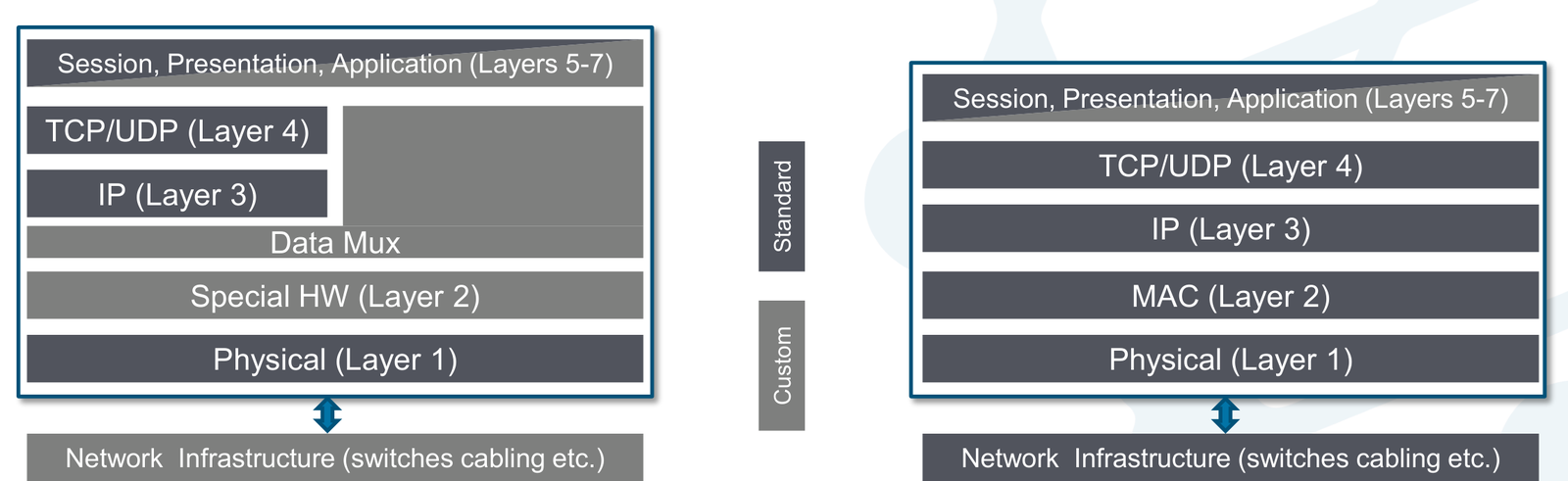
The 2023 overview frames the problem as a choice between two imperfect options [2]:
| Traditional industrial networks | Best-effort Ethernet |
|---|---|
| Tuned for latency and control | Open and interoperable |
| Cannot share the wire | Does not bound latency |
| Cannot scale (limited to 100 Mb/s) | Does not guarantee bandwidth |
| Proprietary hardware and software increase cost |
TSN is meant to keep the right-hand column and add the guarantees of the left.
3. Requirements
Environment and topology
Industrial equipment works from −40 to +85 °C, runs 24/7 for ten years or more, and suffers frequency deviations from ageing, temperature, supply voltage, shock and vibration. Physical constraints make star cabling impractical, so machines are naturally wired point to point [2].
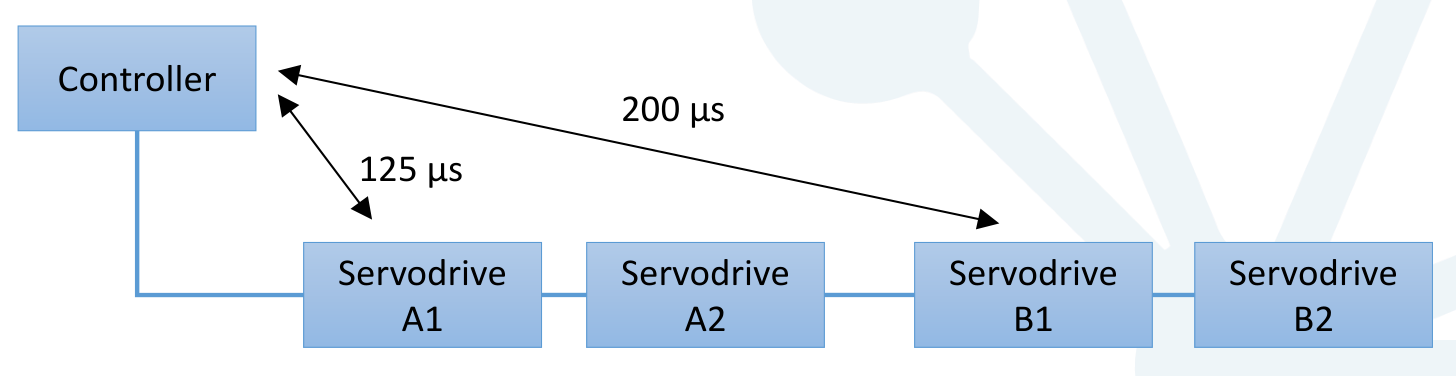
Motion applications use line topologies with embedded switches. A line can have 64 hops or more, control loops can run in tens of microseconds, and the synchronised time must stay within 1 µs of the grandmaster across 64 hops, with 100 hops as the goal [2].
Scheduled traffic
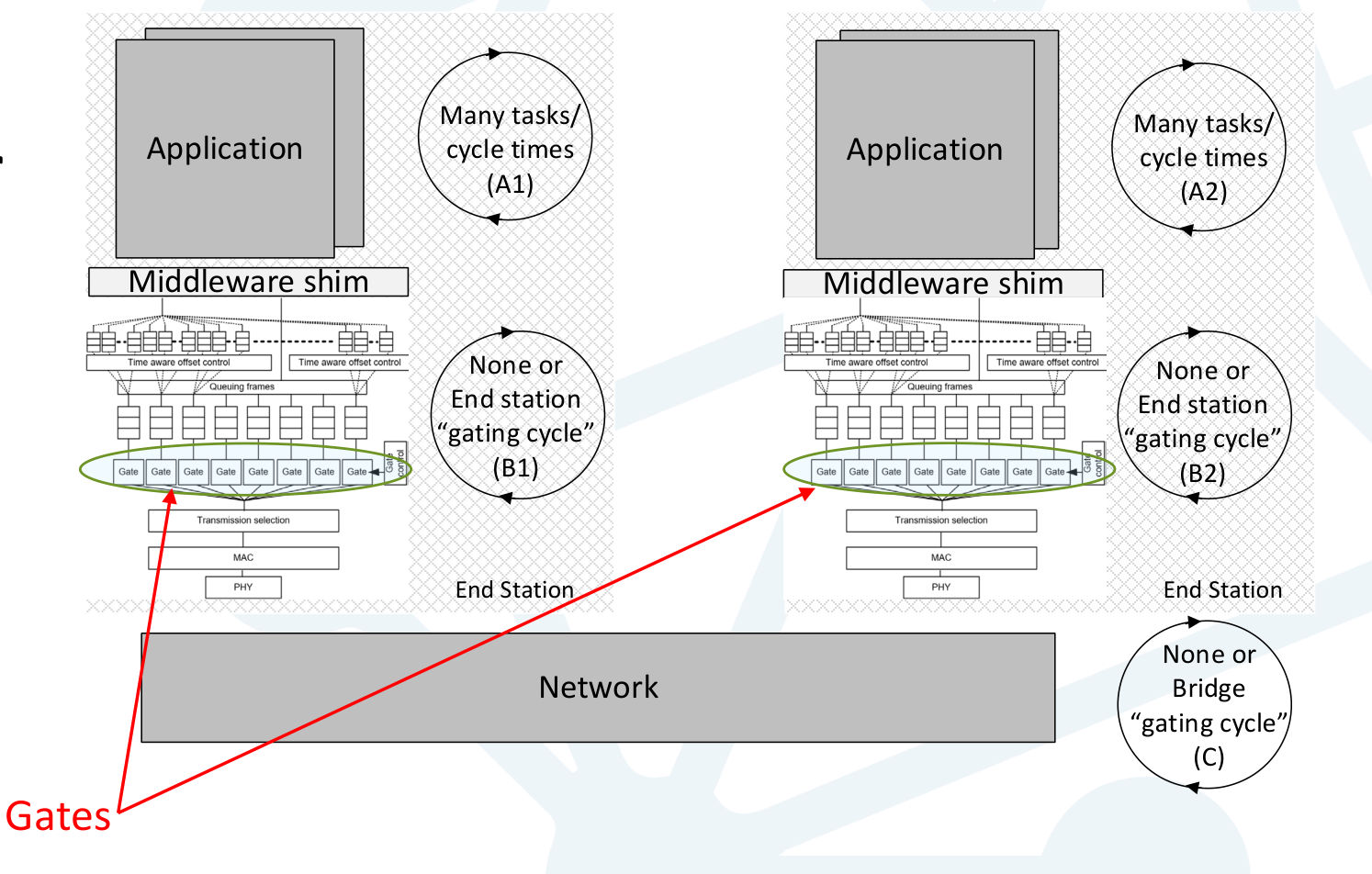
For scheduled traffic (802.1Qbv), the requirements are [2]:
| Parameter | Requirement |
|---|---|
| Tick granularity of the gates | 10 ns or less |
| Gating cycle at 100 Mb/s | 250 µs to 10 ms |
| Gating cycle at 1 Gb/s and above | 31.25 µs to 1 ms |
| Timing points | 10 ns or less |
Two kinds of time
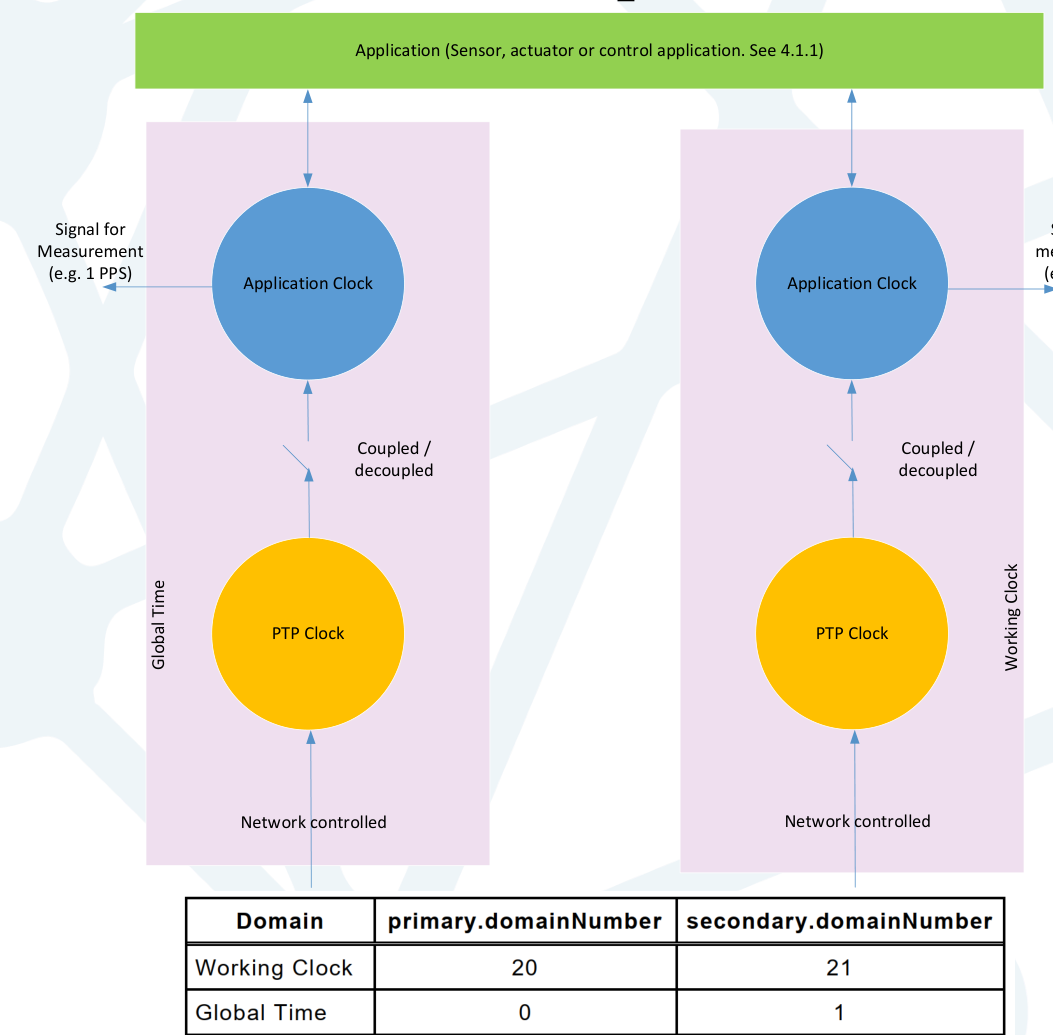
Industrial applications need two times [2][3]:
- a global time, traceable to a known source, for time stamping across the plant;
- a working clock, the time base of the control application itself.
A secondary domain for each may be supported as an option [2]. The 2018 requirements are precise. All synchronisation requirements must hold for line topologies of up to 100 hops. Other requirements include [3]:
- a valid link delay within 1 s, with an error below 10 ns per link;
- a bridge delay error below 50 ns per node, and a residence time below 1 ms;
- detection of a lost working-clock grandmaster within 100 ms;
- reaching "in sync within 1 µs" in under 1 s per device.
These numbers feed directly into the synchronisation error that 802.1AS analyses must assume.
Reliability, migration and configuration
The 2018 requirements also ask for the following [3]:
- Availability. Redundancy for streams and high-availability networks, in which a single failure creates no process disturbance.
- Migration. Support for extending existing (brownfield) installations and connecting non-TSN devices.
- Protection. Protection of a TSN domain against traffic from outside it.
- Configuration. A vendor-independent network configuration, with preconfigured streams, a defined bootstrap configuration and a selected management protocol.
4. The IA-station
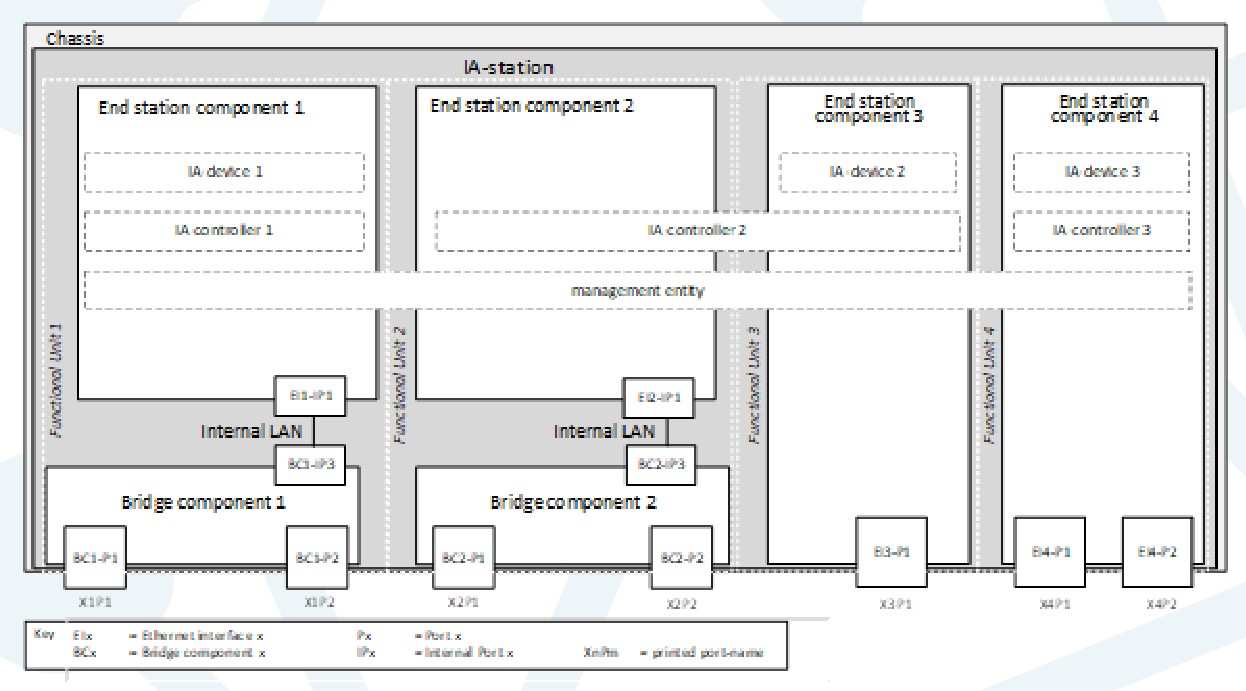
In industrial devices, several end stations and bridge components often live in one chassis, connected internally by interfaces that are not IEEE 802 standards. The profile introduces the IA-station to cover such devices. All components of an IA-station share a common LLDP chassis-ID subtype and a common management entity. Functions such as time synchronisation, management and discovery are specified for the IA-station as a whole [2].
Bridge and end-station components come in two conformance classes [2]:
- class A (ccA) is feature rich, for use cases that need many profile features;
- class B (ccB) is for more resource-constrained implementations.
5. One network for OT and IT
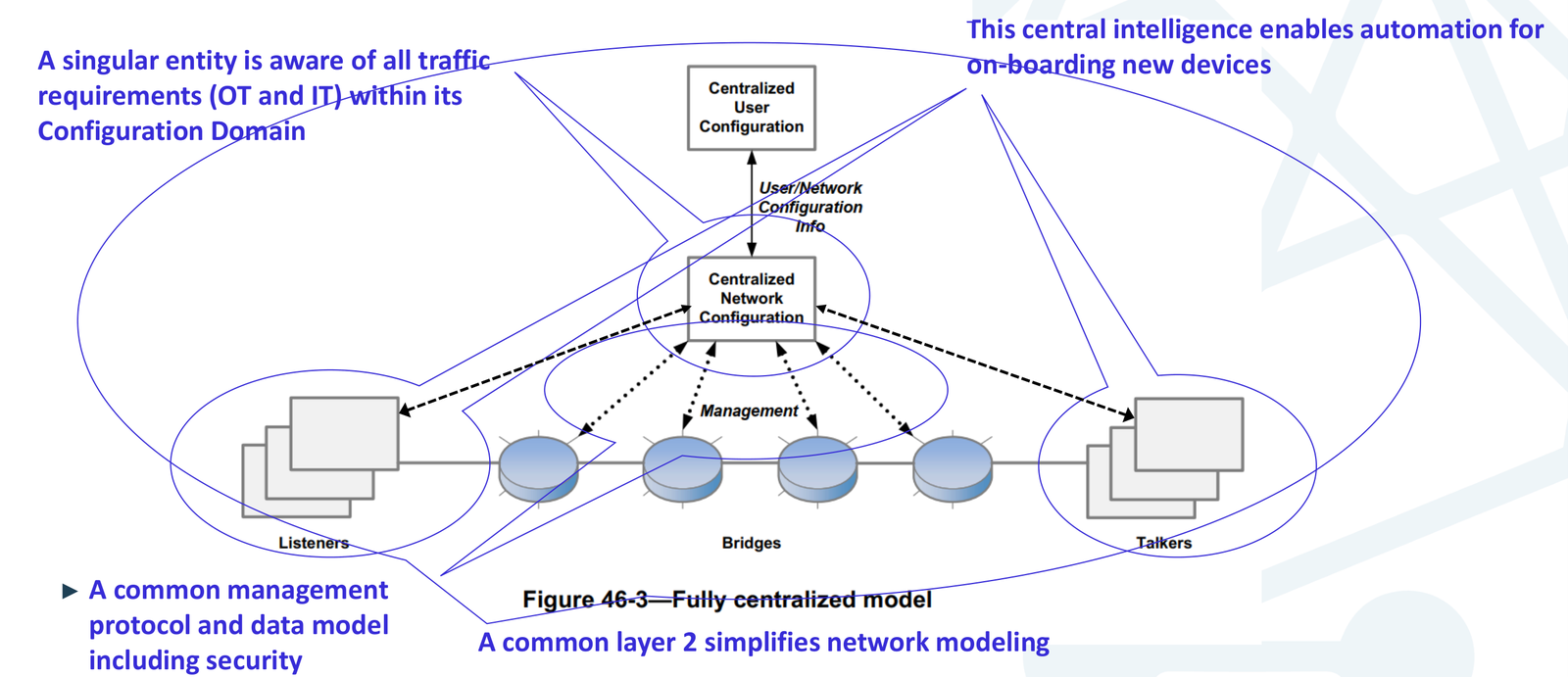
The overview argues that the real value of TSN lies in a common layer 2 with a common approach to resource management. The ambitions it lists [2]:
- Convergence. IT, OT and other devices share one network with guaranteed quality of service.
- Self-protection. The network protects itself, for example against wrong connections, unexpected devices or excessive load.
- Adaptability. It supports plug and produce, topology changes and extensions.
- Scalability. It scales for both the network and the devices.
One entity aware of all traffic requirements in its configuration domain can automate the on-boarding of new devices [2]. That is the central configuration model of 802.1Qcc.
References
- IEEE 802.1, IEC/IEEE 60802 TSN Profile for Industrial Automation, project page. Web page
- J. Woods, "IEC/IEEE 60802: The Case for the Converged Network in the Factory of the Future," IEEE SA TSN webinar series, 6 April 2023, slides 7–19. Slides
- IEC/IEEE 60802 joint project, "Requirements IEC/IEEE 60802," V1.0, 13 September 2018. Document
- IEEE SA, "Time-Sensitive Networking for Industrial Automation: Unlocking the Future of Industrial Automation," Beyond Standards. Article