IEEE 802.1CB FRER: frame replication and elimination for reliability
Bounded latency is useless if a cable cut loses frames for the hundreds of milliseconds it takes to reroute. Frame Replication and Elimination for Reliability (FRER) sends every frame along several paths in parallel, so a single failure costs no frame and no switchover time.
Abbreviations used in this post (13)
| Abbreviation | Stands for | Meaning |
|---|---|---|
| ATS | Asynchronous Traffic Shaping | IEEE 802.1Qcr: per-stream token-bucket shaping at every hop using local clocks only. |
| CNC | Centralized Network Configuration | The 802.1Qcc entity that computes paths, schedules and reservations for the whole network and configures the bridges. |
| DetNet | Deterministic Networking | The IETF architecture and working group for bounded-latency, low-loss flows over IP and MPLS (RFC 8655). |
| FRER | Frame Replication and Elimination for Reliability | IEEE 802.1CB: frames are numbered, sent over disjoint paths, and duplicates are removed. |
| HSR | High-availability Seamless Redundancy | An IEC 62439-3 ring redundancy protocol that sends every frame both ways round a ring. |
| IEC | International Electrotechnical Commission | The international standards body for electrical and electronic technologies; co-owner of IEC/IEEE 60802. |
| IEEE | Institute of Electrical and Electronics Engineers | The professional association whose Standards Association publishes the IEEE 802 LAN/MAN standards. |
| IETF | Internet Engineering Task Force | The body that develops Internet standards, published as RFCs. |
| IS-IS | Intermediate System to Intermediate System | A link-state routing protocol (ISO/IEC 10589, RFC 1195); the control plane of SPB and PCR. |
| PRP | Parallel Redundancy Protocol | An IEC 62439-3 protocol that sends every frame over two independent networks. |
| PSFP | Per-Stream Filtering and Policing | IEEE 802.1Qci: stream filters, stream gates and flow meters that enforce each stream’s contract at ingress. |
| R-TAG | Redundancy tag | The 802.1CB tag that carries the sequence number of a replicated frame. |
| SDN | Software-Defined Networking | An architecture that separates the control plane, run by a logically centralised controller, from the data plane of the network elements (RFC 7426). |
1. Definition
Frame Replication and Elimination for Reliability, IEEE 802.1CB, is per-frame 1+1 (or 1+n) redundancy. The frames of a stream are numbered and sent on two or more maximally disjoint paths. They are then merged, and the extra copies are deleted. Nothing detects the failure and nothing switches over, so a path failure causes no interruption [3].
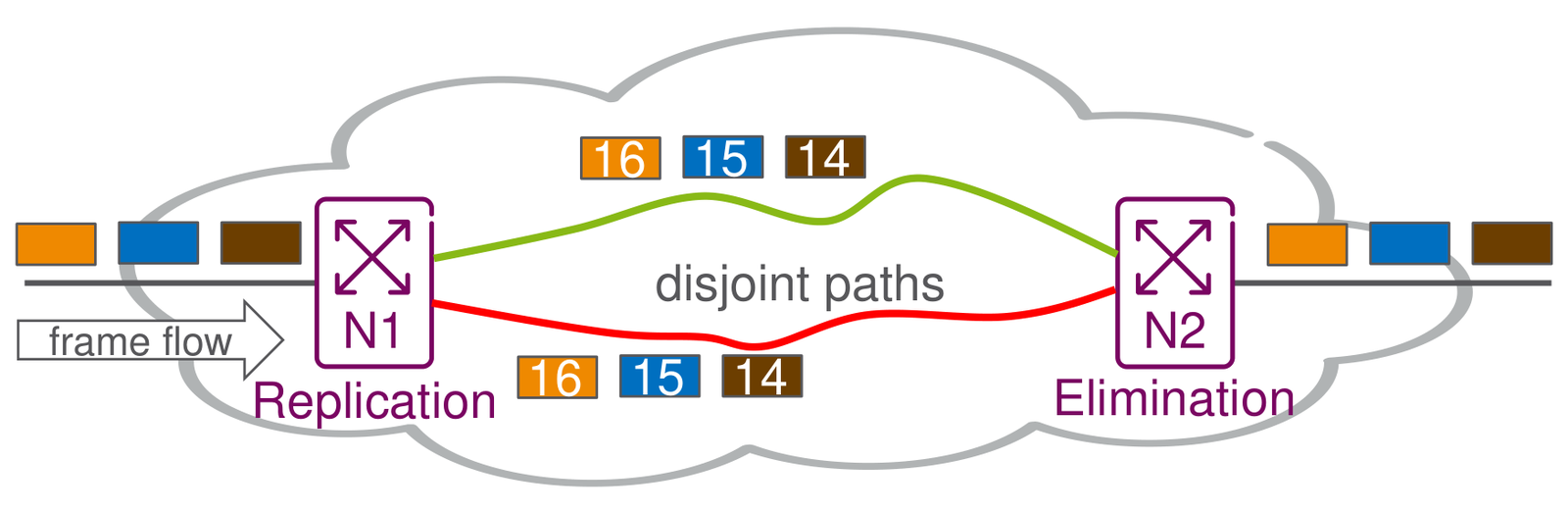
} />
Replication and elimination can happen in the end stations themselves or in bridges. A non-redundant talker can then use a redundant network.
2. The functions on each side
| Function | Side | What it does |
|---|---|---|
| Stream identification | Both | Recognises the stream from frame fields, as in PSFP |
| Sequence generation | Replicating | Gives each frame the next sequence number |
| Stream splitting | Replicating | Makes one copy per member stream, one member per path |
| Sequence encode / decode | Both | Carries the number in a tag: the 802.1CB redundancy tag (R-TAG), or the tags of the HSR and PRP industrial protocols (IEC 62439-3) |
| Individual recovery | Eliminating, optional | Removes duplicates within one member stream |
| Sequence recovery | Eliminating | Removes duplicates across members. The vector algorithm keeps a window of recently seen numbers and accepts frames out of order; the match algorithm only compares with the last number. |
| Latent error detection | Eliminating | Raises an alarm when a path delivers nothing, so that a hidden failure is repaired before a second one causes loss |
3. Where the paths come from
FRER assumes disjoint paths but does not compute them. In a bridged network, the paths come either from path control, 802.1Qca, where IS-IS computes defaults and a controller adds explicit trees, or from a CNC that computes paths and configures them directly [3]. The SDN post covers the controller side. At Layer 3, IETF DetNet provides the same service as packet replication, elimination and ordering (see the DetNet post).
4. What FRER does to the traffic
FRER removes loss, but it changes the traffic that the latency analysis sees. The 2026 tutorial on decentralised latency models lists three effects [4]:
- Longer frames. The tag adds bytes to every frame, which increases the stream's frame size and burst.
- A bigger burst after merging. Even after elimination, the merged stream must often be given twice the original burst to cover the worst case.
- Reordering after a repair. Suppose the two paths have different delays and the faster path fails. When it comes back, the merge point receives old frames from the slower path and recent frames from the faster one. Both are valid and neither is eliminated, so the output is temporarily burstier, until the old frames are used up. Annex C.9 of 802.1CB discusses this case.
The tutorial suggests placing Asynchronous Traffic Shaping at the merge point to restore the original burst at once. The combination of FRER and ATS is still being standardised [4].
In network calculus terms, the arrival curve after elimination is not the talker's curve. It must allow for the extra burst of points 2 and 3. Any bound computed downstream of an elimination point is wrong if it uses the original curve.
5. Summary
| Property | Frame Replication and Elimination |
|---|---|
| Standard | IEEE 802.1CB |
| Acts on | Individual streams, around the relay of replicating and eliminating systems |
| Redundancy | 1+1 or 1+n, per frame, no switchover |
| Needs time synchronisation | No |
| Needs | Maximally disjoint paths, from 802.1Qca or a CNC |
| Analysis caveat | Larger frames and, after merging, a larger burst |
References
- IEEE 802.1, Time-Sensitive Networking (TSN) Task Group. Web page
- Wikipedia, "Time-Sensitive Networking," section on frame replication and elimination. Article
- J. Farkas, "TSN Basic Concepts," DetNet–TSN workshop, 11 November 2018, slides 16–17. Slides
- A. Grigorjew, S. Geissler, J. Schmitt, T. Hossfeld, "Decentralized Latency Models and Information Flow for TSN Shapers – A Tutorial," arXiv:2610.11999, 2026, Sections I and VIII. arXiv