Deterministic networking in OSI 7-layer Architecture
"Deterministic networking" names a goal before it names a technology: a packet network that delivers selected flows within a bounded latency, with almost no loss. This post defines the goal, lists what it demands from the network, and shows which standards body is responsible for which layer.
Abbreviations used in this post (29)
| Abbreviation | Stands for | Meaning |
|---|---|---|
| AVB | Audio Video Bridging | The predecessor of TSN: gPTP, the credit-based shaper and stream reservation, combined for audio and video (profile: IEEE 802.1BA). |
| CBS | Credit-Based Shaper | The IEEE 802.1Qav shaper that limits a traffic class to its reserved rate (idleSlope) with a per-queue credit. In MEF bandwidth profiles, CBS instead means Committed Burst Size. |
| CNC | Centralized Network Configuration | The 802.1Qcc entity that computes paths, schedules and reservations for the whole network and configures the bridges. |
| CQF | Cyclic Queuing and Forwarding | IEEE 802.1Qch: two queues per class alternate every cycle, so a frame advances one hop per cycle. |
| DetNet | Deterministic Networking | The IETF architecture and working group for bounded-latency, low-loss flows over IP and MPLS (RFC 8655). |
| DiffServ | Differentiated Services | The IETF per-class QoS model, in which packets are marked at the edge and treated per class in the core (RFC 2475). |
| DSCP | Differentiated Services Code Point | The 6-bit field in the IP header that selects a DiffServ class (RFC 2474). |
| FRER | Frame Replication and Elimination for Reliability | IEEE 802.1CB: frames are numbered, sent over disjoint paths, and duplicates are removed. |
| IEEE | Institute of Electrical and Electronics Engineers | The professional association whose Standards Association publishes the IEEE 802 LAN/MAN standards. |
| IETF | Internet Engineering Task Force | The body that develops Internet standards, published as RFCs. |
| IntServ | Integrated Services | The IETF per-flow QoS model with reservations in every router (RFC 1633). |
| IP | Internet Protocol | The network-layer protocol of the Internet (IPv4, RFC 791; IPv6, RFC 8200). |
| IS-IS | Intermediate System to Intermediate System | A link-state routing protocol (ISO/IEC 10589, RFC 1195); the control plane of SPB and PCR. |
| IT | Information Technology | Computing and networking for information processing, such as office, business and cloud systems. |
| MAC | Medium Access Control | The lower sublayer of the data link layer, which frames data and controls access to the medium. A MAC address identifies a network interface. |
| MPLS | Multiprotocol Label Switching | Forwarding of packets on short labels along label-switched paths (RFC 3031). |
| MPLS-TE | MPLS Traffic Engineering | Use of MPLS paths with reserved bandwidth to steer traffic (RFC 2702). |
| OSI | Open Systems Interconnection | The seven-layer reference model for communication protocols (ISO/IEC 7498-1). |
| QoS | Quality of Service | The treatment a network gives to a flow or class, in terms of bandwidth, delay, jitter and loss. |
| RFC | Request for Comments | The document series in which IETF standards and related documents are published. |
| RSVP | Resource Reservation Protocol | The IntServ signalling protocol that reserves resources per flow (RFC 2205). |
| RSVP-TE | Resource Reservation Protocol – Traffic Engineering | The signalling protocol that sets up MPLS paths with bandwidth reservations (RFC 3209). |
| SDN | Software-Defined Networking | An architecture that separates the control plane, run by a logically centralised controller, from the data plane of the network elements (RFC 7426). |
| TAS | Time-Aware Shaper | IEEE 802.1Qbv scheduled traffic: a gate per queue, opened and closed by a repeating gate control list. |
| TCP | Transmission Control Protocol | A reliable, connection-oriented transport protocol with congestion control (RFC 9293). |
| TEAS | Traffic Engineering Architecture and Signaling | The IETF working group responsible for MPLS-TE and RSVP-TE. |
| TSN | Time-Sensitive Networking | The set of IEEE 802.1 standards that give Ethernet bounded latency, time synchronisation and high reliability. |
| UDP | User Datagram Protocol | A connectionless transport protocol without congestion control (RFC 768). |
| VLAN | Virtual LAN | A logical LAN within a bridged network, identified by a 12-bit VLAN ID in the 802.1Q tag. |
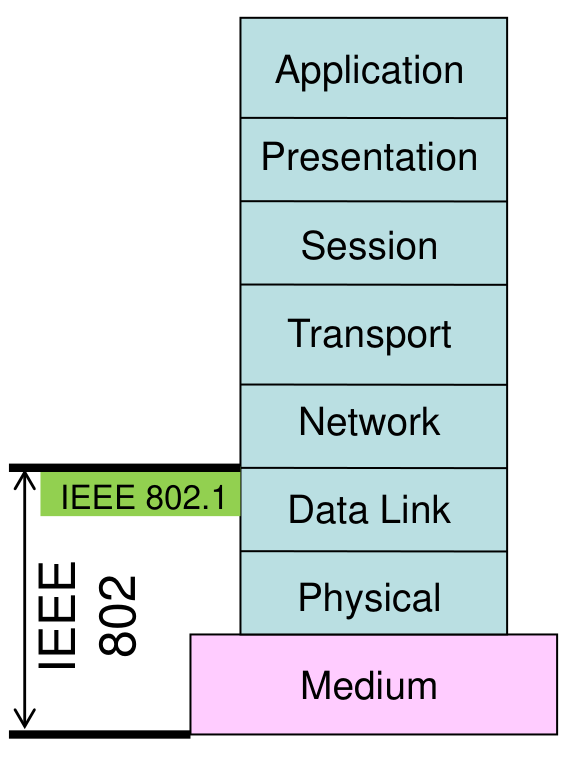
1. Definition
A deterministic network carries, on shared packet infrastructure, flows whose end-to-end latency is bounded, whose delay variation is low, and whose loss is extremely low, while ordinary best-effort traffic continues to use the same links. The IETF Deterministic Networking (DetNet) working group describes its subject as deterministic data paths that run over Layer 2 bridged segments and Layer 3 routed segments and that can bound latency, loss, delay variation and reordering, with high reliability [1].
Nothing above the network layer changes. As Figure 1 shows, the extension happens at two existing layers:
- at Layer 2, the IEEE 802.1 Time-Sensitive Networking (TSN) task group extends bridged Ethernet (see the IEEE 802.1 post and the TSN toolbox post);
- at Layer 3, the IETF DetNet working group extends routed IP and MPLS networks (see the IETF DetNet post).
The two groups collaborate on a common architecture, so that a routed deterministic path can cross bridged deterministic segments [1]. Network calculus, the subject of the next group of posts, is one of the common tool to successfully take the analysis that proves the bound once the network is configured in the industrial applications.
2. Deterministic versus traditional service
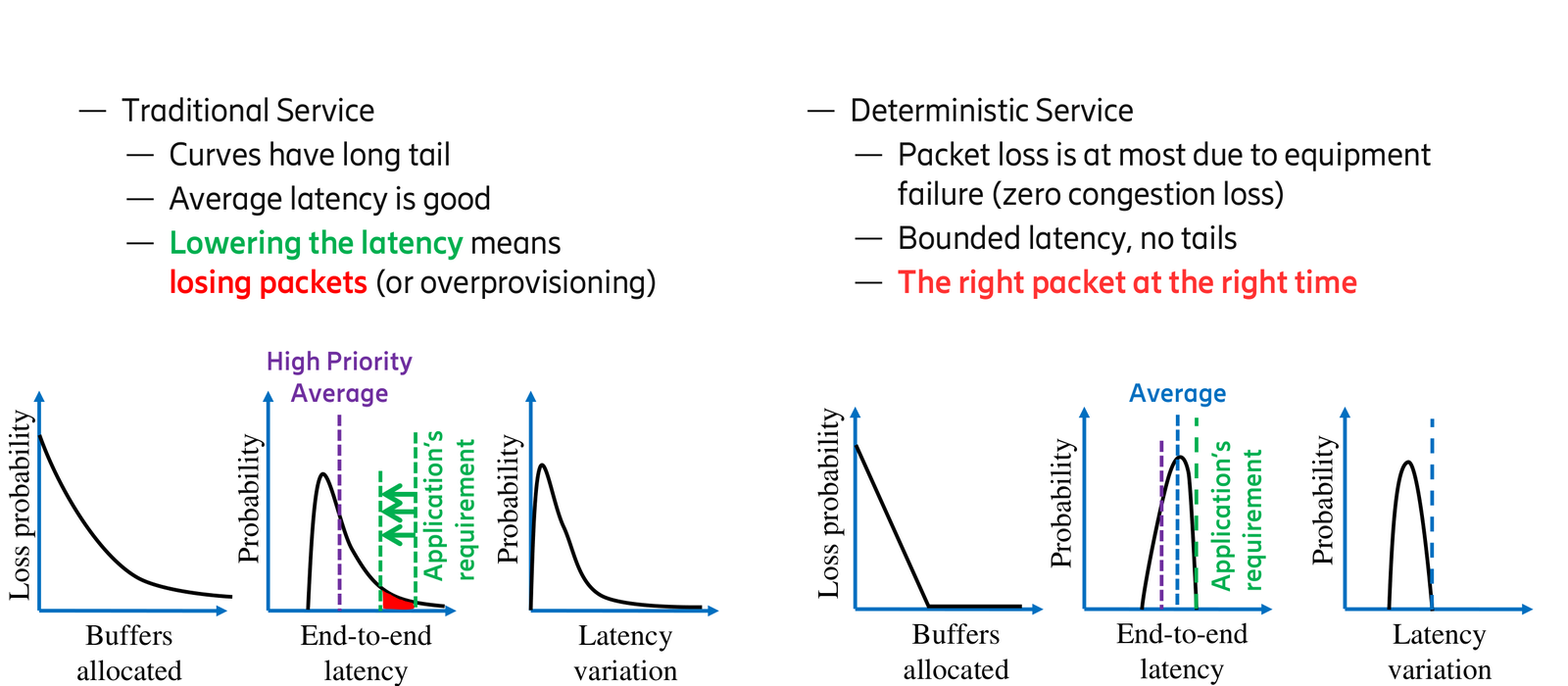
A traditional packet service is engineered for a good average. Its latency distribution has a long tail, and the only ways to shorten the tail are to drop late packets or to over-provision. A deterministic service is specified differently [2]:
- packet loss is caused at most by equipment failure, never by congestion ("zero congestion loss");
- latency is bounded, so the distribution has no tail beyond the application's requirement;
- the aim is the right packet at the right time, not the fastest packet on average.
The reason standard equipment cannot offer this is that queuing in switches and routers is not controlled per flow: a burst from one source delays every other flow sharing the queue. Larger buffers reduce loss but lengthen the delay, which is the wrong trade for a control loop [3].
3. What a deterministic flow requires
The DetNet problem statement, as summarised in [3], gives five requirements. They apply equally at Layer 2 and Layer 3.
| Requirement | Meaning |
|---|---|
| Time synchronisation | Every node(routers/switches) shares a time base, with an accuracy between nanoseconds and microseconds |
| Deterministic flows | Unicast or multicast, with guaranteed minimum and maximum end-to-end latency(tighten jiter depending on its requirements), and loss ratio of to on wired Ethernet and for mesh network, no throttling and no congestion feedback |
| Per-node scheduling | Each node schedules, shapes, limits and controls its transmissions (over-provisioning not required) |
| Protection | A misbehaving node or flow cannot degrade the others, even under high load |
| Reservation | Resources are reserved in every node that carries the flow |
Two points matter for the rest of this series. First, the source must declare a traffic contract: either a fixed transmission schedule, or a maximum bandwidth and a maximum packet size. That contract is exactly what an arrival curve formalises. Second, "no congestion feedback" means the guarantee cannot rely on sources slowing down, meanwhile it has to hold by construction.
4. Three techniques
The DetNet architecture groups the mechanisms into three techniques, which can be used separately or together [4].
| Technique | What it does | What it protects against |
|---|---|---|
| Resource allocation | Reserves buffer space and link bandwidth for a flow, or an aggregate of flows, at each hop based on predefined max transmission rate and packet size. Traffic policing and shaping functions at ingress ports limit data rates to mitigate packet out of scheduled time (next node additional buffer) | Loss caused by contention with unbounded end-to-end latency. Precise packet timestamps and sub-microsecond synchronization across network nodes enable low-latency, jitter-free communication, which is critical for audiovisual quality and deterministic industrial control applications |
| Service protection | Sends copies of each packet over several paths (sequence number & timestamp to transport protocol) and removes duplicates with reordering packets, or adds redundancy & error correction by packet encoding (multi-trans packet unit) | Loss caused by equipment or media failure, bandwidth constraint assurance & delay equalization in failure recovery |
| Explicit routes | Fixes the path in advance, so that it does not change at once when the topology changes | Interruptions while routing or bridging protocols reconverge |
Resource allocation only works for a flow that is limited at the source in a specified packet size and rate [4]. Explicit routes can be installed with RSVP-TE, Segment Routing, IS-IS or a centralised SDN controller [3][4]. In this context, mesh network topology changes can disrupt traffic and cause out-of-order packet delivery (side effect). Meanwhile, real-time networks often use redundant ring topologies, increasing hop count and latency. DetNet instead uses predefined, stable routes to avoid immediate reconfiguration and interruptions caused by routing or bridging convergence.
When the paths have different lengths, the merging node needs extra buffering to remove duplicates and restore the order [3]. This matters for analysis: a merged flow is burstier than either copy, a point taken up again in the TSN shapers post.
5. Who does what
| IEEE 802.1 TSN | IETF DetNet | |
|---|---|---|
| Layer | 2, bridged networks | 3, routed networks |
| Data plane | IEEE 802.1Q bridges over IEEE 802 media | IP and MPLS, and Layer 2 encapsulations carried over them |
| Scope | IEEE 802 networks | Networks under a single administrative control, such as campus networks and private WANs |
| Flow terminology | Talker, Listener, Stream | Source, destination, flow |
| Queuing mechanisms | Defined here: shapers, gates, preemption | Reused from the sub-network; DetNet focuses on the data path |
The terminology row follows the mapping given in the DetNet architecture [4]; the scope row follows the DetNet charter, which explicitly excludes solutions for large groups of domains such as the Internet [1].
Traffic engineering: from a DetNet flow to TSN settings
The two efforts meet where a routed DetNet path crosses a bridged TSN segment. What connects them is traffic engineering, and its protocols come from the IETF. The Traffic Engineering Architecture and Signaling (TEAS) working group maintains MPLS-TE label-switched paths and RSVP-TE signalling [3]. These protocols take the specification of a DetNet flow and turn it into settings of the TSN mechanisms along the bridged segment [3]:
| TSN mechanism configured | What it does for the DetNet flow | Standard |
|---|---|---|
| Credit-based shaper | Limits the flow's class to its reserved rate and spreads its frames evenly | IEEE 802.1Qav, see the CBS post |
| Scheduled traffic | Opens and closes transmission gates on a timetable that repeats every cycle | IEEE 802.1Qbv, see the TAS post |
| Cyclic queuing and forwarding | Alternates two or three buffers in synchronised cycles, so each hop takes a fixed time | IEEE 802.1Qch, see the CQF post |
| Frame preemption | Lets urgent frames interrupt a long frame already on the wire | IEEE 802.1Qbu and IEEE 802.3br, see the preemption post |
| Frame replication and elimination | Sends copies over disjoint paths and removes the duplicates | IEEE 802.1CB, see the FRER post |
Matching a DetNet flow to a TSN stream
The interworking itself is defined in IEEE 802.1CB. Its stream identification functions, in particular active destination MAC and VLAN stream identification, are how a TSN sub-network makes its capabilities known to DetNet flows [3]. When a DetNet flow enters the bridged segment, the edge bridge recognises it from three header fields: the destination MAC address, the VLAN ID and the priority. It then maps the flow to a TSN stream identifier and to the quality-of-service requirements of the talkers and listeners in the AVB/TSN sub-network [3].
| DetNet side (Layer 3) | TSN side (Layer 2) |
|---|---|
| DetNet flow | Stream, with a stream identifier |
| Source and destination | Talker and listeners |
| Flow specification | QoS requirements of the talker and listeners |
| Flow recognised by its IP or MPLS header | Stream recognised by destination MAC address, VLAN ID and priority (802.1CB stream identification) |
Once matched, the flow is handled by the TSN mechanisms of the table above for the whole bridged segment. It leaves the segment as the same DetNet flow it was when it entered.
6. What each layer provides
Figure 1 placed the two efforts in the stack. Figure 4 goes one step further and shows what each layer contributes, and where the control logic sits.
| OSI layer | Function in the deterministic path |
|---|---|
| Application (L7) | Application services: control loops, audio and video, industrial protocols such as OPC UA. They receive bounded latency and very low loss without changing. |
| Presentation (L6) | Data representation: encoding, compression and encryption. Unchanged by DetNet and TSN. |
| Session (L5) | Dialogue control: opening, synchronising and closing sessions between applications. Unchanged by DetNet and TSN. |
| Transport (L4) | End-to-end transport, usually UDP or TCP. DetNet adds no transport protocol, and its flows need no congestion feedback [3]. |
| Network (L3) | Carries DetNet flows over IP or MPLS. The service sub-layer replicates, eliminates and reorders packets; the forwarding sub-layer uses the reserved resources and explicit routes [4]. Policing and shaping at the ingress keep each flow within its declared rate and also protect ordinary IT traffic from a misbehaving DetNet source [3]. |
| L3 → L2 | Where a routed path crosses a bridged segment, each DetNet flow becomes a TSN stream. The bridge recognises it by destination MAC address, VLAN ID and priority, using the stream identification functions of 802.1CB [3]. |
| Data link (L2) | Provides the queuing, shaping, scheduling, preemption and replication mechanisms that actually bound delay on each hop (see the TSN toolbox) [3]. |
| Physical (L1) | The physical link. The only change is the MAC Merge sublayer of 802.3br, which lets urgent frames interrupt long ones (see frame preemption). |
| Under every layer | A shared time base at every node, with accuracy from nanoseconds to microseconds [3]. |
In other words, the TSN algorithms for queuing, shaping and scheduling are not tied to Ethernet. DetNet reuses them at Layer 3 to deliver IP packets with the same guarantees, and hands traffic to TSN hardware where it exists [3]. How traffic-engineering protocols turn a DetNet flow specification into those TSN settings is explained under "Traffic engineering" in section 5.
IntServ and DiffServ in OSI layer 3
Before DetNet, the IETF had two models for quality of service in IP networks. DetNet sits between them.
- Integrated Services (IntServ), from 1994, reserves resources per flow in every router along the path. Reservations are usually signalled with RSVP [5]. Its Guaranteed Service gives a mathematically provable upper bound on queuing delay for a flow described by a token bucket [6]. This is the same kind of bound that network calculus derives. The price is per-flow state in every router, which does not scale to large networks.
- Differentiated Services (DiffServ), from 1998, does not track flows. The edge of the network classifies each packet and marks it with a 6-bit code point in the IP header (DSCP). Core routers then apply one of a few per-hop behaviours to whole classes [7]. DiffServ scales well, but it promises only relative treatment of a class, not a bound for an individual flow, and the service a class receives can differ from one operator to the next [8].
A long-standing compromise uses IntServ at the edges, to admit and shape each flow, and DiffServ in the core, to forward aggregates [8][9]. DetNet follows the same pattern. Each flow is admitted and policed individually, while nodes can treat aggregates of flows together. The aggregation analysis of the multiplexing post is what makes this safe.
Where SDN fits
The Wikipedia article on DetNet describes the Layer 3 part as working through a software-defined networking layer that brings IntServ and DiffServ together [3]. In practice, a logically central controller does three jobs that neither IntServ nor DiffServ could do alone:
- it computes explicit routes, which do not change immediately when the topology changes, so routing protocols reconverging cause no interruption. RSVP-TE, Segment Routing, IS-IS or MPLS-TE can install the same routes [3];
- it reserves resources per flow at every node, with the knowledge of all other flows that admission control needs;
- it configures the TSN segments on the path, through the CNC of IEEE 802.1Qcc.
RFC 8655 places this logic in the controller plane of the DetNet architecture (see the IETF DetNet post). The SDN post shows the same structure on the TSN side.
7. Where it is used
The application areas named by the two groups overlap widely [1][3]: professional and home audio and video, industrial automation and machine-to-machine control, in-vehicle networks, electrical generation and distribution, building automation, and cellular fronthaul and backhaul. A common motivation is to move time-critical applications from dedicated fieldbus networks onto packet networks that also carry ordinary IT traffic [3].
References
- IETF, Deterministic Networking (detnet) working group: charter. Datatracker
- J. Farkas, "TSN Basic Concepts," DetNet–TSN workshop, 11 November 2018. Slides
- Wikipedia, "Deterministic Networking." Article
- N. Finn, P. Thubert, B. Varga, J. Farkas, Deterministic Networking Architecture, RFC 8655, October 2019. RFC Editor
- R. Braden, D. Clark, S. Shenker, Integrated Services in the Internet Architecture: an Overview, RFC 1633, June 1994. RFC Editor
- S. Shenker, C. Partridge, R. Guerin, Specification of Guaranteed Quality of Service, RFC 2212, September 1997. RFC Editor
- S. Blake et al., An Architecture for Differentiated Services, RFC 2475, December 1998. RFC Editor
- I. Behnke, H. Austad, "Real-Time Performance of Industrial IoT Communication Technologies: A Review," arXiv:2311.08852, 2023, Section III-D. arXiv
- Y. Bernet et al., A Framework for Integrated Services Operation over Diffserv Networks, RFC 2998, November 2000. RFC Editor