Determinism: from the OSI and TCP/IP Ethernet stack to TSN
A control loop on a factory floor and an e-mail server can share the same cable only if the network can promise the first one something the second never needs: that every packet arrives on time. This post starts from the ordinary Ethernet and TCP/IP stack, shows where its timing breaks down, and explains how Time-Sensitive Networking (TSN) extends it without replacing it.
Abbreviations used in this post (24)
| Abbreviation | Stands for | Meaning |
|---|---|---|
| CSMA/CD | Carrier-Sense Multiple Access with Collision Detection | The access method of the original shared-medium Ethernet: listen before sending, detect collisions, back off for a random time and retry. The random back-off makes the delay unpredictable. |
| DetNet | Deterministic Networking | The IETF architecture and working group for bounded-latency, low-loss flows over IP and MPLS (RFC 8655). |
| FRER | Frame Replication and Elimination for Reliability | IEEE 802.1CB: frames are numbered, sent over disjoint paths, and duplicates are removed. |
| GCL | Gate Control List | The repeating timetable of gate states used by the Time-Aware Shaper (and by stream gates in PSFP). |
| gPTP | generalized Precision Time Protocol | The profile of PTP defined by IEEE 802.1AS, in which every bridge takes part in time distribution. |
| IEEE | Institute of Electrical and Electronics Engineers | The professional association whose Standards Association publishes the IEEE 802 LAN/MAN standards. |
| IETF | Internet Engineering Task Force | The body that develops Internet standards, published as RFCs. |
| IP | Internet Protocol | The network-layer protocol of the Internet (IPv4, RFC 791; IPv6, RFC 8200). |
| IT | Information Technology | Computing and networking for information processing, such as office, business and cloud systems. |
| LAN | Local Area Network | A network covering a limited area, such as a building or a vehicle; IEEE 802 standardises LANs. |
| MAC | Medium Access Control | The lower sublayer of the data link layer, which frames data and controls access to the medium. A MAC address identifies a network interface. |
| OSI | Open Systems Interconnection | The seven-layer reference model for communication protocols (ISO/IEC 7498-1). |
| OT | Operational Technology | Hardware and software that monitor and control physical processes, such as controllers, drives and sensors in a factory. |
| PDU | Protocol Data Unit | The unit of data at one layer: a frame at the data link layer, a packet at the network layer, a segment (TCP) or datagram (UDP) at the transport layer. |
| PHY | Physical layer | Layer 1: the transmission of bits over a medium such as copper, fibre or radio. |
| PTP | Precision Time Protocol | IEEE 1588, a protocol that synchronises clocks over a packet network using timestamped message exchanges. |
| QoS | Quality of Service | The treatment a network gives to a flow or class, in terms of bandwidth, delay, jitter and loss. |
| R-TAG | Redundancy tag | The 802.1CB tag that carries the sequence number of a replicated frame. |
| RFC | Request for Comments | The document series in which IETF standards and related documents are published. |
| TAS | Time-Aware Shaper | IEEE 802.1Qbv scheduled traffic: a gate per queue, opened and closed by a repeating gate control list. |
| TCP | Transmission Control Protocol | A reliable, connection-oriented transport protocol with congestion control (RFC 9293). |
| TSN | Time-Sensitive Networking | The set of IEEE 802.1 standards that give Ethernet bounded latency, time synchronisation and high reliability. |
| UDP | User Datagram Protocol | A connectionless transport protocol without congestion control (RFC 768). |
| VLAN | Virtual LAN | A logical LAN within a bridged network, identified by a 12-bit VLAN ID in the 802.1Q tag. |
1. Definition: determinism
A network is deterministic for a flow when it can guarantee that every packet of the flow arrives within a precise, predictable and bounded time. In practice that means three properties, each stated as a bound rather than an average:
| Property | Guarantee |
|---|---|
| Bounded latency | No packet takes longer than a known maximum from source to destination |
| Bounded jitter | The variation of that latency stays within a known range |
| No congestion loss | No packet is dropped because a queue overflowed |
Fast is not the same as deterministic. A best-effort network can have a very low average delay and still, occasionally, delay a packet by orders of magnitude. For a closed control loop, one late packet can be as bad as a lost one [1]. Why deterministic guarantees? develops this contrast between average and worst case.
2. The OSI reference model: seven layers
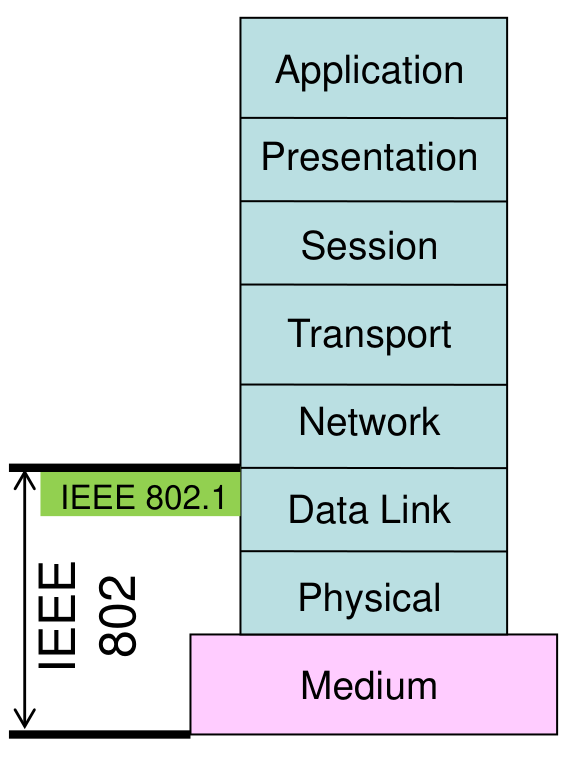
The OSI model, published by ISO in 1984, describes communication in seven abstraction layers, from the transmission of bits to the data of a distributed application. Each layer serves the one above it and is served by the one below [2]:
| Layer | Role | Ethernet / Internet example | Data unit |
|---|---|---|---|
| 7 Application | Services to applications | HTTP, MQTT, OPC UA | data |
| 6 Presentation | Representation of data | encoding, encryption (TLS) | data |
| 5 Session | Dialogue between applications | opening and closing sessions | data |
| 4 Transport | End-to-end delivery between processes | TCP, UDP | segment, datagram |
| 3 Network | Addressing and routing across networks | IP | packet |
| 2 Data link | Delivery between neighbours on one network | Ethernet MAC, bridging (IEEE 802.1) | frame |
| 1 Physical | Bits on the medium | Ethernet PHY (IEEE 802.3), cable, fibre | bits |
3. From OSI to the TCP/IP model
The protocols actually used on the Internet follow a simpler model. The Internet protocol suite, or TCP/IP model, defined in RFC 1122 and RFC 1123, has four layers named by their scope rather than numbered by function [3][4]:
| TCP/IP layer | Scope | Corresponding OSI layers |
|---|---|---|
| Application | Process-to-process data for applications | 7, 6 and most of 5 |
| Transport | Host to host: TCP (reliable) or UDP (unreliable) | 4 (and part of 5) |
| Internet | Between independent networks: IP | part of 3 |
| Link | Within one network segment: for example Ethernet | 2, with functions of 1 |
The OSI model is still the common vocabulary, but the TCP/IP suite became the standard for networking because its protocols were simpler and could be implemented independently [2]. Both models rest on encapsulation: each layer wraps the data of the layer above in its own header [3].
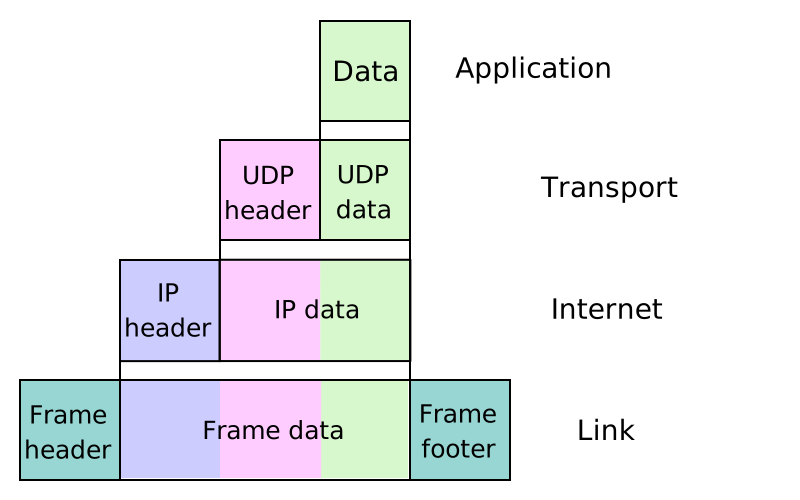

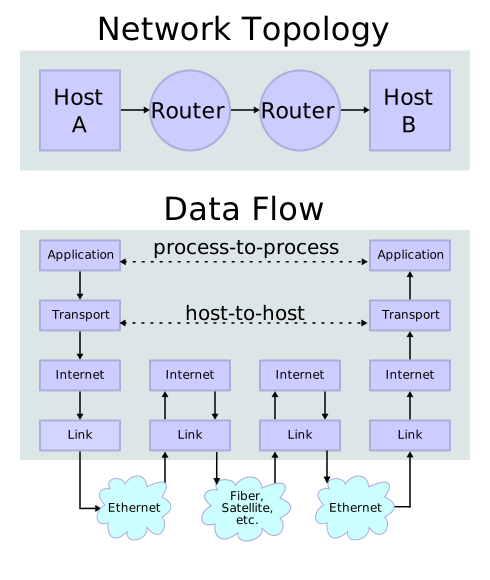

Figure 4 shows the key point for determinism: the link layer is where frames wait. Every switch or router on the path queues frames before sending them on the next link. Whatever happens in those queues decides the delay.
4. Ethernet: the link layer of almost everything


Ethernet, standardised by the IEEE 802 project from 1980 onward, covers the physical layer and the lower part of the data link layer (IEEE 802.3), while bridging and VLANs are specified by IEEE 802.1 [5][6]. Its history explains why it was not deterministic to begin with:
- Shared medium. The original Ethernet put every station on one coaxial cable. Access was governed by CSMA/CD: a station listens, transmits, and on a collision backs off for a random time and tries again. The random back-off makes the delay of a frame unpredictable, and heavy load makes collisions more frequent [5].
- Switched, full-duplex Ethernet. Bridges and switches split the network into separate links, and full-duplex links remove collisions altogether [5]. This is the Ethernet used today. But a switch still stores frames in queues at each output port. When frames from several inputs head for the same output, they wait, and the waiting time depends on all the other traffic.
- Priorities are not enough. IEEE 802.1Q gives eight priority levels, but a frame already being transmitted cannot be interrupted, and nothing ties transmission to a common time. A critical frame can still wait behind a long frame or a burst of other traffic [7].
The layers above add their own variability. TCP retransmits lost segments and slows down on congestion, which is right for file transfer but useless for a control message that is only valid for a few milliseconds. UDP adds no retransmission, but no guarantee either. The stack as a whole is best effort: it delivers, usually quickly, but promises no bound.
5. Why industry needs a deterministic Ethernet
Industrial systems carry two kinds of traffic with opposite needs [1]:
| OT (operational technology) | IT (information technology) | |
|---|---|---|
| Examples | Machine control, sensor values | E-mail, firmware updates |
| What matters | Fixed delay, low latency, low jitter | Throughput |
| If late | The data is useless, and the machine may fail | Nothing serious; best effort is enough |
| Bandwidth | Usually small | Usually larger |
The traditional answer was two networks: one for OT, often a fieldbus or a proprietary variant of Ethernet, and one for IT. That doubles cabling and equipment, and the proprietary OT networks do not interoperate with each other or follow the speed increases of standard Ethernet [1][8].
6. TSN: an extension of standard Ethernet
Time-Sensitive Networking sits on top of standard Ethernet. It is a set of IEEE 802.1 standards that lets one Ethernet network carry IT and OT data on a shared connection, while each kind of traffic still gets what it needs [1][10]. In Cisco's description, the IEEE TSN task group develops specifications that provide deterministic services over layer 1 and layer 2. These are implemented in Ethernet switches such as the Cisco Industrial Ethernet 4000 Series, and are being extended towards wireless access such as 5G [9].
TSN does not replace any layer. As Figure 1 shows, applications, TCP/IP and the Ethernet frame format stay the same; TSN adds functions to the bridges and the MAC. Each standard covers one function, and system designers combine the ones they need [1]. The three described in [1] cover the three gaps of Section 4:
A common time: 802.1AS. TSN timing comes from the Precision Time Protocol (PTP, IEEE 1588), which distributes time from a grandmaster clock, such as a GPS-disciplined source, through a tree of master and slave clocks. The generalized PTP of 802.1AS is a stricter profile: it requires a peer-to-peer delay measurement on every link, expects all devices to run at the same frequency (syntonised), and in newer revisions brings back one-step timestamping [1]. Devices are synchronised to within nanoseconds [1]. See the 802.1AS post.
Scheduled transmission: 802.1Qbv. A time-aware shaper at each egress port gives each of the eight queues a gate. A gate control list opens and closes the gates on a repeating schedule, so time slots can be reserved for OT traffic and others left to IT traffic [1].
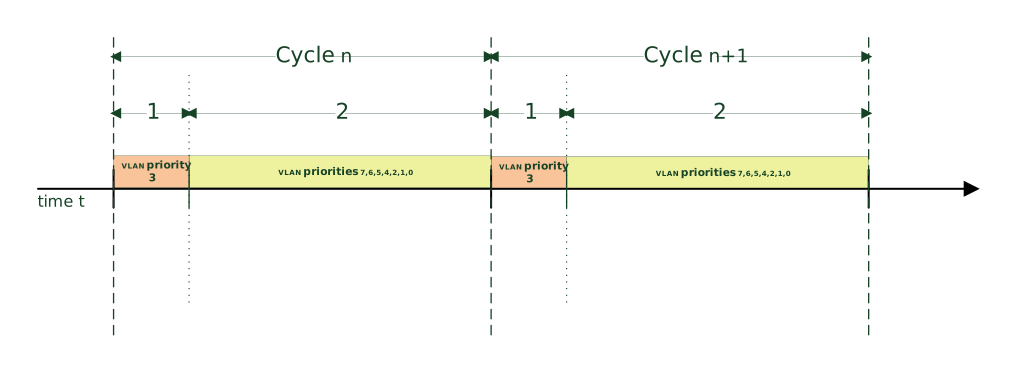

Before each protected slot, the hardware keeps a guard band: it does not start a frame that could not finish before the slot begins, and holds it for the next slot of its class instead [1]. Traffic is mapped to queues by priority, protocol, destination port or traffic type [1]. See the TAS post.
Redundancy without retransmission: 802.1CB. Frames of a stream are replicated and sent over two paths, typically both ways round a ring. A redundancy tag carries a sequence number, and the receiver keeps the first copy of each number and discards the duplicates. If a link breaks, no frame is lost and no retransmission delay occurs, and the hardware does the work instead of application software [1]. See the FRER post.
The full set of tools, including credit-based shaping, preemption, cyclic queuing, policing and configuration, is described in the TSN toolbox.
7. Why it prepares a system for the future
- One converged network. IT and OT share cables, switches and management, instead of running two networks side by side [1].
- Standard Ethernet underneath. TSN rides on IEEE 802.3, so it benefits from each new Ethernet speed and from multi-vendor, standard hardware rather than a proprietary fieldbus [1][8].
- Guarantees that can be proven. Bounded latency and no congestion loss are properties of the configuration, which can be checked before a stream is admitted. That is the role of network calculus in this series.
- Beyond one LAN. Where a deterministic path must cross routers, IETF DetNet provides the same service at the internet layer (Figure 1 and the DetNet post).
8. Summary
| Layer (TCP/IP) | Ordinary behaviour | Deterministic extension |
|---|---|---|
| Application, transport | TCP retransmits and adapts; UDP gives no guarantee | Unchanged: they receive a bounded service |
| Internet | IP routing, best effort | IETF DetNet |
| Link (Ethernet) | Switched queues, eight priorities, no common time | IEEE 802.1 TSN: 802.1AS time, 802.1Qbv schedules, 802.1CB redundancy, and more |
| Physical | IEEE 802.3 PHY | Unchanged, plus frame preemption (802.3br) |
References
- J. Steinheider (NXP Semiconductors), "The Fundamentals of Time-Sensitive Networking," All About Circuits, industry article, 19 January 2021. Article
- Wikipedia, "OSI model," sections on the layer architecture and the comparison with the TCP/IP model. Article
- Wikipedia, "Internet protocol suite," sections on key architectural principles and layers. Article
- R. Braden (Ed.), RFC 1122, "Requirements for Internet Hosts – Communication Layers," IETF, October 1989. RFC Editor
- Wikipedia, "Ethernet," sections on standardisation, shared medium, and bridging and switching. Article
- IEEE, IEEE 802.3, Standard for Ethernet. IEEE SA
- J. Farkas, "TSN Basic Concepts," DetNet–TSN workshop, 11 November 2018. Slides
- J. Woods, "IEC/IEEE 60802: The Case for the Converged Network in the Factory of the Future," IEEE SA TSN webinar series, April 2023, slide 8. Slides
- Cisco Systems, "Wi-Fi 6 and Private LTE/5G Technology and Business Models in Industrial IoT," white paper, 2019, section on IEEE standards. PDF
- IEEE 802.1, Time-Sensitive Networking (TSN) Task Group. Web page