IEEE 802.1Qch CQF: cyclic queuing and forwarding, one hop per cycle
Cyclic Queuing and Forwarding (CQF) makes latency independent of the other traffic. A frame advances exactly one hop per cycle, so its delay depends only on the path length. No new hardware is needed: CQF is a particular way of configuring two TSN tools that already exist.
Abbreviations used in this post (8)
| Abbreviation | Stands for | Meaning |
|---|---|---|
| ATS | Asynchronous Traffic Shaping | IEEE 802.1Qcr: per-stream token-bucket shaping at every hop using local clocks only. |
| CBS | Credit-Based Shaper | The IEEE 802.1Qav shaper that limits a traffic class to its reserved rate (idleSlope) with a per-queue credit. In MEF bandwidth profiles, CBS instead means Committed Burst Size. |
| CQF | Cyclic Queuing and Forwarding | IEEE 802.1Qch: two queues per class alternate every cycle, so a frame advances one hop per cycle. |
| IEEE | Institute of Electrical and Electronics Engineers | The professional association whose Standards Association publishes the IEEE 802 LAN/MAN standards. |
| IPV | Internal Priority Value | A priority assigned inside a bridge (for example by a PSFP stream gate) that selects the traffic class, independently of the frame’s PCP. |
| PSFP | Per-Stream Filtering and Policing | IEEE 802.1Qci: stream filters, stream gates and flow meters that enforce each stream’s contract at ingress. |
| TAS | Time-Aware Shaper | IEEE 802.1Qbv scheduled traffic: a gate per queue, opened and closed by a repeating gate control list. |
| TSN | Time-Sensitive Networking | The set of IEEE 802.1 standards that give Ethernet bounded latency, time synchronisation and high reliability. |
1. Definition
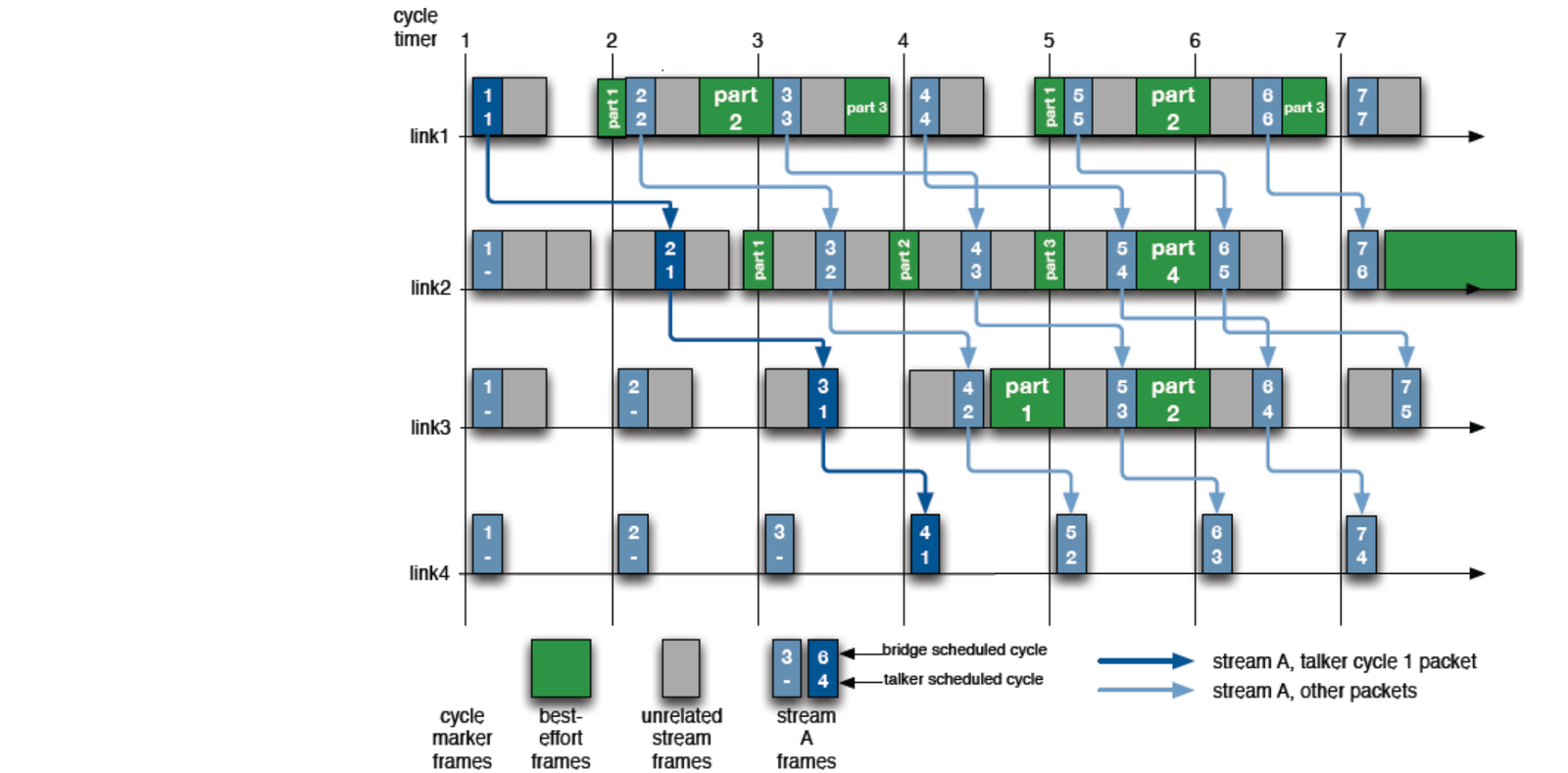
Cyclic Queuing and Forwarding, IEEE 802.1Qch (Annex T of IEEE 802.1Q), divides time into cycles of equal length , synchronised across the network. Two queues serve one traffic class and swap roles every cycle:
- during a cycle, frames received by a bridge are stored in one queue;
- the frames received in the previous cycle are sent from the other queue.
A frame received in one cycle is therefore sent in the next [2][3].
2. How it is built from gates

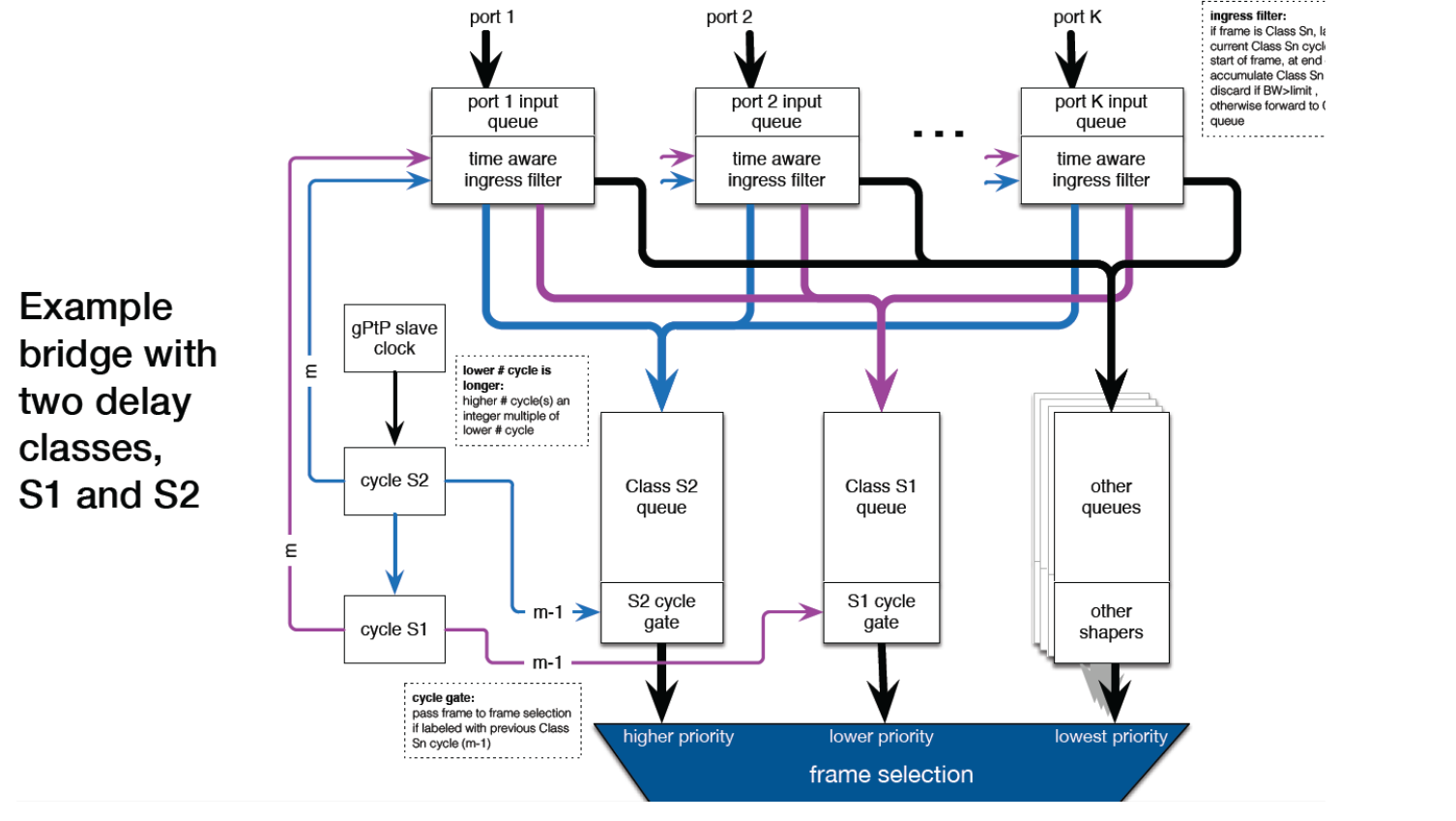
Standardisation-wise, CQF is not a separate shaper. It is a joint configuration of Per-Stream Filtering and Policing and the Time-Aware Shaper [4]:
- The stream gate of PSFP sets the internal priority value (IPV) of arriving frames, alternating between two values each slot, for example 7 and 6.
- The transmission gates of TAS run out of phase: while arriving frames go to queue 7, gate 7 is closed and gate 6 is open, and vice versa.
When bridge A opens a gate and sends, bridge B classifies those frames into its own closed queue. That queue opens exactly later. Both gating mechanisms need synchronised time, and every device carries the same configuration [4].
3. The cycle-time condition
CQF works only if every frame sent in a cycle reaches the next bridge and is queued before that cycle ends. The cycle must therefore cover:
- the transmission time of all frames the bridge may send in one cycle, which is what admission control limits;
- the propagation delay of the link;
- the processing delay of the receiving bridge;
- the synchronisation error between the two bridges.
The tutorial on decentralised latency models expresses this as a latency threshold per hop, . Here accounts for synchronisation inaccuracy. If admission control keeps the worst-case delay of the hop below , the queue is guaranteed to be empty at the end of its cycle. The downstream shaper then sees every frame as eligible exactly after the upstream one [4].
End to end, the latency is about per hop. It varies by at most about one cycle, depending on where in a cycle the frame first arrives. This is why CQF gives very low jitter and why its bound needs no knowledge of the other flows [2].
4. Costs and comparison
The same tutorial evaluates CQF against strict priority, ATS and CBS, using latency models that every bridge can compute locally [4]:
- Half the traffic classes. Each class needs two queues, so with eight queues only four classes remain for reserved traffic. Priorities are merged, for example 7 and 6 into 7, which increases interference within a class.
- Best jitter under a global configuration. When one setting is applied network-wide, CQF minimised jitter.
- Beaten by per-hop tuning. When latency thresholds could be optimised hop by hop, strict priority with a network calculus bound gave better latency and jitter than CQF.
- A cycle is a hard minimum. Even a lightly loaded path pays per hop, so trades bandwidth per cycle against latency.
For network calculus, CQF is the simplest case of all. Each hop is a delay element of with no burst growth. The burstiness cascade that complicates aggregate multiplexing does not occur.
5. Summary
| Property | Cyclic Queuing and Forwarding |
|---|---|
| Standard | IEEE 802.1Qch, Annex T of IEEE 802.1Q |
| Built from | Stream gates (802.1Qci) and transmission gates (802.1Qbv) |
| Queues per class | Two, alternating every cycle |
| Needs time synchronisation | Yes |
| Latency | About one cycle per hop |
| Main cost | Half the traffic classes; a full cycle per hop even at low load |
References
- IEEE 802.1, Time-Sensitive Networking (TSN) Task Group. Web page
- Wikipedia, "Time-Sensitive Networking," section on cyclic queuing and forwarding. Article
- J. Farkas, "Introduction to IEEE 802.1: Focus on the Time-Sensitive Networking Task Group," 15 May 2017, slides 35–36. Slides
- A. Grigorjew, S. Geissler, J. Schmitt, T. Hossfeld, "Decentralized Latency Models and Information Flow for TSN Shapers – A Tutorial," arXiv:2610.11999, 2026, Sections VI-C and VII-F. arXiv