IEEE 802.1Qcr ATS: asynchronous traffic shaping without a clock
Class-based shapers let the bursts of a stream grow from hop to hop, and scheduled traffic needs a network-wide clock and a central schedule. Asynchronous Traffic Shaping (ATS) avoids both problems: it restores each stream's original traffic contract at every hop, using only the bridge's local clock.
Abbreviations used in this post (5)
| Abbreviation | Stands for | Meaning |
|---|---|---|
| ATS | Asynchronous Traffic Shaping | IEEE 802.1Qcr: per-stream token-bucket shaping at every hop using local clocks only. |
| BE | Best Effort | Traffic with no guarantee of delay or delivery. |
| FRER | Frame Replication and Elimination for Reliability | IEEE 802.1CB: frames are numbered, sent over disjoint paths, and duplicates are removed. |
| IEEE | Institute of Electrical and Electronics Engineers | The professional association whose Standards Association publishes the IEEE 802 LAN/MAN standards. |
| PSFP | Per-Stream Filtering and Policing | IEEE 802.1Qci: stream filters, stream gates and flow meters that enforce each stream’s contract at ingress. |
1. Definition
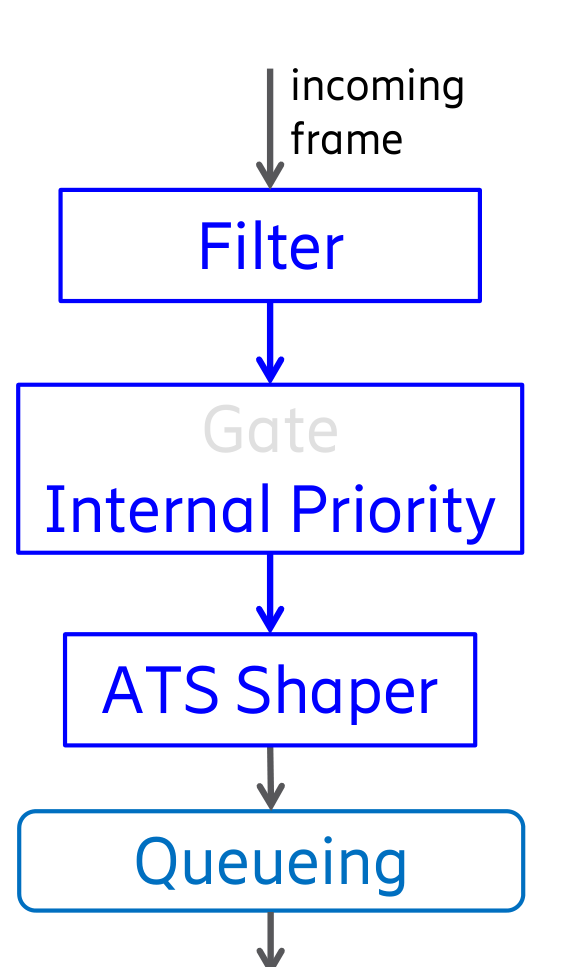
Asynchronous Traffic Shaping, IEEE 802.1Qcr, is based on the urgency-based scheduler of Specht and Samii. Each stream gets its own token bucket at every bridge, with a committed burst size and a committed rate . A frame becomes eligible for transmission at the earliest time its bucket holds enough tokens for it. Strict priority then serves eligible frames [2][3][4].
Two features distinguish it from plain per-flow shaping:
- Shared queues. Streams share a small number of shaped queues. The shaper state of each frame's stream is applied to the frame at the head of the queue [3].
- No synchronisation. Eligibility times are computed from the local clock. A frame whose eligibility time lies too far in the future, beyond a configured maximum residence time, is discarded [2].
2. Queue allocation rules
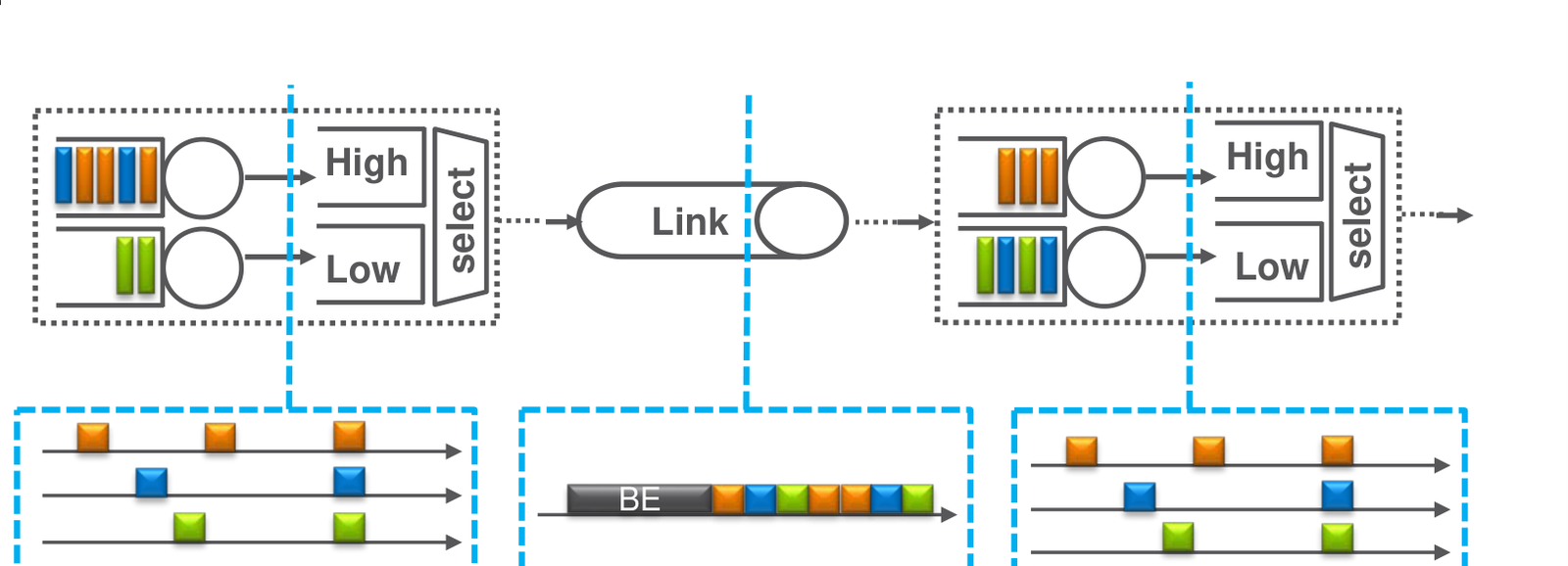
Sharing a queue between streams can cause head-of-line blocking: a frame that is not yet eligible holds up an eligible frame behind it. ATS limits this with queue allocation rules. Frames go to separate shaped queues if they differ in [4]:
- the ingress port they arrived on (the upstream transmitter);
- the egress port;
- the traffic class in the upstream bridge or in the current bridge.
Inside one queue, all frames then come from the same upstream queue, so they arrive in an order compatible with their eligibility times.
3. Delay segments: from shaper to shaper

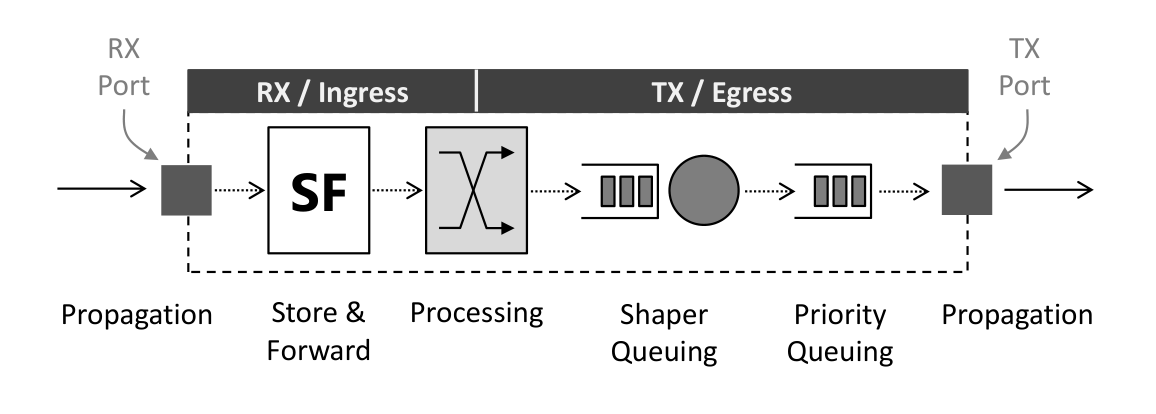
The ATS analysis does not measure delay from ingress to ingress. It measures from the end of one shaper to the end of the next, as in Figure 3. This boundary was first used in the ATS latency analysis of Specht and Samii. It was proposed for the P802.1DD Resource Allocation Protocol, and a 2026 tutorial applies it to all shapers [4].
The choice matters because traffic leaving a token-bucket shaper is known to conform to . Each segment therefore starts from a clean, well-defined arrival curve, whatever happened upstream. The downstream bridge computes the bound for the segment that ends in it, using what its neighbour tells it [4]. The stream reservation post lists the information it receives.
4. Why the bound does not cascade
With class-based shapers or plain strict priority, a stream's burst grows by its rate times the delay variation it has accumulated:
where and are its accumulated maximum and minimum latencies (the fundamental bounds post gives the general result). ATS removes the extra term at every hop. Its per-segment bound uses the original burst declared by the talker. It also needs no pre-configured latency threshold, although its queue allocation rules require more queues [4].
In network calculus, the ATS shaper is an interleaved regulator. Its key property, shown by Le Boudec, is that an interleaved regulator placed after a FIFO system does not increase that system's worst-case delay. Re-shaping is therefore "for free" in the worst case [5]. A review of industrial IoT networking cites the same property: ATS does not increase the worst-case delay through the network [6].
5. How ATS compares
The 2026 tutorial compares five decentralised latency models on industrial and linear topologies [4]:
- ATS performed well everywhere. It gave the best burstiness at the receiver and worst-case latency similar to the best strict-priority model.
- Strict priority with a network calculus bound can still win at the highest priority, especially in bridges with very few ports, because frames from one ingress link cannot arrive faster than that link (serialisation). At lower priorities ATS consistently did better.
- The main disadvantage is hardware. Per-stream state and extra queues make ATS costly and still rarely available.
ATS is also a remedy for a redundancy side effect. After FRER eliminates duplicates, the merged stream can be burstier than the original. Placing ATS at the merge point reshapes it, although combining FRER and ATS is still being standardised [4].
The industrial review summarises the division of labour. ATS suits sporadic or aperiodic critical traffic, such as alarms and events. The credit-based shaper suits regular but bursty traffic, and the time-aware shaper suits regular critical traffic [6].
6. Summary
| Property | Asynchronous Traffic Shaping |
|---|---|
| Standard | IEEE 802.1Qcr |
| Acts on | Per-stream state at the ingress, shared shaped queues at the egress |
| State | One token bucket per stream per bridge |
| Needs time synchronisation | No; local clocks only |
| Bound | Uses the talker's original burst; no burstiness cascade |
| Main cost | Per-stream state, more queues, limited hardware support |
References
- IEEE 802.1, Time-Sensitive Networking (TSN) Task Group. Web page
- Wikipedia, "Time-Sensitive Networking," section on asynchronous traffic shaping. Article
- J. Farkas, "TSN Basic Concepts," DetNet–TSN workshop, 11 November 2018, slides 13–15. Slides
- A. Grigorjew, S. Geissler, J. Schmitt, T. Hossfeld, "Decentralized Latency Models and Information Flow for TSN Shapers – A Tutorial," arXiv:2610.11999, 2026, Sections I, IV, VI-A, VI-D, VII-F and VIII. arXiv
- J.-Y. Le Boudec, "A Theory of Traffic Regulators for Deterministic Networks With Application to Interleaved Regulators," IEEE/ACM Transactions on Networking, vol. 26, no. 6, 2018.
- I. Behnke, H. Austad, "Real-Time Performance of Industrial IoT Communication Technologies: A Review," arXiv:2311.08852, 2023, Section III-D. arXiv